
Short Selling Myths That Mislead New Traders
A long and a short in the same share, run side by side, show where short selling myths break: open-ended losses, holding costs, gaps and growing exposure.
Common short selling myths: shorting is just buying in reverse, losses are capped, holding is free, high short interest means a fall, short sellers cause crashes and a stop always limits the damage. Running a long and a short in the same share side by side, through the same events, shows where the mirror image breaks.
The mirror test
If shorting were simply buying in reverse, a long and a short in the same share would produce equal and opposite results through any sequence of events. The test below holds both at once: 100 CFD shares long and 100 CFD shares short in the same company, opened at $50, an exposure of $5,000 each. (Illustrative figures throughout.) Each event is recorded in a two-column ledger. Wherever the columns stop being mirror images, a myth breaks.
Event 1: the share falls to zero, or triples
| Long | Short | |
|---|---|---|
| Share falls to $0 | −$5,000, the maximum possible loss | +$5,000, the maximum possible gain |
| Share rises to $150 | +$10,000 | −$10,000, and still no ceiling |
Myth broken: “losses are capped.” A long can lose at most what the share is worth. A short’s loss grows without limit as the price rises. The mirror holds only in the middle of the range; at the extremes it breaks completely.
Event 2: thirty days of holding
| Long | Short | |
|---|---|---|
| Overnight financing at an illustrative 6.8% a year | About −$28 | Varies: may be a smaller charge or a small credit |
| Borrowing charge at 2% a year, hard-to-borrow share | None | About −$8 |
| Dividend of $0.50 going ex during the month | About +$50 adjustment | About −$50 adjustment |
Myth broken: “shorts are free to hold.” The costs differ by direction. Shorts in hard-to-borrow shares pay borrowing charges that can rise sharply at short notice, and shorts always pay dividend adjustments. See how short selling works with CFDs.
Event 3: a takeover offer overnight
The company receives a takeover offer after the close, and the share opens at $65. Both positions had stops $5 away: the long at $45, the short at $55.
| Long | Short | |
|---|---|---|
| Planned risk to the stop | −$500 | −$500 |
| Actual result at the open | +$1,500 | −$1,500, three times the planned loss |
Myth broken: “a stop always limits the loss.” Gaps hurt whichever side they go against, but upward gaps from takeovers, short squeezes and surprise results are a particular hazard for shorts, because they often come suddenly and can be very large. See what a short squeeze is.
Event 4: the position grows against you
Suppose the share rises steadily from $50 to $75. The long’s exposure grows from $5,000 to $7,500 while it is winning; the short’s exposure grows from $5,000 to $7,500 while it is losing. A losing short therefore becomes a larger position, taking more margin and carrying more risk with each move against it, while a losing long shrinks.
| Long | Short | |
|---|---|---|
| Exposure after a rise to $75 | $7,500, while in profit | $7,500, while in loss |
| Exposure after a fall to $25 | $2,500, while in loss | $2,500, while in profit |
Myth broken: “shorting is the mirror of buying.” Even before costs and gaps, the risk of a short grows in the direction that hurts it, and shrinks in the direction that helps it. Shorts need closer monitoring and smaller starting sizes for the same risk.
The mirror test in one table
| Myth | What the ledger showed |
|---|---|
| Shorting is buying in reverse | Exposure grows when a short is losing |
| Losses are capped | A long’s loss stops at 100%; a short’s has no ceiling |
| Shorts are free to hold | Borrowing charges and dividend debits fall on shorts |
| A stop always limits the loss | Upward gaps can triple the planned loss |
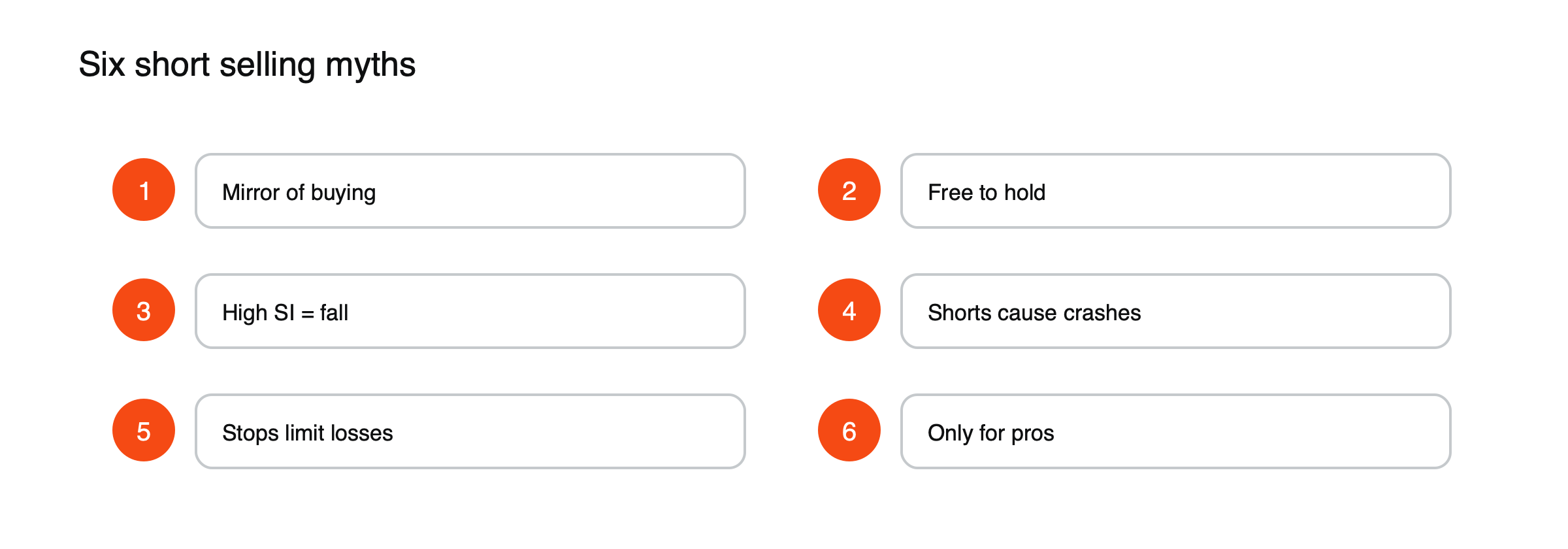
Figure: Six short selling myths.
Myths the ledger cannot test
Two common beliefs are about markets rather than positions.
“High short interest means the share will fall.” Heavy short interest shows that many investors expect a fall, but it also means many must eventually buy back. GameStop’s short interest reached about 140% of its free float before the share soared in 2021. Short interest is a measure of crowding, not a forecast. See what short interest is.
“Short sellers cause crashes.” During the 2008 financial crisis, several countries banned short selling in financial shares. A study by US regulators’ staff found that selling pressure in September 2008 came mainly from investors selling shares they owned, and that financial shares kept falling during the ban. Shorts can add to falls, but they rarely cause them on their own. See how short-selling rules work across markets.
What the test means in practice
Retail traders can short shares easily through CFDs, but the ledger shows why shorts need different handling from longs: smaller initial size, awareness of borrowing costs and dividend dates, caution around takeover candidates and heavily shorted shares and regular review as exposure grows. Shorting is a legitimate tool for expressing a negative view or hedging, provided its asymmetries are planned for rather than discovered. See what moves stock prices and how stock CFDs work.
Event 5: a slow grind higher
Not every loss on a short comes from a gap. Suppose the share drifts from $50 to $60 over six months, with no single dramatic day. (Illustrative figures.)
| Long | Short | |
|---|---|---|
| Price change | +$1,000 | −$1,000 |
| Financing over six months | About −$168 | Varies |
| Borrowing charge at 2% | None | About −$49 |
| One $0.50 dividend | About +$50 | About −$50 |
The short loses more than the price move alone, through borrowing and dividends, while the long’s gain is reduced only by financing. A short that is slowly wrong is expensive to hold, which is why many traders set time limits as well as price stops on short positions.
Sizing a short with the ledger in mind
Because a short’s exposure grows as it loses, many traders start shorts at a smaller size than comparable longs, often half to two-thirds, and recalculate exposure regularly. They also avoid shorting shares with upcoming catalysts, such as results or votes on takeover offers, unless the position is sized for a large gap. Guaranteed stops, where offered, cap the gap risk for a fee.
When shorting works best
Shorts tend to work best when a share’s decline is driven by a clear, lasting problem, such as falling demand, rising debt or accounting concerns, when the trade is not already crowded and when the broader market is weak. Shorting a strong share simply because it looks expensive, in a rising market, is one of the most common ways short sellers lose money.
A pre-short checklist
- How heavily shorted and how costly to borrow is the share?
- Are there results, dividends or takeover risks ahead?
- Is the position sized for a gap well beyond the stop?
- How long will you hold it if nothing happens?
CFD shorts and borrowed shares
In the traditional way of shorting, an investor borrows shares, sells them and later buys them back to return. With a CFD, the trader does not borrow shares directly; the provider manages any hedging, and charges for it through financing and borrowing fees where applicable. The economic exposure is similar, but CFD shorts can be closed by the provider if borrowing becomes unavailable, and their costs can change at short notice.
Rules on short selling
Regulators in many countries require disclosure of large short positions and can restrict or ban short selling in emergencies, as several did in 2008 and 2020. Such bans can force shorts to close or prevent new ones. See how short-selling rules work across markets.
The role of short sellers
Short sellers add liquidity, help bring overpriced shares back toward reasonable values and have exposed several accounting frauds through detailed research. Their activity can be uncomfortable for companies, but markets without them tend to be less efficient. Understanding their role clearly helps keep the many myths about them in a more realistic perspective.
This article is educational content and does not constitute financial, investment, legal or tax advice. Digital assets are volatile and you may lose the amount you invest.
Sources
- Anatomy of a short squeeze (VW 74% stake; free float 6% vs short interest 12%; ~€200 to over €900; GameStop short interest ~140% of float) — Janus Henderson
- Statement on the alternative uptick rule (SEC staff study: September 2008 selling mainly from long sellers; financials fell during the ban) — SEC, February 2010