
What Is a Short Squeeze?
A short squeeze is a rapid rise forced by short sellers buying back shares. How squeezes start and accelerate, and what Volkswagen and GameStop showed.
A short squeeze is a rapid price rise driven by short sellers buying back shares to cut losses. As a heavily shorted stock rises, shorts lose money; their buying pushes the price higher, forcing more to buy. Volkswagen briefly became the world’s most valuable company in a 2008 squeeze, and GameStop soared in 2021.
How a squeeze unfolds
- A stock has high short interest and limited shares available to trade.
- A catalyst, such as good news, heavy buying or a large holder’s disclosure, lifts the price.
- Short sellers face losses and margin calls, so they buy to close.
- Their buying pushes the price higher, triggering more covering.
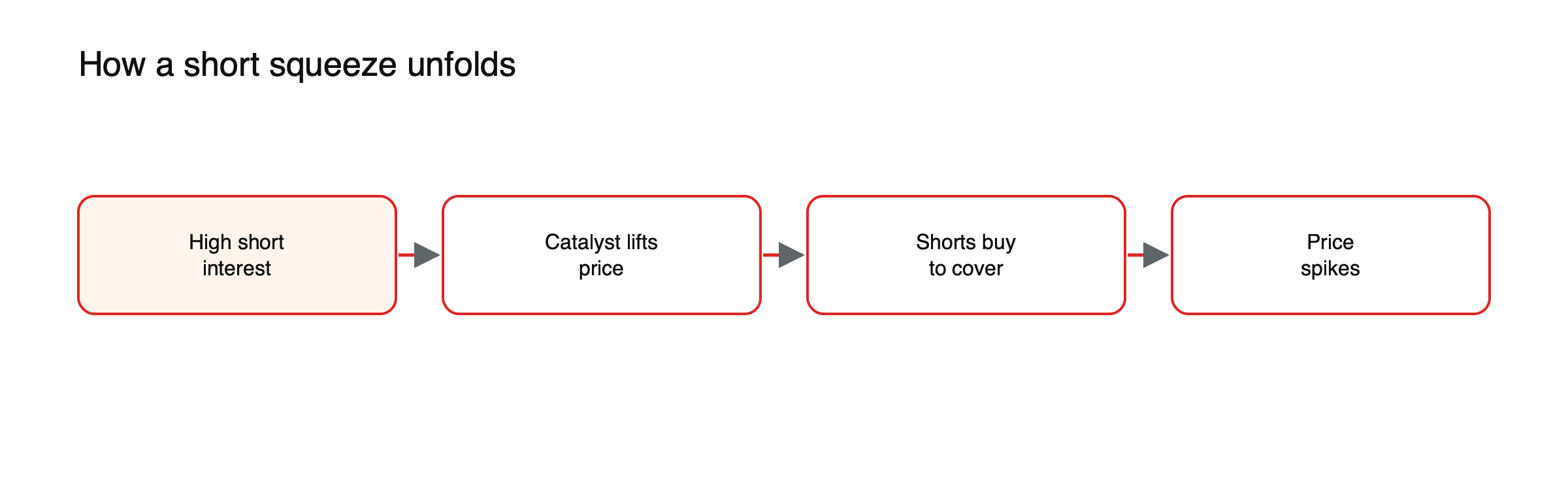
Figure: The squeeze feedback loop.
A squeeze in numbers
Suppose a trader shorts 100 CFD shares at $20, a $2,000 position with $400 of margin at 5:1. A surprise announcement lifts the price to $25 at the open; the loss is $500, more than the entire margin. If the price keeps climbing to $30 as other shorts cover, the loss reaches $1,000, two and a half times the margin, and the position is likely to have been closed by a margin call along the way, at whatever price was available. (Illustrative figures.) A long position’s loss is capped at the price falling to zero; a short’s is not capped at all.
Signs a squeeze could happen
| Sign | Why it matters |
|---|---|
| High short interest as a share of the float | Many potential buyers if shorts must cover |
| High days to cover | Shorts would take a long time to exit |
| Small free float or concentrated ownership | Few shares available to buy |
| Rising cost to borrow | Shorts are becoming expensive to maintain |
| A catalyst ahead, such as results or a deal | Something could force a sharp move |
No single sign predicts a squeeze, but several together make one more likely. See what short interest is.
Volkswagen, 2008
Porsche revealed it controlled about 74% of VW; with little free float left and heavy short interest, the price rose from around €200 to over €900 in days. See how Volkswagen briefly became the world’s most valuable company.
GameStop, 2021
With short interest around 140% of float, retail buying drove the price from about $17 to an intraday high near $483. See what happened in the GameStop short squeeze.
Gamma squeezes
Options can add fuel. When many investors buy call options on a share, the dealers who sell them often hedge by buying the share, and as the price rises, they need to buy more. That buying can push the price up further, forcing more hedging. In 2021, heavy buying of call options was one of the forces behind the GameStop surge, alongside short covering. A squeeze driven by option hedging can move even faster than one driven by shorts alone.
Regulatory responses
Extreme squeezes have led to interventions. During the GameStop episode, some brokers, including Robinhood, restricted buying in affected shares on January 28, 2021, citing deposit requirements from clearing houses, which drew heavy criticism. Regulators later reviewed the episode and the role of short selling, options and payment for order flow. Such responses can end a squeeze abruptly, adding another unpredictable risk for anyone trading during one.
Why it matters for short CFD positions
Losses on a short have no ceiling, and squeezes can move faster than stops can fill. Providers can also restrict or close shorts in hard-to-borrow stocks. See how short selling works with CFDs.
What usually follows
Squeezes often reverse once covering ends, sometimes sharply.
See what short interest is and what moves stock prices.
A squeeze or a real rally?
Not every sharp rise in a heavily shorted share is a squeeze. Sometimes good news changes the company’s prospects, and shorts are simply wrong. A squeeze usually shows extreme volume, a price move far out of proportion to the news and a collapse in short interest in later data, followed by a sharp reversal once covering ends. A fundamental rally tends to hold its gains as investors reassess the business.
Protecting a short position
Shorts in heavily shorted shares carry extra risk. Practical protections include smaller positions, stops placed with gaps in mind, guaranteed stops where offered, avoiding holding through catalysts such as results and watching the cost to borrow, which often rises before squeezes. Some traders avoid shorting the most crowded names altogether. See how short selling works with CFDs.
Squeezes beyond single shares
Squeezes are not limited to heavily shorted shares. In commodities, the 2022 nickel squeeze on the London Metal Exchange forced a large producer to cover a short as prices more than doubled in hours. In 1980, the Hunt brothers’ attempt to corner silver created the opposite pressure on those who had sold short. Whenever positions are concentrated and liquidity is thin, a forced exit can move prices far beyond normal ranges. See what happened in the 2022 LME nickel squeeze.
After the squeeze
Once short sellers have covered, the buying that drove the move disappears. Prices often fall sharply, sometimes giving back most of the rise within days or weeks, though some squeezed shares stay well above their starting level for a long time. Late buyers who joined near the peak, expecting the move to continue, are often the biggest losers.
How providers manage squeeze risk
CFD providers can raise margin requirements on shares that become extremely volatile, restrict new positions or allow only closing trades, and close shorts if borrowing is no longer available. These measures protect the provider and the market, but they can force clients out of positions at difficult moments.
Common misreadings
- Assuming high short interest guarantees a squeeze.
- Buying late in a squeeze expecting it to continue.
Online communities and squeezes
The GameStop episode showed how online communities can coordinate buying at a scale that once required large institutions. Posts identifying heavily shorted shares, combined with easy access to trading apps and options, helped draw in many individual buyers at once. Similar, smaller episodes have followed in other shares. For short sellers, it means that crowd attention, not just fundamentals and data, has become part of squeeze risk; for buyers, it means prices can detach from fundamentals in both directions, and quickly. Shares that rise on social media enthusiasm can fall just as fast when attention moves elsewhere, leaving late buyers with large losses. Treating social media momentum as a reason to buy, rather than as a risk to manage, has proved expensive for many traders. The lesson applies to both sides of crowded trades.
Frequently asked questions
How long do short squeezes last?
Most last days or a few weeks, ending when covering is exhausted. Prices often fall sharply afterward, though some squeezed shares remain elevated for long periods.
Can a long position benefit from a squeeze?
Yes, if it is held before the squeeze begins. Buying after a large rise is risky, because squeezes often reverse quickly once covering ends.
This article is educational content and does not constitute financial, investment, legal or tax advice. Digital assets are volatile and you may lose the amount you invest.
Sources
- Anatomy of a short squeeze (VW: 74% stake, 6% free float vs 12% short interest, ~€200 to over €900; GameStop: short interest ~140% of float) — Janus Henderson
- What were the biggest short squeezes in history? (GameStop at $17.25 before the surge; ~140% of float short; Robinhood halted buying on January 28, 2021) — IG
- What is a short squeeze (GameStop intraday peak of $483 on January 28, 2021, pre-split prices) — Freedom Isn’t Free