
Leverage Limits in the EU, UK and Australia Compared
Retail CFD leverage is capped at 30:1 for major currency pairs and 2:1 for crypto in the EU and Australia; the UK banned crypto derivatives. How they compare.
Retail leverage limits on CFDs are now similar across the EU, UK and Australia: a maximum of 30:1 for major currency pairs, falling to 2:1 for cryptocurrencies. The EU set these caps in August 2018, the UK followed and then banned crypto derivatives for retail clients in 2021, and Australia adopted matching limits in March 2021. Rules elsewhere differ widely.
Side by side
| Underlying | EU (ESMA, 2018) | UK (FCA) | Australia (ASIC, 2021) |
|---|---|---|---|
| Major currency pairs | 30:1 | 30:1 | 30:1 |
| Non-major pairs, gold, major indices | 20:1 | 20:1 | 20:1 |
| Other commodities, minor indices | 10:1 | 10:1 | 10:1 |
| Individual shares | 5:1 | 5:1 | 5:1 |
| Cryptocurrencies | 2:1 | Banned for retail since Jan 2021 | 2:1 |
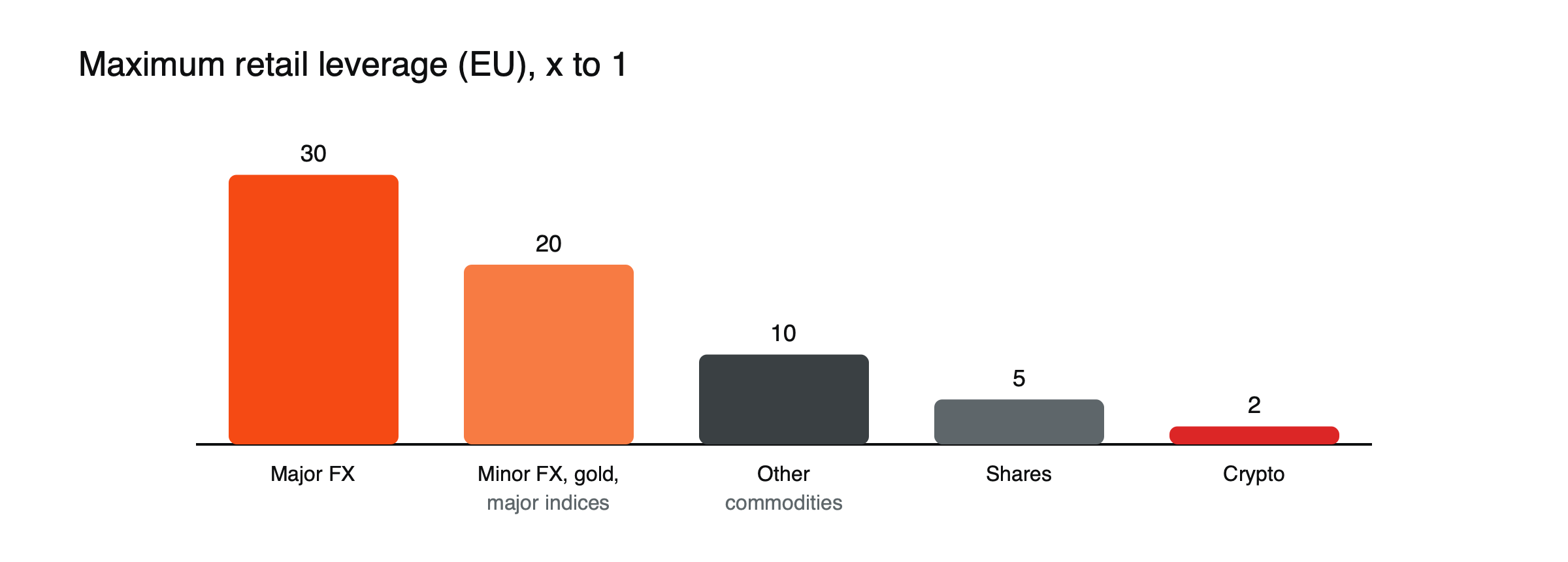
Figure: EU retail leverage caps by underlying (Australia uses the same levels).
Why the limits exist
Regulators found that most retail CFD accounts lose money: in the EU, national regulators’ studies showed 74% to 89% of retail accounts typically lost money, with average losses of €1,600 to €29,000 per client. In Australia, retail clients of 13 CFD issuers lost more than $774 million in five weeks of 2020’s volatility.
The same deposit, three caps, illustrated
Suppose a trader deposits $2,000 and wants exposure to individual shares, a major currency pair and bitcoin. (Illustrative scenario.) Under the 5:1 cap for shares, the maximum position is $10,000. Under the 30:1 cap for major pairs, it is $60,000. Under the 2:1 cap for crypto, it is $4,000, where permitted. The caps scale exposure to each market’s volatility: a 10% move in bitcoin, not unusual, would cost $400 at full 2:1 leverage, while a 10% move in a major currency pair, rare in a short period, would cost $6,000 at full 30:1 leverage.
What else comes with the caps
The EU and Australian rules also include margin close-out at 50% of required margin, negative balance protection and limits on incentives. See what ESMA’s 2018 CFD rules changed.
Where the usual answer flips
Lower leverage reduces the speed of losses but not the direction: a losing strategy still loses. Professional clients, who meet experience and wealth tests, can access higher leverage, with fewer protections.
The United States
The US takes a different approach. Retail forex is allowed with leverage of up to 50:1 on major currency pairs and 20:1 on others, under rules from the Commodity Futures Trading Commission and the National Futures Association. CFDs, however, are generally not available to US retail clients, so share and index exposure is usually obtained through regulated futures, options or margin accounts instead.
Japan
Japan’s Financial Services Agency capped retail forex leverage at 50:1 in August 2010 and lowered it to 25:1 from August 2011, one of the earliest and strictest regimes among major markets. The limits affected Japanese retail traders, who had been among the most active in carry trades.
Other regions
Rules in the US, Asia and offshore jurisdictions differ significantly and are not covered here. See why the UK banned crypto derivatives for retail investors and why best execution matters for traders.
Effective leverage versus maximum leverage
Maximum leverage is a ceiling, not a target. A trader with $10,000 who opens a $50,000 currency position is using 5:1 effective leverage, even if the account allows 30:1. Effective leverage, calculated from total position size divided by account equity, gives a clearer picture of risk. Many professional traders use far less than the maximum available. See leverage in CFD trading.
Margin, illustrated
The leverage caps translate into minimum margin requirements: 3.33% for major currency pairs, 5% for minor pairs, gold and major indices, 10% for other commodities and minor indices, 20% for individual shares and 50% for crypto. A $10,000 position in a major pair therefore needs at least $333 of margin, while the same position in shares needs $2,000. See how CFD margin works.
Leverage and losses
Studies behind the EU rules found that 74% to 89% of retail CFD accounts typically lost money. Higher leverage tends to increase the speed of losses, especially for inexperienced traders who size positions to the maximum allowed. Lower leverage gives more time to react but does not change the outcome of a losing strategy.
Position sizing under the caps, illustrated
Suppose a trader with $5,000 decides to risk no more than 1% of the account, $50, on a trade in a major currency pair, with a stop 50 pips away. (Illustrative scenario.) At about $10 per pip for a standard lot, the right size is 0.1 lots, a position worth about $10,000, using effective leverage of only 2:1. The 30:1 cap would allow up to $150,000, but sensible risk management keeps actual leverage far lower. Caps set the ceiling; position sizing decides the risk.
Who qualifies as professional
In the EU and UK, retail clients can request professional status if they meet at least two of three criteria, broadly covering significant trading activity, a sizeable financial portfolio and relevant professional experience. Professional clients can access higher leverage but lose protections such as negative balance protection. Regulators expect firms to verify the criteria rather than simply accept requests.
Why crypto gets the lowest cap
Crypto prices can move 10% or more in a day, and gaps over weekends and in thin markets are common. A 2:1 cap means a 50% fall would be needed to wipe out the margin, offering some cushion against these swings. The UK went further, banning crypto derivatives for retail clients.
Common misreadings
- Believing the maximum leverage is the recommended leverage.
- Assuming professional status brings better trading results.
How the caps changed trading
After the EU caps took effect in 2018, many retail traders opened smaller positions, and some moved to providers outside the EU where higher leverage remained available. Regulators responded by limiting the marketing of such providers to EU clients. Over time, the caps became an accepted standard, and some providers built their offerings around them, competing on costs and tools rather than leverage. See what ESMA’s 2018 CFD rules changed.
Higher leverage elsewhere
Some jurisdictions permit retail leverage well above the EU, UK and Australian caps. Higher leverage can amplify gains, but it also magnifies losses and can wipe out accounts quickly in volatile markets. Traders using higher leverage should check whether protections such as negative balance protection, segregated client money and clear close-out rules apply, and should size positions as carefully as if lower caps were in force.
Leverage and close-outs, illustrated
Suppose a trader with $3,000 opens a $90,000 position in a major currency pair, using the full 30:1 leverage, so the required margin is $3,000. (Illustrative scenario.) A 1.67% adverse move would cost $1,500, halving the account’s equity relative to the margin requirement and triggering the 50% close-out rule in the EU, UK and Australia. The same move on a $15,000 position, at 5:1 effective leverage, would cost only $250, leaving the position open. The difference shows how much effective leverage, not the cap, decides how quickly a position is closed.
Indices and commodities
Major indices and gold share the 20:1 cap, reflecting their moderate volatility, while other commodities, such as oil and silver, are capped at 10:1 because their prices can swing more sharply.
Questions to ask
- What leverage applies to each product I trade?
- At what level are positions closed out?
- Does negative balance protection apply to my account?
Leverage and financing costs
Leverage also affects overnight financing. Financing charges apply to the full value of a CFD position, not just the margin, so a highly leveraged position held for weeks can accumulate large costs relative to the trader’s deposit. A $60,000 position financed at 6% a year costs about $10 a day, or about $300 a month, a significant drag on a $2,000 account. See overnight financing on CFDs. Lower effective leverage reduces both the risk of close-outs and the steady drag from overnight financing charges.
Frequently asked questions
Why do different countries have different limits?
Each regulator sets limits based on its own assessment of risk and market practices, though many have converged on similar levels since 2018.
Is higher leverage always worse?
Not in itself, but it increases the speed and size of potential losses, so it requires stricter risk management.
This article is educational content and does not constitute financial, investment, legal or tax advice. Digital assets are volatile and you may lose the amount you invest.
Sources
- ESMA adopts CFD measures (from August 1, 2018: 30:1 to 2:1 by underlying; 50% margin close-out; negative balance protection) — Finadium
- ESMA agrees to restrict CFDs (74%–89% of retail accounts lose money; average losses €1,600–€29,000) — ESMA, March 2018
- ASIC product intervention order strengthens CFD protections (from March 29, 2021; 30:1 major pairs; $774 million losses in five weeks of 2020) — Mondo Visione
- ASIC matches EU regulators with 30x cap (2x on crypto CFDs) — FX News Group
- FCA bans cryptocurrency CFDs for retail traders (UK followed ESMA caps in 2018; crypto ban from January 6, 2021) — FX News Group
- Retail foreign exchange trading (CFTC limits retail forex leverage to 50:1 on major pairs and 20:1 on others; Japan’s FSA capped retail forex leverage at 50:1 in August 2010 and 25:1 from August 2011) — Wikipedia