
What Is Short Interest and What Does It Signal?
Short interest is shares sold short and not yet covered, often as a percentage of float. What high short interest signals, days to cover and why squeezes start.
Short interest is the number of shares sold short and not yet bought back, usually shown as a percentage of the free float. High short interest shows many investors expect a fall, but also that many must eventually buy, which can fuel a squeeze. GameStop’s short interest reached about 140% of its float in January 2021.
How it is measured
- Short interest % of float = shares sold short ÷ free float. If 1.5 million of 10 million shares are short, short interest is 15%.
- Days to cover = shares sold short ÷ average daily volume: how many days of normal trading it would take to buy them all back.
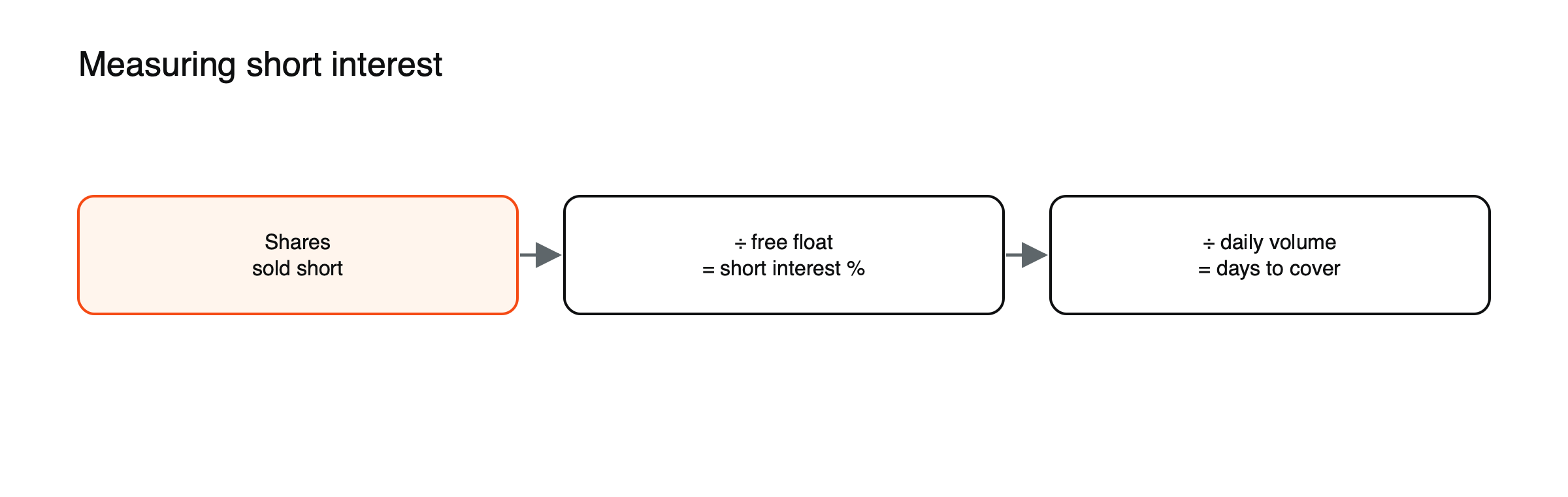
Figure: Two ways to measure short positioning.
Exchanges publish short interest data at regular intervals, so it is not real time.
A worked example
A company has 20 million shares in its free float, of which 3 million are sold short, so short interest is 15% of the float. Average daily trading volume is 500,000 shares, giving 6 days to cover: if all shorts tried to buy back, it would take about six days of normal volume. A reading of 15% and six days would be considered high for a large company. (Illustrative figures.)
Where the data come from
In the United States, short interest for listed shares is reported twice a month and published a few days after each reporting date, so it is always somewhat out of date. In Europe, investors must report significant net short positions to regulators, and positions above a set threshold are published with the holder’s name, giving a different, more targeted view. Data providers also estimate shorting activity from securities lending markets more frequently.
What high short interest signals
- Bearish conviction: investors see problems, such as weak finances or overvaluation.
- Squeeze fuel: if the price rises, short sellers may rush to buy. See what a short squeeze is.
- Borrowing costs: heavily shorted stocks are costly to borrow, which affects short CFD charges.
Cost to borrow and utilization
Short sellers must borrow shares, and lenders charge a fee that rises when shares are scarce. Utilization, the share of lendable stock already on loan, shows how tight borrowing is. When utilization approaches 100% and borrowing fees jump, it becomes expensive to stay short, and some shorts may close, which can itself lift the price. For CFD traders, these costs often appear as higher borrowing charges on short positions, and providers may stop new shorts entirely.
How it can exceed 100%
Borrowed shares can be lent again, so total short interest can exceed the float, as in GameStop’s case, creating an unstable setup.
What low short interest tells you
Low short interest means few investors are betting against the company. It is not a buy signal, but it means there is little squeeze fuel if good news arrives, and that bad news would have to be absorbed by long holders selling. In many large, stable companies, short interest stays in low single digits most of the time.
Watching the trend
Changes in short interest are often more informative than the level. Rising short interest alongside a falling price suggests growing conviction among bears; falling short interest during a rally suggests shorts are covering, which can mean the rally’s fuel is running out. Comparing several reporting periods shows whether positioning is building or unwinding.
Limits
Short interest data are delayed, and high short interest alone does not predict a squeeze; a catalyst is needed.
See how short-selling rules work across markets and what moves stock prices.
Using short interest as a trader
For long positions, high short interest adds both risk and opportunity: bad news may already be expected, and good news could trigger a squeeze. For short positions, it is a warning: the trade is crowded, borrowing may be costly and squeezes are more likely. Combining short interest with days to cover, borrowing costs, upcoming catalysts and the price trend gives a fuller picture than any one number. See what a short squeeze is.
Common misreadings
- Treating high short interest as a reason to buy on its own.
- Ignoring how old the data are.
- Comparing short interest across companies with very different floats and volumes.
Not all short interest is a bet on a fall
Some short positions are hedges rather than bets. Investors who own a company’s convertible bonds often short its shares to offset the share price risk embedded in the bonds. Market makers short to manage inventories, and funds short one company while owning another in the same sector to isolate a view. Because of this, a high figure does not always mean that many investors think the share will fall.
GameStop: short interest above the float
In early 2021, short interest in GameStop reached about 140% of its free float, possible because borrowed shares had been lent again. When retail buyers and options activity pushed the price higher, shorts faced enormous pressure to cover, and the share rose from about $17 to an intraday high near $483 within weeks. The episode made short interest one of the most watched statistics among retail traders. See what happened in the GameStop short squeeze.
What it means for CFD shorts
Providers watch the same data. When short interest and borrowing costs rise, they may increase charges on short CFD positions, raise margin requirements or stop accepting new shorts. Existing shorts can occasionally be closed if the underlying borrow is recalled. Checking a share’s borrowing status before opening a short avoids surprises.
A short interest checklist
- What share of the float is sold short, and how is it changing?
- How many days would it take to cover?
- Is the share becoming harder or more expensive to borrow?
- Is a catalyst coming up?
Short sellers as researchers
Some short sellers publish detailed reports explaining why they believe a company is overvalued or has accounting problems. These activist short reports can move a share sharply on the day they appear, and the company’s response can move it back. Short interest often rises after such reports. Whether the share keeps falling depends on whether the claims are confirmed, which can take months. Reading both the report and the company’s reply, rather than reacting to the headline, gives a better basis for any decision. A detailed short report is a starting point for research, not a conclusion, for longs and shorts alike, until the facts are confirmed.
Frequently asked questions
Is high short interest bullish or bearish?
Both. It shows that many investors expect a fall, but it also creates the conditions for a squeeze if the price rises.
Why do some brokers stop short selling in certain shares?
Because shares can become hard or impossible to borrow, or because the risk of a squeeze is high, especially when short interest and borrowing costs are extreme.
This article is educational content and does not constitute financial, investment, legal or tax advice. Digital assets are volatile and you may lose the amount you invest.
Sources
- Anatomy of a short squeeze (VW: 74% stake, 6% free float vs 12% short interest, ~€200 to over €900; GameStop: short interest ~140% of float) — Janus Henderson
- Biggest short squeezes (short interest definition and calculation example) — Forex.com
- What is a short squeeze (shares can be lent and re-lent) — Freedom Isn’t Free