
How Shorting Bitcoin With a CFD Works
Shorting a bitcoin CFD lets you profit if bitcoin falls without borrowing coins. How it works, a 0.2 BTC example, the costs and why short risk is open-ended.
Shorting bitcoin with a CFD means opening a sell position that gains if bitcoin falls and loses if it rises, without borrowing coins. You post margin, at least 50% under EU and Australian retail rules, and close by buying back. Shorting 0.2 BTC at $60,000 gains $1,200 at $54,000 and loses $1,200 at $66,000.
How it works
- Choose a size and click sell.
- Post margin, at least 50% of the position at 2:1.
- Close by buying back; profit or loss = (entry − exit) × size.
A worked example
0.2 BTC at $60,000 is a $12,000 position needing $6,000 margin at 2:1. A fall to $54,000 gains $1,200; a rise to $66,000 loses $1,200. (Example values.)
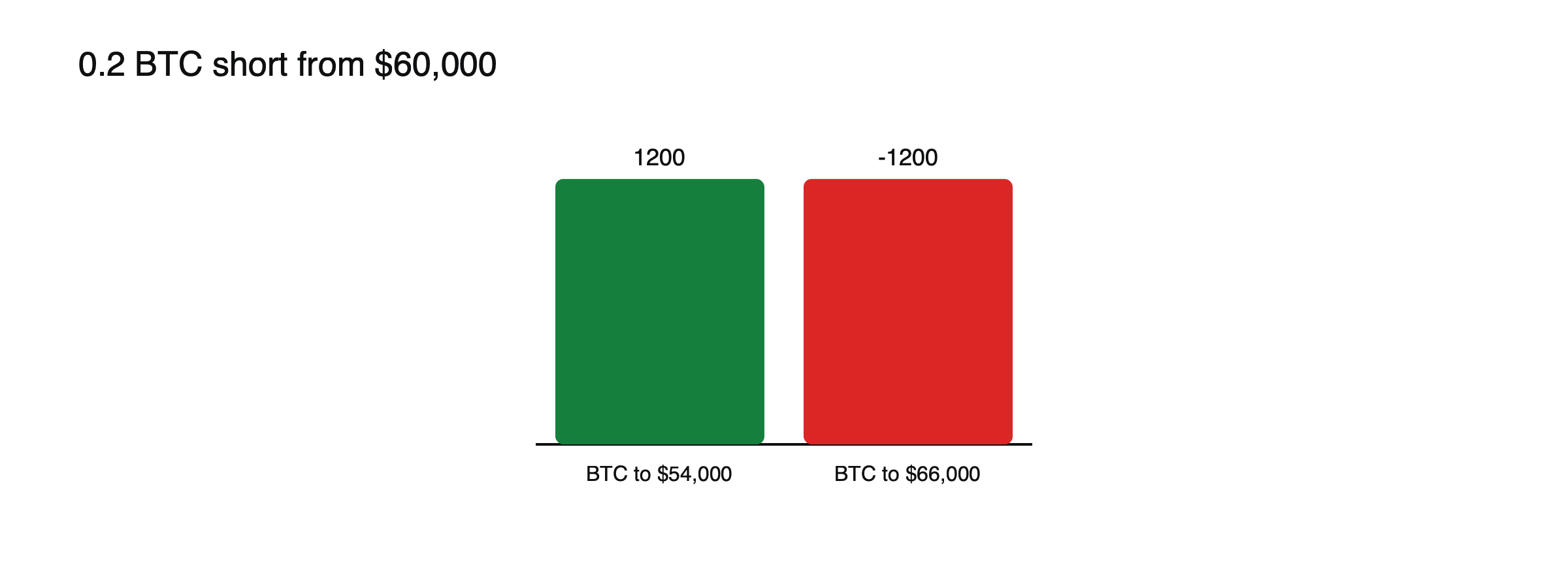
Figure: Short P&L before costs (example values).
A short in a rally, worked through
Suppose the trader deposits exactly the $6,000 margin for the 0.2 BTC short at $60,000. As bitcoin rises, the loss grows and so does the margin required, because the position is worth more. Equity equals $6,000 minus the loss; used margin equals 50% of the position’s current value. The position is closed when equity falls to half the used margin, which happens at about $72,000, a rise of only 20%. (Example values.) A long position with the same deposit would survive a 33% fall, so shorts reach the close-out level sooner because losses and margin grow together.
Costs
Spread on entry, and overnight financing on the position, which on crypto CFDs is often charged to shorts as well as longs. See how much it costs to hold a bitcoin CFD for a month.
Financing on a short
Many providers charge crypto financing on short positions as well as longs. On the $12,000 short at an illustrative 18% a year, 30 days cost about $178, so bitcoin must fall about 1.5% just to cover a month of holding costs. Checking the short rate before planning a trade that may take weeks matters.
Risks specific to shorts
- Open-ended loss: bitcoin can keep rising; a long can lose at most its value.
- Squeezes: sharp rallies when short sellers buy back together. See what a short squeeze is.
- Weekend gaps when liquidity is thin.
Squeezes in crypto
Crypto markets have frequent upward squeezes, when heavily shorted positions on exchanges are liquidated and forced buying drives prices higher in minutes. Funding rates that turn sharply negative, meaning many traders are short, often precede such moves. CFD shorts are priced from the same markets and feel the same jumps.
When traders short with CFDs
To profit from expected falls, or to hedge coins they hold. See how to hedge crypto holdings with CFDs.
See how short selling works with CFDs and what a crypto CFD is.
Stops on shorts
A stop on a short sits above the entry. Because crypto can jump sharply on news, short stops are often skipped in rallies, filling well above their level. Sizing as if the stop could fill at twice its distance keeps a sudden rally survivable. See how to set stop-losses on crypto CFDs when prices gap.
Shorting smaller coins
Shorting altcoins brings larger swings in both directions and wider spreads. Squeezes in small coins can be extreme, and providers may limit short positions or withdraw a coin altogether, forcing positions to close. Many traders keep crypto shorts to the largest coins.
Three ways to short compared
| CFD | Perpetual futures | Borrowing coins | |
|---|---|---|---|
| Venue | Regulated provider | Crypto exchange | Lending platform or exchange |
| Leverage | 2:1 for EU retail | Often much higher | Depends on collateral |
| Holding cost | Financing | Funding, often received by shorts | Borrowing fee |
| Loss protection | Negative balance protection for EU retail | Liquidation; insurance funds | Collateral liquidation |
See crypto CFDs vs crypto futures and perpetuals.
A short checklist
- Is the reason for the short specific and time-limited?
- How far could bitcoin rise before the close-out level?
- What does a month of financing cost?
- Are funding rates or positioning pointing to a squeeze?
A short in a falling market, worked through
Suppose bitcoin falls from $60,000 to $48,000 over 30 days, a decline of 20%. The 0.2 BTC short gains $2,400 gross. A month of financing at 18% on the $12,000 position costs about $178, and the spread about $12, leaving a net gain of about $2,211. (Example values.) Shorts can be profitable in sustained declines, but the costs of holding them grow with time.
Shorting in a bear market
Even in long declines, crypto prices often rebound sharply, sometimes by 20% or more in days, as shorts cover and buyers return. Shorts held through those rebounds can be stopped out before the decline resumes. Many traders who short in bear markets take profits more quickly than on longs and re-enter after rebounds rather than holding throughout.
Reasons for shorting
Shorts tend to work best when based on a clear catalyst or a breakdown in market structure, such as a failed rally at a key level, heavy leveraged long positioning or a major negative event. Shorting simply because a price looks too high, during a strong uptrend, is one of the most common ways short sellers lose money.
Funding as a clue
On crypto exchanges, positive funding means longs are paying shorts, often because many traders are long with leverage. Very high funding can signal crowded long positions vulnerable to a sell-off, which some traders see as an opportunity to short. Sharply negative funding, by contrast, warns that shorts are crowded and a squeeze is possible. See funding rates vs overnight financing.
Common misreadings
- Believing the close-out level is as far away for a short as for a long.
- Assuming shorts earn financing on crypto CFDs.
Sizing a short, worked through
A trader risking $100 places a stop 8% above a $60,000 entry, at $64,800, a distance of $4,800 per coin. The size is about 0.02 BTC, a $1,250 position. Allowing for a squeeze that fills the stop at twice its distance, the trader might halve that to about 0.01 BTC. (Example values.) Shorts deserve the extra caution because rallies can be faster and sharper than declines.
Shorting around events
Shorting ahead of an expected negative announcement can work, but if the news is better than feared, crypto can rally sharply as shorts rush to cover. Many traders reduce or close shorts before major events, or use guaranteed stops, rather than betting on the outcome.
Closing a short
A short is closed by buying back the same size. Many traders close in stages, taking part of the profit at a first target and moving the stop to the entry price on the rest.
Short-term and longer shorts
Short-term shorts, held for hours or days, avoid most financing and rely on precise entries and quick exits. Longer shorts need a strong reason, room for rebounds and a budget for financing.
A short journal
Recording why each short was opened, how it was sized, how far it ran against the position and how it ended reveals whether shorts are adding to results. Many traders find their shorts perform differently from their longs, which helps decide how much of their trading should be on the short side.
Shorting and overall exposure
If you also hold coins or long positions elsewhere, a short partly offsets them, acting as a hedge rather than a separate bet. Counting all positions together honestly shows your real net exposure to crypto, which is what decides how a broad market move affects your total wealth overall.
Frequently asked questions
Do I need to borrow bitcoin to short with a CFD?
No. The CFD is a contract with the provider, so no coins are borrowed or delivered.
Can I lose more than my deposit on a short?
EU and Australian retail clients have negative balance protection, so account losses are capped at the balance. Elsewhere, check the provider’s terms.
Leverage, margin and cost figures in this article are example values for illustration. Actual terms depend on the provider, the instrument and the rules in your country.
This article is educational content and does not constitute financial, investment, legal or tax advice. Digital assets are volatile and you may lose the amount you invest.