
What Happened to the 2017 ICO Boom?
In 2017 token sales raised about $11.9 billion; most projects failed or were scams and regulators stepped in. How the ICO boom worked and what it changed.

The ICO boom 2017 investors remember was a wave of token sales in which projects raised about $11.9 billion by selling new tokens directly to the public, mostly on Ethereum. A 2018 study found about 78% of those offerings were scams by count. Prices collapsed in the 2018 bear market, regulators applied securities law, and the model largely ended.
What an ICO was
An initial coin offering let a project sell tokens to anyone with an internet connection, usually in exchange for ether or bitcoin, often before any product existed. Buyers hoped the tokens would rise once listed on exchanges. Ethereum made this easy: a token sale could be launched with a standard smart contract in days. Ethereum itself had been funded by a 2014 crowdsale that raised about $18 million.
Inside a typical ICO
Most token sales followed a similar script. A team published a white paper describing a future network and the role its token would play. A smart contract was deployed to accept ether, sometimes bitcoin, and send back new tokens at a fixed rate, often with bonuses for the earliest buyers. Marketing ran through forums, chat groups and paid promoters. Once the sale closed, the team hoped to list the token on exchanges, where early buyers could sell. Listings themselves became a business, with some exchanges charging very large fees to add new tokens. In many cases the product described in the white paper did not yet exist, and the token’s only immediate use was trading.
The biggest raises
| Project | Approximate amount raised | Note |
|---|---|---|
| EOS | About $4 billion | A year-long sale running into 2018 |
| Filecoin | About $257 million | About $200 million in the first half hour |
| Tezos | About $232 million | Paid in bitcoin and ether; later lawsuits |
| Bancor | About $153 million | Raised in the record second quarter of 2017 |
Funding accelerated through the year. The second quarter of 2017 alone brought about $797 million, a record at the time, and the pace kept rising after that.
Timeline
- 2014: Ethereum’s crowdsale raises about $18 million, an early model for token funding.
- July 2017: the US SEC publishes its DAO Report, stating that securities law can apply to token sales.
- 2017: token sales raise about $11.9 billion during the year; EOS begins a sale that runs into 2018 and raises around $4 billion.
- 2018: Telegram raises about $1.7 billion privately for its TON blockchain; most 2017 tokens lose the large majority of their value in the bear market.
- July 2018: Satis Group publishes its classification of 2017 ICOs.
- 2020: after SEC action, Telegram’s project is halted in its original form and investors are refunded.
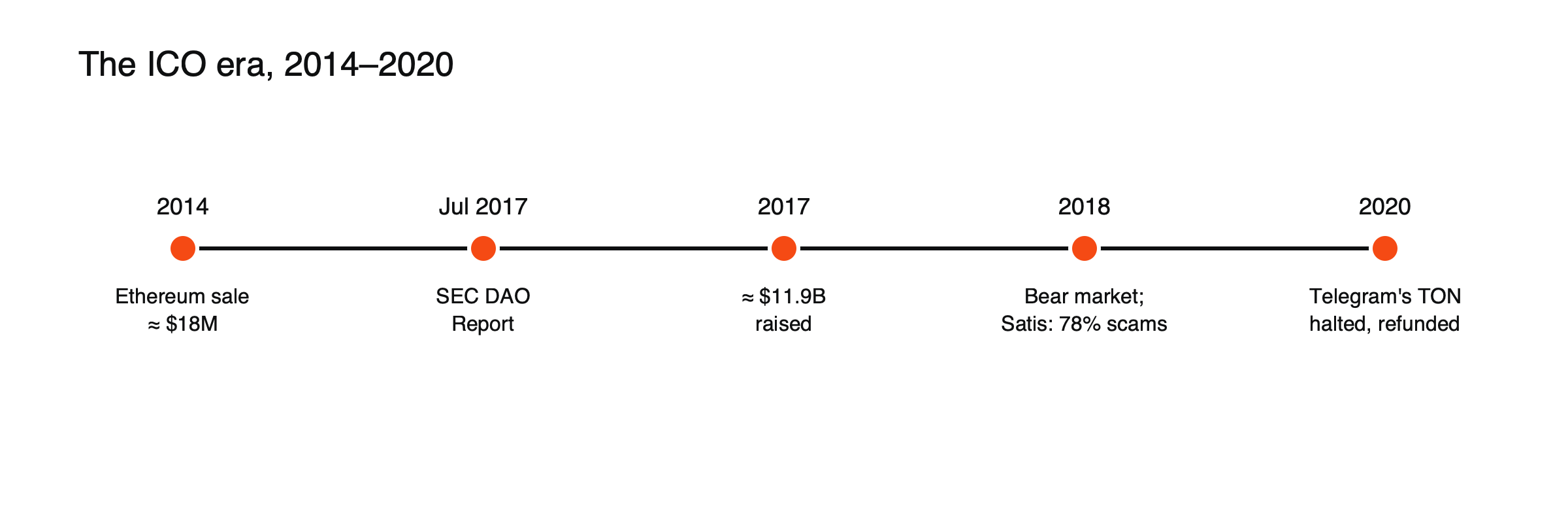
Figure: The rise and end of the ICO boom.
Why ether rose with it
Because most sales accepted ether, anyone who wanted to buy a new token first had to buy ether. That demand helped push ether’s price up sharply during 2017. Projects that raised ether then often sold it to pay salaries and costs, which became a source of selling once prices turned. The two moved together: when China banned ICOs in September 2017, ether fell about 20% in a day, more than twice as much as bitcoin.
China’s ban
On September 4, 2017, the People’s Bank of China declared ICOs illegal and ordered fundraising through token sales to stop, with refunds expected for sales already completed. More than 65 token sales had been run from China that summer, raising about $394 million from roughly 105,000 people. The ban was the first major government action of its kind and signaled that regulators were no longer prepared to watch from the sidelines.
The Munchee order
In the United States, the turning point for «utility token» arguments came on December 11, 2017. The SEC issued a cease-and-desist order against Munchee, a company selling tokens to fund a restaurant review app. Munchee had stopped its sale after a day when contacted by regulators. The SEC concluded that the tokens were securities, because the company planned to increase their value and buyers expected profits from its efforts, regardless of the «utility» label. The same day, the SEC chairman issued a statement warning market professionals and investors that securities law applied to these offerings.
How many were scams
Satis Group classified about 78% of the 2017 ICOs it studied as identified scams by number, about 4% as failed and about 3% as gone dead, with about 15% going on to trade on an exchange. By money raised, the picture was different: less than a tenth of funding, about $1.3 billion, went to identified scams, and much of that came from a few large frauds. Most investors’ money went to projects that did launch tokens, though many of those tokens later lost most of their value.
How buyers fared
Outcomes depended almost entirely on timing and selection. Some early buyers who sold soon after tokens listed made large gains, because new listings often jumped in the frenzy of late 2017. Buyers who held through 2018 usually lost most of their money, as token prices fell further than bitcoin and ether, and many projects never shipped a product or stopped trading altogether. Even among the minority that went on to trade, the token’s value often had little to do with whether the promised network was ever built. The lesson many buyers drew was that a token sale funds a team, not a product, and that the gap between the two can last for years, or never close at all.
Why it ended
Three forces ended the boom. Prices fell through 2018, so new token sales could no longer count on quick listing gains. Regulators treated many tokens as securities and brought enforcement actions. And the record of failures made buyers far more cautious about white papers with no product.
What it changed
Lawsuits followed the money. Tezos, one of the year’s largest raises, soon faced class actions from buyers alleging misleading statements and unregistered securities sales, along with a public dispute between its founders and its foundation. Similar suits followed other large raises.
Some projects shipped. Filecoin raised about $257 million in 2017 and launched its storage network in 2020. Several tokens from the era still trade.
Fundraising moved elsewhere. Projects shifted to private sales to venture funds, exchange launch platforms, airdrops and, later, points programs, often with insiders buying cheaper and earlier than the public.
Regulation caught up. The idea that securities law applies to token sales, signaled in 2017, shaped how projects raised money for years after.
The format kept returning in new forms. Exchange-run token sales took over in 2019, decentralized finance launched its own tokens through liquidity incentives in 2020, and memecoin launch platforms made token creation almost free in 2024. Each wave changed the mechanics but repeated a familiar pattern: easy issuance, heavy promotion and most of the risk carried by the last buyers in.
Investor lessons stuck, partly. Many of the same patterns, hype, no product, concentrated supply, reappeared later in memecoins and token launches.
For how today’s tokens fail, read why most cryptocurrencies fail. For the scam pattern that replaced many exit scams, see what a rug pull is, and for context, what an altcoin is.
This article is educational content and does not constitute financial, investment, legal or tax advice. Digital assets are volatile and you may lose the amount you invest.
Sources
- 80% of ICOs in 2017 were scams (Satis Group: $11.9 billion total 2017 token funding; $1.3 billion to scams; 78% / 4% / 3% / 15%) — CryptoTicker, July 2018
- SATIS Group Report: ‘78% of ICOs are Scams’ (under a tenth of funding to scams) — CryptoSlate, July 2018
- What Was the ICO Boom? (SEC DAO Report July 2017; EOS ~$4 billion; Telegram ~$1.7 billion; Ethereum ~$18 million crowdsale; Filecoin ~$257 million) — Banxa
- China’s central bank bans ICOs (September 4, 2017; 65+ ICOs raised $394 million from 105,000 people; Tezos $232 million) — CriptoNoticias, September 2017
- China deems ICOs illegal (ether fell about 20%, bitcoin about 8%) — Mobile Marketing Magazine, September 2017
- Company halts ICO after SEC cease-and-desist order (Munchee, December 11, 2017; chairman’s statement) — Sullivan & Cromwell
- The most successful ICOs of 2017 (Filecoin $257 million with $200 million in 30 minutes; Bancor $153 million; Tezos lawsuits) — Inc. Russia, October 2017
- Companies raised $797 million through ICOs in Q2 2017, a record — Inc. Russia via TechCrunch, 2017