
Why Companies Buy Back Their Own Shares
Buybacks return cash by cutting the share count, lifting EPS. S&P 500 companies spent a record $942.5 billion in 2024. Why companies do it, the pros and cons.
Share buybacks are when a company uses cash to repurchase its own shares, reducing the number outstanding. They return money to shareholders, like dividends, and lift earnings per share because profits are spread over fewer shares. S&P 500 companies spent a record $942.5 billion on buybacks in 2024, with Apple alone spending $104.2 billion.
Why companies buy back shares
- Return excess cash when they lack better investment opportunities.
- Flexibility: unlike dividends, buybacks can be cut without the same signal of distress.
- Offset dilution from employee stock awards.
- Signal confidence that management thinks shares are undervalued.
How buybacks affect the numbers
Fewer shares mean higher EPS even if profit is flat. See how earnings per share is calculated. Ownership stakes of remaining shareholders also rise.
Buyback math, worked through
Suppose ExampleCo uses $20 million of its free cash flow to buy back shares at $39. It retires about 0.51 million shares, roughly 1% of its 50 million. With net income unchanged at $97.5 million, EPS rises from $1.95 to about $1.97, an increase of about 1%. Remaining shareholders each own about 1% more of the company. (Hypothetical figures.) The effect is modest in a single year but compounds when companies buy back shares year after year.
Buybacks or dividends?
Both return cash, but they differ. Dividends pay every shareholder in cash, creating a tax bill for many; buybacks return cash only to those who sell, while others see their stake grow. Dividends are seen as a commitment, so cutting them sends a strong negative signal; buybacks can be scaled back quietly. Many companies use both: a steady dividend plus buybacks that vary with cash flow. See how to calculate dividend yield.
How companies buy back shares
Most buybacks happen on the open market over months, under an authorization from the board. Companies can also make tender offers, inviting shareholders to sell at a set price, or arrange accelerated repurchases with banks that deliver shares upfront. The authorization amount announced is a ceiling, not a commitment, so tracking actual spending in quarterly reports matters.
The scale
In 2024, S&P 500 buybacks reached $942.5 billion, up 18.5% from 2023, and total shareholder returns including dividends reached a record $1.57 trillion. Information technology companies accounted for the largest share.
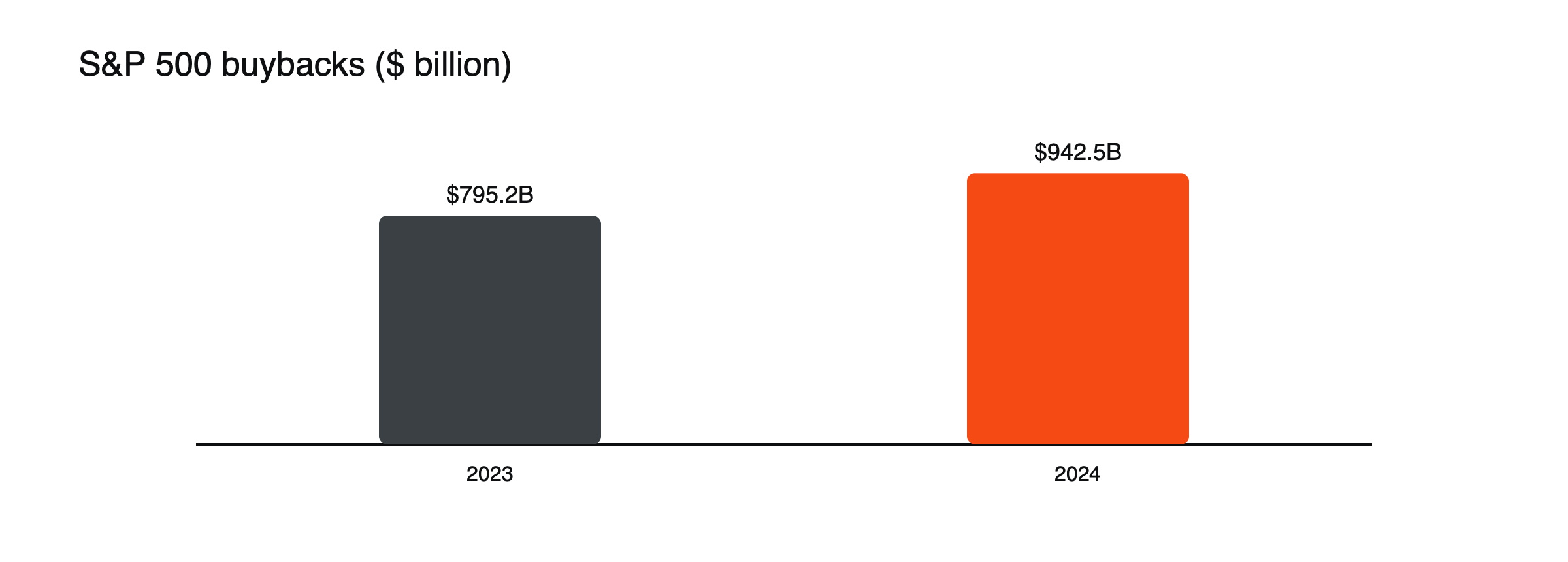
Figure: S&P 500 buybacks. Source: S&P Dow Jones Indices.
The largest buyers
Spending is concentrated among the biggest companies. In 2024, Apple alone repurchased about $104.2 billion of its shares, more than many entire sectors. Large technology companies with strong free cash flow and limited need for capital have accounted for a large share of total buybacks in recent years.
Criticisms
- Buying at high prices destroys value if shares are overvalued.
- Debt-funded buybacks weaken balance sheets.
- Short-termism: they can flatter EPS-linked pay instead of funding investment.
- Tax: the US introduced a 1% excise tax on buybacks in 2023.
Net buybacks and dilution
Many companies issue shares to employees as pay, which increases the share count. Some buybacks simply offset that dilution, leaving the share count roughly flat. The useful measure is the change in shares outstanding over time: a company that spends billions on buybacks while its share count barely falls is mainly paying employees, not returning cash to shareholders.
When buybacks destroy value
Buying back shares at high prices and later issuing new shares at low prices, often in a downturn, transfers value away from long-term shareholders. Buybacks funded by debt can also leave companies exposed when conditions worsen. The best buybacks are funded from free cash flow and made when shares are reasonably valued.
Buyback yield
Dividing the amount spent on buybacks over a year by market value gives a buyback yield. Adding it to the dividend yield gives the shareholder yield, a fuller picture of how much cash a company returns. A company with a 1% dividend yield and a 3% buyback yield returns about 4% of its value a year.
What traders watch
New buyback authorizations, actual spending versus announcements, and whether buybacks are funded from free cash flow. See how to calculate free cash flow and what moves stock prices.
Buybacks and share prices
Steady buyback programs add a regular buyer in the market, which can support share prices, especially in quiet periods. Announcements of large new programs often lift shares on the day, and companies sometimes announce buybacks alongside results to soften disappointing news. Around earnings, many US companies observe self-imposed blackout periods when they do not buy, which can briefly remove that support.
What timing can signal
Companies that buy back heavily when their shares are depressed and slow down when they are expensive show disciplined capital allocation. Those that buy most at market peaks, when cash is plentiful and confidence high, and stop in downturns, when shares are cheap, tend to destroy value. Comparing buyback spending with the share price over several years shows which pattern a company follows.
Buybacks and insider selling
A company buying back shares while its executives sell large amounts of their own holdings sends mixed signals. Sometimes the selling is routine, for example to pay taxes on share awards; sometimes it suggests insiders see less value than the buyback implies. Insider transactions are disclosed in regulatory filings and worth checking alongside buyback announcements.
Buybacks outside the United States
Buybacks have long been most common in the United States, but they have grown in Europe and Japan. In Japan, pressure from the stock exchange and investors to improve returns on capital, especially at companies trading below their book value, has encouraged more buybacks and dividends in recent years. Rules and tax treatment differ by country, which affects how companies choose between buybacks and dividends.
A buyback checklist
- Is the buyback funded from free cash flow or from debt?
- Is the share count actually falling over time?
- Is the company buying at reasonable valuations?
- Are insiders buying or selling?
Common misreadings
- Treating an authorization as money already spent.
- Crediting EPS growth from buybacks as business growth.
How buybacks show up in accounts
Repurchased shares are either cancelled or held as treasury shares, which carry no votes or dividends. Either way, the cash spent reduces shareholders’ equity on the balance sheet. Companies that buy back large amounts over many years can end up with very low or negative equity, which makes ratios such as return on equity and debt-to-equity look extreme even when the business is healthy. See how to read a balance sheet.
Tax treatment
Since 2023, US companies have paid a 1% excise tax on the value of shares repurchased, net of new issuance. The tax is small relative to most programs but adds to the cost of buybacks compared with dividends. Other countries tax buybacks and dividends in different ways, which affects how companies choose to return cash.
The investment debate
Critics argue that large buybacks divert cash from investment in research, equipment and staff. Supporters reply that returning cash that a company cannot invest profitably lets shareholders redeploy it elsewhere. The answer depends on the company’s opportunities: buybacks make most sense when they follow, not replace, worthwhile investment.
Buybacks and the market as a whole
Across the market, buybacks reduce the number of shares available and add steady demand, which some analysts see as an important support for US share prices in recent decades. Because index providers adjust for changes in share counts, buybacks also lift earnings per share for the index as a whole, flattering growth figures that are measured per share. Index investors therefore benefit from the buybacks of hundreds of large companies at once.
Frequently asked questions
Do buybacks always raise the share price?
No. They support EPS and add demand, but if a company overpays or the business weakens, the share price can still fall.
Do CFD holders benefit from buybacks?
Indirectly. CFD holders have no shares to sell back, but they benefit from any rise in the share price and EPS that buybacks support.
This article is educational content and does not constitute financial, investment, legal or tax advice. Digital assets are volatile and you may lose the amount you invest.