
Spot FX vs Currency Futures
Spot FX trades over the counter in flexible sizes; currency futures trade on exchanges in standard contracts like CME's 125,000-euro contract. A comparison.
The main difference between spot FX vs currency futures is where and how they trade. Spot FX trades over the counter through dealers and brokers in flexible sizes, settling in two business days. Currency futures trade on exchanges such as CME in standard contracts, like 125,000 euros, with quarterly expiries and central clearing.
Side by side
| Spot FX | Currency futures | |
|---|---|---|
| Venue | Over the counter, dealer or broker | Exchange (e.g. CME) |
| Contract size | Flexible; micro lots of 1,000 units | Standard: €125,000 (6E); €12,500 micro |
| Expiry | None; rolled daily | Quarterly: March, June, September, December |
| Counterparty | Dealer or broker | Central clearing house |
| Price | Varies by provider | One public price |
| Holding cost | Daily rollover | Built into the futures price |
| Trading hours | Sunday to Friday, 5 p.m. New York | Nearly 24 hours, Sunday to Friday, with a daily break |
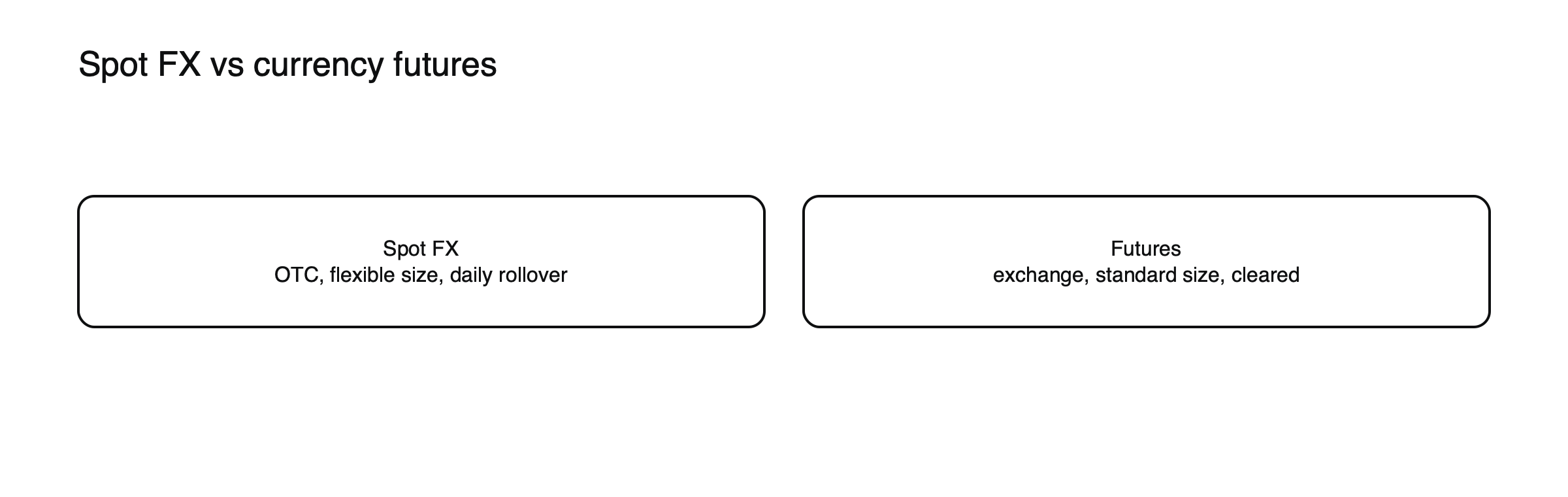
Figure: Where each trades and how.
How futures prices relate to spot
A currency future’s price is the spot rate adjusted for the interest rate difference between the two currencies until expiry. Suppose EUR/USD trades at 1.1000, with annual rates of 4.5% in dollars and 2.5% in euros. (Illustrative rates.) A contract expiring in three months would trade near 1.1000 × (1 + 0.025 ÷ 4) ÷ (1 + 0.045 ÷ 4) ≈ 1.0946, about 54 pips below spot. As expiry approaches, the gap shrinks until futures and spot converge. The difference is the same cost or income that spot traders pay or receive through daily rollover, just built into the price. See how interest rate differentials drive currency pairs.
Margin works differently
Futures margins are set by the exchange and its clearing house, not by a broker’s leverage setting. Traders post an initial margin to open a position, and gains and losses are settled every day: if the position loses, the account must cover the loss in cash, and if it gains, cash is credited. Around $3,000 of margin can control a euro contract worth roughly $137,500, which is substantial leverage even though no ratio is quoted. Spot and CFD positions, by contrast, use the broker’s margin rules and the leverage caps that apply to retail clients.
Ticks and contract values
Prices in the standard euro future move in steps called ticks. With a contract size of 125,000 euros and a minimum price step of 0.00005, each tick is worth $6.25, and a full one-pip move, 0.0001, is worth $12.50 per contract. Micro contracts at one-tenth of the size cut those values by ten. Knowing the tick value is essential for sizing, just as pip value is in spot trading.
Advantages of futures
Transparent central pricing, reduced counterparty risk through clearing, and exchange regulation. CME’s euro contract is the most traded currency future, with hundreds of thousands of contracts on busy days.
Advantages of spot
Smaller and more flexible sizes, no expiry to manage and access through most retail brokers.
Is a futures contract really safer?
Futures are often called «safer» because of clearing, but each contract is large: a 125,000-euro contract at 1.10 is worth about $137,500, so even one contract carries significant risk. Micro contracts at a tenth of the size reduce this.
Rolling a futures position
Because futures expire, a trader who wants to keep a position beyond the quarter must close the expiring contract and open the next one, usually in the week or two before expiry when trading shifts to the new contract. The price difference between the two contracts reflects the interest rate gap for the next three months. Spot traders avoid this step, but they pay or receive rollover every night instead.
Who uses which
Companies and large investors often use futures and forwards to lock in exchange rates for future payments. Hedge funds and professional traders use futures for their transparency and clearing. Retail traders mostly use spot forex or CFDs through brokers, because of smaller sizes and simpler account set-up. Some retail platforms also offer CFDs based on currency futures rather than spot prices.
What to choose
It depends on account size, holding period and whether central clearing matters to you. See what forex rollover is, how lot size changes your risk per pip and how the forex market works.
Three months held either way
Suppose a trader wants long euro exposure of about 125,000 euros for three months. Through spot or a CFD, they pay or receive rollover each night, based on the interest rate gap plus the broker’s fee. Through a future, the same interest gap is built into the lower futures price, with no nightly charge but exchange and broker commissions instead. Economically the two are close; the differences come down to fees, the broker’s markup on rollover and the convenience of contract size and expiry.
A futures trade, worked through
A trader buys one standard euro futures contract at 1.0946 and sells it a week later at 1.0996, a gain of 50 pips. (Example prices.) At $12.50 per pip, the profit is about $625, before commissions. The same exposure in spot would be 1.25 standard lots, also worth $12.50 per pip, giving the same profit before costs, but with nightly rollover instead of a price already adjusted for the interest gap. Along the way, the futures account would have been credited or debited each day as the price moved, so the profit would have arrived in daily steps rather than all at once. Commissions and exchange fees on futures are usually quite small per contract, but they are charged on both opening and closing trades, so they belong in any honest cost comparison.
Settlement, explained
A spot currency deal agreed today normally settles two business days later, when the two currencies actually change hands. Retail spot and CFD positions never settle in that way: the broker rolls them forward each night, charging or crediting the interest difference. A currency future settles at expiry, either by delivery of the currency or, more commonly for traders, by closing or rolling the position beforehand. Very few speculative positions in either market ever lead to physical delivery.
Regulation and protection
Exchange-traded futures are overseen by market regulators and cleared through a central counterparty that stands between buyers and sellers, which reduces the risk that the other side fails. Spot and CFD trading through a broker depends on that broker’s regulation, its handling of client money and the retail protections in its jurisdiction, such as leverage caps and negative balance protection. Both can be safe; the protections simply come from different places. See what negative balance protection is.
Prices you can see
Futures trade on a central order book, so everyone sees the same prices and volumes, which some traders value for transparency. Spot quotes differ slightly from broker to broker, depending on their liquidity sources and markups, though competition keeps major-pair prices very close. Many spot traders watch futures volume as a rough guide to activity, since spot volume is not reported centrally.
Common misreadings
- Treating the futures price as the market’s forecast of the future spot rate.
- Ignoring the size of a full futures contract when comparing risk with a spot position.
- Forgetting that rollover on spot and the futures discount or premium reflect the same interest gap.
Frequently asked questions
Can retail traders trade currency futures?
Yes, through brokers with access to futures exchanges. Account requirements and margin rules differ from spot forex accounts, and contracts are larger, though micro contracts make smaller positions possible.
Is the futures price a forecast of where the currency will be?
No. It mainly reflects today’s spot rate and the interest rate difference until expiry, not a prediction of future exchange rates.
This article is educational content and does not constitute financial, investment, legal or tax advice. Digital assets are volatile and you may lose the amount you invest.
Sources
- FX futures trading (spot settles in two business days; futures quarterly, centrally cleared, CFTC-regulated; micro lots in spot; $3,000 margin controls about $137,500) — Grey
- Euro FX 6E futures (125,000 euros; over 300,000 contracts on liquid days) — NexusFi
- CME Euro FX futures FAQs (trading hours Sunday 5 p.m. to Friday 4 p.m. CT; micro 12,500 euros) — NinjaTrader