
Gold vs Stocks During Market Crashes
Gold has often diversified equity losses during severe selloffs, but not on every day. Compare how gold and stocks behave when liquidity and fear spike.
Gold has historically behaved better than stocks during many severe equity selloffs, but it is not a perfect inverse of the stock market. In sustained stress, gold’s correlation with equities has often become more negative. During the first days of a liquidity panic, however, investors may sell gold alongside other assets to raise cash.
Gold and stocks respond to different economic forces
Stocks are claims on corporate earnings.
Their value depends on expected profits, growth, financing conditions and the return investors demand for taking equity risk. A recession or credit shock can therefore hit both earnings expectations and valuation multiples at the same time.
Gold has no corporate cash flow. Its price is influenced by real interest rates, the US dollar, investment demand, central-bank demand, jewelry demand and perceptions of financial or geopolitical risk.
Those different drivers are why gold can diversify stocks.
They are also why the relationship changes from one crisis to another.
The historical comparison is strongest during deep equity stress
World Gold Council research finds that gold’s correlation with equities tends to become more negative as stock-market losses become more severe.
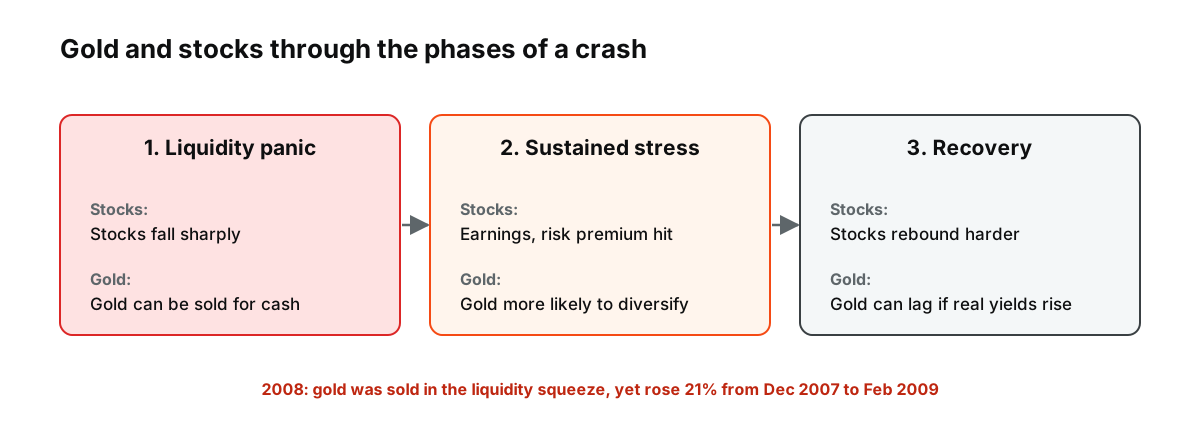
Figure: Gold’s role changes with the phase of the crash. Data point: gold rose 21% in US dollars from December 2007 to February 2009 (World Gold Council).
In its 2025 strategic-asset research, the Council notes that gold rose 21% in US dollar terms from December 2007 to February 2009 while many risk assets were falling. It also reports that gold’s performance remained positive through major equity pullbacks in 2020 and 2022.
A separate study covering the ten worst quarters for US equities found gold delivered positive returns in eight of them and outperformed equities in the other two.
That is strong historical diversification evidence. It is not a promise that gold rises every time stocks fall.
Crisis behavior side by side
| Feature | Stocks | Gold |
|---|---|---|
| Main cash-flow driver | Corporate earnings | No contractual cash flow |
| Sensitive to recession | Usually high | Indirect |
| Sensitive to real yields | Valuation effect varies by sector | Often important |
| Liquidity-panic behavior | Can fall sharply | Can be sold temporarily for cash |
| Sustained systemic stress | Earnings/risk premium often pressured | Historically more likely to diversify |
| Recovery phase | Often strong once growth expectations turn | Can lag if real yields rise and fear fades |
The table explains why the two assets can diverge over a full crisis even if they sometimes fall together over a few chaotic sessions.
2008 showed both sides of gold’s crisis behavior
The global financial crisis is often summarized as “stocks down, gold up.”
That misses the path.
Gold held up much better than equities over the broader crisis period, but it also experienced sharp pullbacks as investors raised cash and met margin calls. Highly liquid assets are sometimes sold because they can be sold, not because their long-term case has changed.
World Gold Council research notes that disorderly selling can temporarily push correlations higher across asset classes.
Once the immediate liquidity scramble fades, the deeper drivers can reassert themselves. In 2008–2009 those drivers included financial-system risk, aggressive monetary easing and falling confidence in conventional assets.
The hedge worked over the episode without working every day.
March 2020 produced another temporary liquidity distortion
The COVID panic created a similar pattern at much higher speed.
Equities fell sharply as investors tried to estimate the impact of global shutdowns. Gold initially held up, then experienced periods of selling as the scramble for US dollars and liquidity intensified.
World Gold Council analysis of the March 2020 selloff noted that gold was one of the few major liquid assets with positive year-to-date returns early in the crisis, making it a natural source of cash for investors facing losses elsewhere.
By the first quarter of 2020 as a whole, the Council’s later data show gold positive while US equities suffered a double-digit decline.
The difference between intraday hedge and crisis-period diversifier matters.
Gold can disappoint when rising real yields are the source of the shock
Not every stock selloff is driven by financial panic.
Suppose equities fall because inflation is high and real interest rates are rising quickly. Higher real yields can pressure gold at the same time they compress equity valuations.
The 2022 market environment illustrated this complication. Stocks struggled as policy tightened. Gold’s behavior was more resilient than many risk assets, but the interaction between a strong US dollar and higher real yields limited the simple safe-haven story at points during the year.
A hedge that works best against systemic stress may behave differently during a pure discount-rate shock.
Stocks usually have the stronger recovery beta
The characteristic that hurts stocks during a crash can help them during the recovery.
When recession risk falls, earnings expectations improve and risk premiums compress, equities can rebound quickly. Gold may still perform, particularly if real yields remain low, but the relative advantage can shift back toward growth assets.
World Gold Council data on post-crisis periods show gold can continue to perform through some recoveries, but its purpose in a portfolio is not to outpace equities in every bull phase.
The two assets solve different problems.
The time horizon changes the answer
Ask “did gold rise today while stocks fell?” and you may get a disappointing answer.
Ask “did gold reduce the damage across a sustained period of equity stress?” and the historical record becomes more favorable.
This is true of diversification broadly. Correlations are unstable at very short horizons, especially when leverage is unwinding and everyone wants the same cash asset.
A useful comparison should therefore specify:
- the crisis window;
- the currency in which returns are measured;
- whether the comparison uses daily, weekly or quarterly returns;
- whether the shock is recessionary, inflationary or liquidity-driven.
Without those details, “gold is a safe haven” is too vague to test.
When the usual answer can flip
Gold may fail to diversify stocks when the market shock is driven by a sharp rise in real yields and the dollar, or when investors liquidate everything for cash.
Stocks may outperform gold even in a weak economy if investors expect a rapid earnings recovery and aggressive policy support.
That is the situation where a simple crisis rule flips.
The historical evidence supports gold as a useful diversifier during many severe selloffs. It does not support treating gold as a mirror image of the equity market.