
How 24/7 Trading Is Changing Market Structure
Crypto never closes, and US stock exchanges are moving to 23-hour days. What longer hours change for liquidity, prices and risk, and what is unresolved.

24/7 trading is spreading from crypto to stocks. In 2026 the SEC approved Nasdaq’s plan to trade stocks and ETFs 23 hours a day, five days a week, and NYSE Arca targeted December 2026 for its own 23-hour schedule. Longer hours give global investors access when news breaks, but overnight sessions have thinner liquidity, wider spreads and more volatile prices.
What is changing
- Crypto: has always traded around the clock, including weekends.
- Alternative venues: overnight US stock trading began on off-exchange systems such as Blue Ocean.
- Exchanges: the SEC approved the 24X National Exchange in 2024; Nasdaq filed for 23-hour trading in December 2025 and received approval in 2026; NYSE Arca planned a similar move.
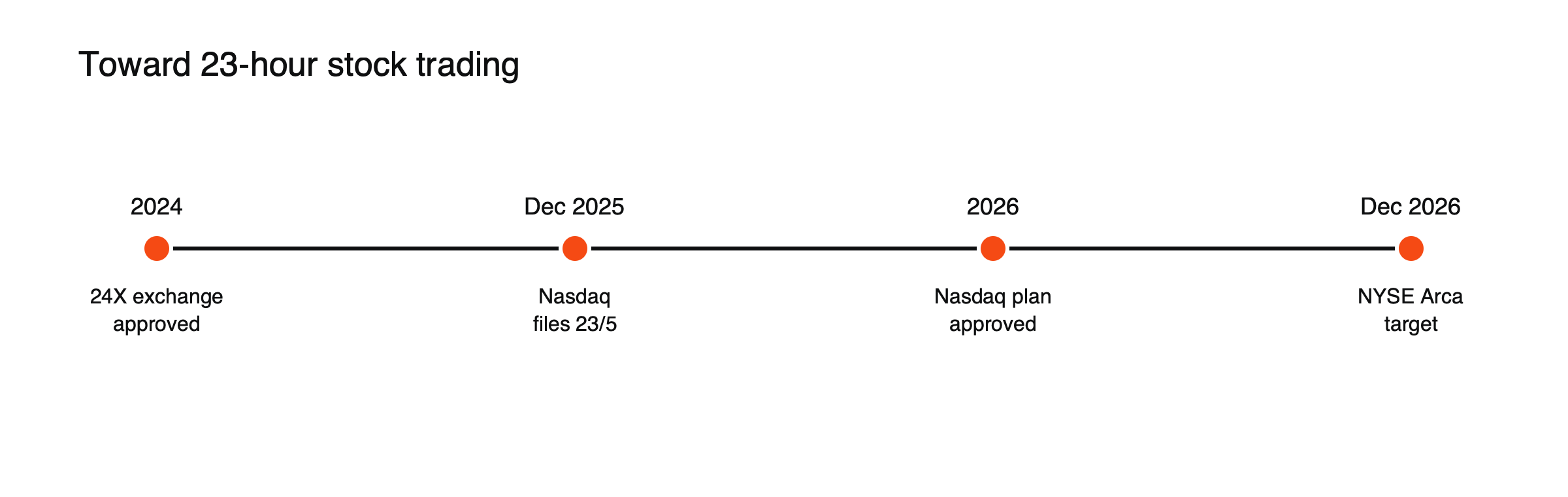
Figure: Steps toward round-the-clock stock trading.
An overnight session, illustrated
Suppose a major US company announces results at 4:30 p.m. New York time and its shares can trade overnight. (Illustrative scenario.) Investors in Tokyo and Singapore react during their business day, pushing the price up 6% in thin trading with spreads ten times wider than during regular hours. By the next morning, when US liquidity returns, the price settles at a 4% gain. Traders who bought overnight at the peak paid both the wider spread and the 2% retracement. Longer hours bring access, but liquidity still follows the main sessions.
Why it matters
Investors in Asia and Europe can trade US stocks during their own day, and reactions to overnight news no longer wait for the opening bell.
The trade-offs
Liquidity: overnight volume is concentrated in the largest stocks and ETFs; elsewhere, spreads can be wide.
Price reference: the national best bid and offer, the standard US price benchmark, is published only during regular hours.
Infrastructure: clearing, settlement and market data systems were built for a shorter day. Exchanges’ plans depend on readiness of these systems.
Investor protection: critics warn that overnight sessions could encourage impulsive trading when markets are thin.
Lessons from crypto
Crypto’s round-the-clock markets offer a preview. Weekend and overnight sessions often have thinner liquidity, and large moves frequently happen when traditional markets are closed. On October 10, 2025, a sharp crypto sell-off erased more than $19 billion in leveraged positions in a single day, showing how fast moves can spread in markets that never pause. Stock markets moving toward longer hours will need to manage similar risks.
Effects on traders and brokers
Brokers must staff risk and support teams around the clock, manage margin through the night and decide how to handle stop orders in thin overnight markets. Traders gain flexibility but face more decisions about when to trade and how to protect positions. Some may find that constant access encourages overtrading.
The global angle
A large share of interest in overnight US trading comes from investors in Asia, who want to trade US shares during their own day. Longer hours could shift some trading away from local brokers’ extended-hours products and toward US exchanges directly.
What to watch
How much volume moves overnight, how spreads behave and whether circuit breakers and halts work the same way around the clock. See how circuit breakers work , why institutional traders care about market depth and why payment for order flow is so controversial.
The timeline
- 2024: the SEC approves the 24X National Exchange.
- December 15, 2025: Nasdaq files to trade 23 hours a day, five days a week.
- 2026: the SEC approves Nasdaq’s plan and examines the shift toward 24-hour trading; NYSE Arca targets December 2026.
How CFDs fit in
Many CFD providers already offer extended or near-continuous trading on major indices and some popular shares, based on futures prices or their own pricing outside exchange hours. Spreads are typically wider overnight. As exchanges extend hours, CFD pricing outside regular hours may become more closely linked to actual exchange trading. See CFD trading costs.
Settlement and clearing
US share trades settle one business day after the trade, a cycle shortened from two days in 2024. Trades made overnight still settle on business days, which means clearing systems must handle a longer trading day without weekend or holiday operations. Moving to settlement around the clock would require major changes to banking and payment systems, which also operate on business-day schedules. See what T+1 settlement means.
Halts overnight
Circuit breakers and single-stock pauses were designed for regular hours. Regulators and exchanges must decide how these protections apply overnight, when liquidity is thinner and fewer professional participants are active. Consistent rules matter so that investors know what protections exist at any hour.
Tokenized stocks
Some crypto platforms offer tokenized versions of shares that trade around the clock, including weekends, for non-US users. Their prices can drift from the underlying shares when exchanges are closed, and holders may not have the same rights as shareholders. See what tokenized stocks are.
Who benefits most
Investors in other time zones, active traders reacting to news and platforms earning revenue from more trading hours stand to gain most. Long-term investors may notice little change.
Common misreadings
- Assuming more hours means more liquidity.
- Believing overnight prices set the next day’s open precisely.
Market makers overnight
Market makers provide much of the liquidity in modern markets, but overnight they face higher risks: less information flowing from other markets, fewer participants to hedge with and the chance of sudden news. They respond by quoting wider spreads and smaller sizes. As overnight volumes grow, competition among market makers may narrow spreads, but liquidity is likely to remain thinner than during regular hours for some time. See how market makers make money.
Managing overnight risk
Traders holding positions through extended sessions can use limit orders rather than market orders, size positions for wider price swings and check how their provider handles stops outside regular hours. Watching index futures and major news overnight helps anticipate moves.
The case against longer hours
Critics argue that overnight trading benefits brokers and high-frequency firms more than ordinary investors, who face wider spreads and more volatile prices. Investor advocates warn that constant access can encourage impulsive trading, especially through mobile apps, and that thin markets may be easier to manipulate. Some also question whether the infrastructure, from clearing to market surveillance, is ready for continuous trading.
Reference prices
The national best bid and offer, used to judge execution quality, is published only during regular hours. Without it, investors and regulators have less ability to compare prices across venues overnight. Building reliable overnight reference prices is one of the technical challenges exchanges and regulators are working through.
Effects on volatility
Some analysts expect longer hours to smooth price adjustments, because news can be absorbed as it happens rather than all at once at the open. Others expect more volatility overnight, as thinner markets react sharply to news. Early data from overnight venues suggest both can be true: large stocks may adjust smoothly, while smaller ones swing more.
Brokers and overnight access
Some retail brokers already offer overnight trading in popular US shares through alternative venues, and more are expected to follow as exchanges extend hours. Brokers must decide which shares to offer overnight, how to handle margin calls at night and whether to apply different risk limits. Clients should check how their broker treats orders placed outside regular hours, including whether they carry over to the next session.
A checklist for overnight trading
- Is the share liquid enough overnight?
- How wide is the spread compared with regular hours?
- Will a limit order protect against sudden moves?
- How will stops behave in thin markets?
- Is there news due before the regular open?
Early evidence
Early overnight volumes have been concentrated in a small number of large shares and exchange-traded funds, suggesting that overnight liquidity will build only gradually as participation grows.
Frequently asked questions
Will stock markets ever trade on weekends?
Current plans focus on 23 hours a day, five days a week; weekend trading remains largely limited to crypto.
Are overnight prices reliable?
They can be less reliable because of thinner liquidity and wider spreads, especially outside the largest stocks.
This article is educational content and does not constitute financial, investment, legal or tax advice. Digital assets are volatile and you may lose the amount you invest.
Sources
- SEC sets September test for 24-hour stock trading (Nasdaq 23/5 approved; NYSE Arca targeting December 6, 2026; NBBO only in regular hours; lower overnight liquidity) — Arkolith, 2026
- Nasdaq proposes near-24-hour trading (December 15, 2025 filing; 24X approved in 2024; thinner liquidity, wider spreads) — Hogan Lovells
- The US will have the first 23-hour exchange (24X approval; Blue Ocean; Better Markets criticism) — Bursa
- SEC to examine shift towards 24-hour US stock trading (liquidity concentrated in large stocks and ETFs) — Crowdfund Insider, July 2026
- DeFi TVL drops 39% in 2026 (October 10, 2025 crash erased more than $19 billion of leveraged positions) — Cointelegraph, June 2026