
What Does a CFD Trade Really Cost?
A CFD trade's cost adds up the spread, any commission, overnight financing and conversion fees. A worked example on a share CFD shows how 5,000 costs about 2.
CFD trading costs come from the spread, any commission, overnight financing on positions held past the daily cut-off and currency conversion. On a $15,000 share CFD held for 10 nights, these can total about $62, or 0.41% of the position, so the price must move about 62 cents per share to break even.
The cost components
- Spread: the gap between buy and sell prices, paid on entry.
- Commission: often charged on share CFDs, per trade or as a percentage.
- Overnight financing: daily charges on positions held overnight. See how overnight financing works.
- Currency conversion: if your account currency differs from the market’s.
- Other: guaranteed stop premiums, data or inactivity fees, where applicable.
Worked example: share CFD
- 100 shares at $150: position value $15,000
- Spread: $0.05 per share (example value) = $5
- Commission: 0.1% each way (example value) = $15 to open + $15 to close
- Financing: 6.5% a year for 10 nights = $15,000 × 6.5% ÷ 365 × 10 = $26.71
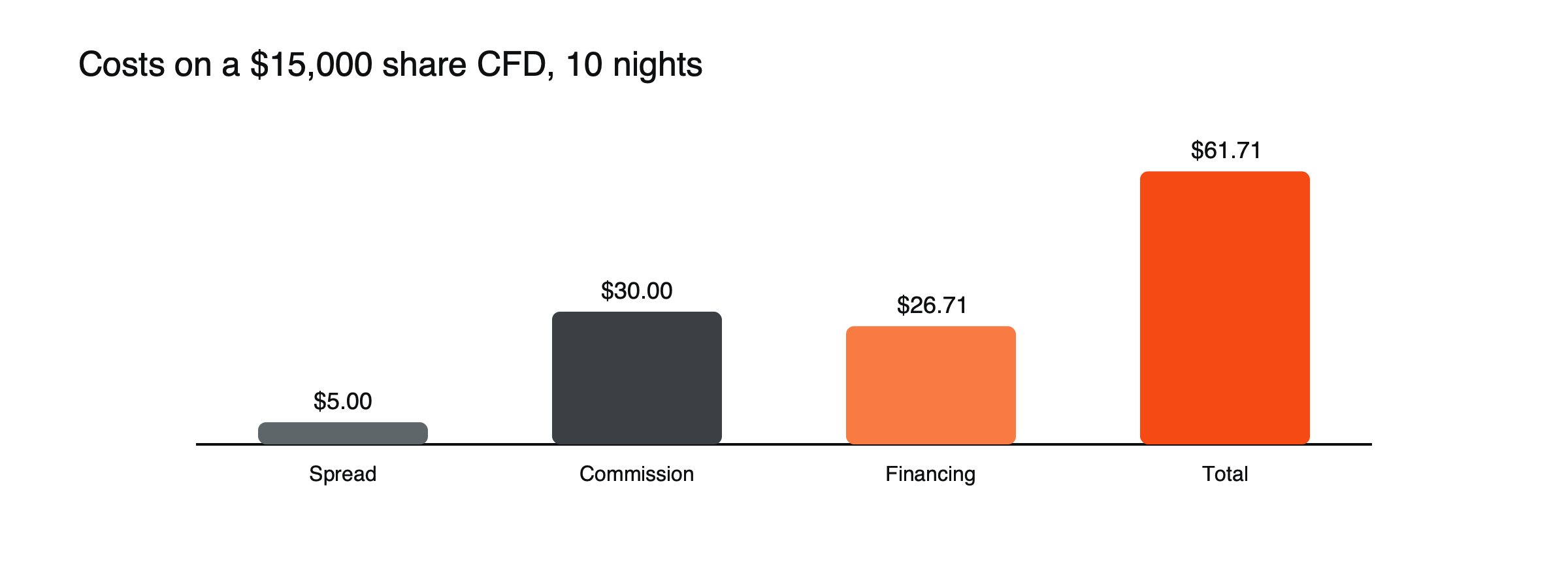
Figure: Where the costs come from (example values).
Total ≈ $61.71, or 0.41% of the position. Break-even move ≈ $0.62 per share.
Total ≈ $5 + $30 + $26.71 = $61.71, about 0.41% of the position’s value.
Worked example: a currency pair held for ten nights
You buy 1 lot of EUR/USD. The spread is 1 pip, worth about $10, and there is no commission. The provider’s long swap is −$7 a night, and you hold for 10 nights, including one Wednesday triple charge, so 10 nights of financing in total: about $70. (Example values.) Total cost ≈ $80. On the $3,666.67 margin for this position at 30:1, that is about 2.2% of the money put up.
Worked example: an index, one day or one month
An index CFD position worth $50,000, at $10 a point, with a 1-point spread: opening and closing within the day costs about $10. Held for 30 nights at a long rate of 6.5%, financing adds about $267, for a total of about $277. (Example values.) The same position is 27 times more expensive to hold for a month than for a day, which is why holding period matters as much as the spread.
How costs scale
- Holding time: financing grows every night; spread and commission do not.
- Trading frequency: spreads and commissions add up quickly for active traders.
- Leverage: costs are charged on the full position, not your margin. On $3,000 of margin, $61.71 is about 2% of the money you put up.
How to keep costs down
Compare spreads at the times you trade, check commission rates, estimate financing before holding and avoid unnecessary currency conversion. See how to calculate overnight financing and what leverage is in CFD trading.
Costs as a hurdle
Every cost is a move the market must make in your favor before you profit. In the share example, the price must rise about 0.41% to cover costs over ten nights; in the index example held for a month, about 0.55%. Writing the break-even move next to your target before opening a trade shows whether the expected gain is large enough to bother.
Costs you do not see on a fee page
- Slippage: fills at worse prices than quoted, especially in fast markets or with large orders.
- Wider spreads at certain times: around market opens, news releases and overnight in less liquid markets.
- Currency conversion: profits and losses in another currency are converted, often with a fee.
- Inactivity or data fees: charged by some providers on dormant accounts or for premium data.
Comparing providers fairly
Compare typical spreads at the hours you trade, not just the minimum advertised; commission per trade for the sizes you use; long and short financing rates for your markets; and conversion fees for your account currency. A provider with slightly wider spreads but lower financing may be cheaper for someone who holds positions for weeks.
A year of costs for an active trader
Suppose a trader with a $10,000 account opens and closes about ten one-lot EUR/USD trades a week, paying a 1-pip spread, about $10, on each round trip. Over 50 weeks, that is 500 round trips and about $5,000 in spreads, half the account, before any financing, slippage or losses. (Illustrative figures.) No single trade felt expensive, but the trading frequency turned small costs into the largest line in the account’s results. Trading less often, or only when the expected move is many times the spread, changes that picture more than any provider discount.
Costs on short positions
Short positions carry their own costs. Financing can be a small credit or, when rates are low, a charge. Short share CFDs may add a borrowing fee, which can be high for heavily shorted stocks. And shorts pay the equivalent of any dividend the share pays while the position is open, which can be a surprise for traders who hold through an ex-dividend date.
Lowering costs without trading less
Using limit orders rather than market orders, trading during the busiest hours for each market when spreads are tightest, avoiding opening positions just before major news and closing short-term trades before the daily financing cut-off all reduce costs. Checking whether a futures-based CFD is cheaper for longer holds can help as well.
Reading a provider’s cost disclosure
Regulated providers publish their charges and, in many jurisdictions, standardized documents showing the expected costs of holding a typical position. Reading these for the markets you trade, and comparing them with the costs you actually see on statements, shows whether the advertised figures match your experience.
Costs compared across asset classes
| Market | Main costs to watch |
|---|---|
| Major currency pairs | Spreads, overnight swaps |
| Share CFDs | Commission, financing, borrowing fees on shorts, dividend adjustments |
| Index CFDs | Spreads, financing on cash contracts, rollover on futures contracts |
| Commodity CFDs | Spreads, cost of carry or rollover |
| Crypto CFDs | Wide spreads, high financing rates, weekend pricing |
A pre-trade cost checklist
- What is the current spread, in money and as a percentage?
- Is there a commission, and on which side?
- How many nights will I hold, and at what rate?
- Will profits be converted from another currency?
- What move do I need just to break even?
Costs are easiest to control before a trade opens. Afterwards the spread is paid, financing accumulates and the temptation is to hold longer to earn the costs back. Deciding the maximum holding period and the cost you are willing to pay at the very start keeps those numbers from quietly growing.
Frequently asked questions
Are spreads fixed?
Some providers offer fixed spreads, but most vary with market conditions and widen when liquidity is thin. The advertised spread is often a minimum or a typical figure, not a guarantee.
Is the spread charged twice?
No. You pay the spread once per round trip: buying at the ask and later selling at the bid captures the full gap once.
Leverage, margin and cost figures in this article are example values for illustration. Actual terms depend on the provider, the instrument and the rules in your country.
This article is educational content and does not constitute financial, investment, legal or tax advice. Digital assets are volatile and you may lose the amount you invest.