
What Is an Altcoin?
An altcoin is any cryptocurrency other than bitcoin. Learn the main types of altcoins, how they differ from bitcoin, why they swing more and how to judge one.
An altcoin is any cryptocurrency other than bitcoin. The term covers everything from ether, which runs the second-largest blockchain, to stablecoins, exchange tokens and memecoins created in minutes. Altcoins differ widely in purpose and quality, but most share two traits: they move more than bitcoin, and their prices depend heavily on bitcoin’s direction.
Where the word comes from
“Altcoin” is short for “alternative coin.” Early altcoins were copies of Bitcoin’s code with small changes, such as faster block times or a different supply. Once Ethereum made it easy to create tokens on an existing blockchain, the number of assets exploded. CoinGecko’s GeckoTerminal tracker listed about 20.2 million tokens by the end of 2025, most of them created through simple launch platforms.
A short history of altcoins
The first alternatives to bitcoin appeared within a few years of its launch. Most early ones copied Bitcoin’s code and changed a few settings. Litecoin, released in October 2011, is the best-known survivor of that era, with faster blocks and a larger supply. Ethereum’s launch in 2015 changed the picture: instead of copying a blockchain, developers could create tokens on Ethereum itself, which led to the token sale boom of 2017. Later waves brought decentralized finance tokens in 2020, NFTs in 2021, and memecoins created on launch platforms in their millions from 2024. Each wave added new kinds of assets and left most of the earlier ones behind. See what happened to the 2017 ICO boom.
Coins and tokens
- Coins are the native asset of their own blockchain, used to pay fees and secure the network. Ether, SOL and ADA are examples.
- Tokens are created on top of an existing blockchain by a smart contract. Most stablecoins, governance tokens and memecoins are tokens.
Both are called altcoins in everyday use. Our guide to what a crypto token is covers the distinction in detail.
The main types of altcoins
- Platform coins pay for activity on smart-contract networks, such as ether.
- Stablecoins aim to hold a steady value, usually one US dollar.
- Governance and utility tokens give voting rights or access to a specific application; see utility tokens vs governance tokens.
- Exchange tokens are issued by trading platforms and often tied to fee discounts.
- Memecoins have no function beyond community and attention; see what meme coins are.
- NFTs are unique tokens rather than interchangeable coins, covered in what an NFT is.
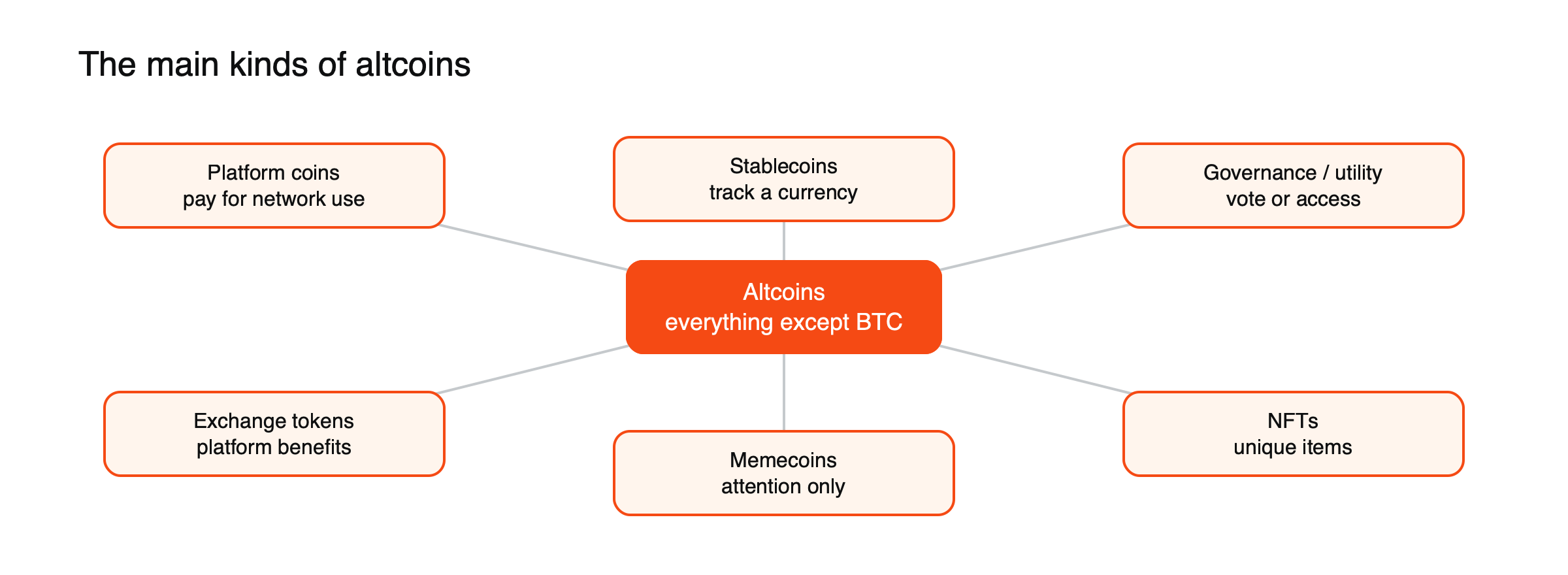
Figure: The main families of altcoins covered in this guide.
Millions of tokens, a few that matter
The number of altcoins is enormous, but value is concentrated. Of the roughly 20.2 million tokens tracked by CoinGecko’s GeckoTerminal by the end of 2025, more than half had already stopped trading. Most of the remaining market value sits in a small group: ether, the largest stablecoins, a handful of major platform coins and exchange tokens. Beyond the top few hundred, many tokens trade in tiny volumes on a single venue. “Investing in altcoins” can therefore mean very different things, from holding the second-largest network to buying a token created last week. See why most cryptocurrencies fail.
How altcoins differ from bitcoin
Bitcoin has one job, a fixed supply and the longest track record. Altcoins try to do something different: run applications, process payments faster, offer privacy or capture attention. That gives them more possible upside and many more ways to fail. Teams, foundations and early investors often hold large shares of supply and can change the rules, which is rarely true of bitcoin.
Bitcoin and altcoins compared
| Bitcoin | Large altcoins | Small altcoins | |
|---|---|---|---|
| Purpose | Scarce digital money | Platforms, payments, applications | Often a single app, idea or meme |
| Supply rules | Fixed, predictable | Vary; some issuance or burns | Often set by a small team |
| Who can change the rules | Very hard to change | Foundations, governance, developers | Frequently the founding team |
| Liquidity | Deepest in crypto | Deep on major venues | Thin, often one or two venues |
| Typical drawdowns | Large | Larger | Often near-total |
Why people buy altcoins
People hold altcoins for different reasons. Some want exposure to a specific network they expect to grow, such as a smart-contract platform used by many applications. Some use the tokens directly, paying fees, staking to earn rewards or voting on a protocol’s future. Many are looking for higher returns than bitcoin, accepting higher risk in exchange. And a large share of trading is simple speculation on attention and momentum. Knowing which of these reasons applies to a given purchase helps decide how much to hold and when to sell.
Why altcoins swing more
Most altcoins have thinner liquidity, so the same amount of buying or selling moves their price further. Much of their trading also runs through bitcoin and stablecoins, so a fall in bitcoin often triggers larger falls across altcoins. Our article on why most cryptocurrencies move together explains the mechanics. And many simply fail: more than half of the tokens CoinGecko tracked since 2021 had stopped trading by the end of 2025.
Altcoins and the market cycle
Altcoins tend to follow bitcoin with a delay. Early in a rally, money usually flows into bitcoin first; as confidence grows, it spreads to large altcoins and then to smaller, riskier ones, a phase traders call altcoin season. In sell-offs the order reverses, and the smallest coins lose liquidity first. Bitcoin’s share of total crypto market value, known as bitcoin dominance, is the usual way to track this rotation. See what altcoin season is and what bitcoin dominance is.
The risks most specific to altcoins
- Supply unlocks that release insiders’ tokens into the market. See what token unlocks are.
- Smart-contract exploits that drain an application or bridge the token depends on.
- Delistings by exchanges, which can remove most of a small token’s liquidity overnight.
- Regulatory action against a project’s team or against tokens that resemble securities.
- Concentrated holdings, where a few wallets can move the price at will.
Comparing two altcoins
Suppose two tokens each have a market cap of $500 million. (Illustrative figures.) Token A has 90% of its supply circulating, pays out part of the fees its network earns and trades on many large exchanges. Token B has 15% circulating, large unlocks due over the next year, no fee income and most of its volume on one exchange. On the headline number they look identical; on almost every measure that decides how they behave under pressure, they are not. Comparing circulating supply, fully diluted value, real usage and liquidity side by side is the quickest way to see the difference. See what tokenomics is.
How to judge an altcoin
- What is it for, and does anyone use it for that today?
- Who holds the supply, and when do insiders’ tokens unlock?
- How deep is its liquidity across reputable venues?
- Who can change the rules, and has the code been audited?
- How has it behaved in past sell-offs relative to bitcoin?
For a full checklist, read how to research a crypto asset. For the basics, start with what cryptocurrency is.
This article is educational content and does not constitute financial, investment, legal or tax advice. Digital assets are volatile and you may lose the amount you invest.
How altcoin prices are set
An altcoin’s price is set wherever it trades, on centralized exchanges through order books and on decentralized exchanges through liquidity pools. Market makers quote both sides on the larger venues and keep prices aligned between them. For smaller tokens, a single pool or exchange may effectively set the price, and a few large trades can move it sharply. New listings often bring a burst of trading and volatility, which is why the days around a listing can look very different from the token’s longer-term behavior. See how exchange listings affect token prices.
Taxes on altcoin trading
In many countries, swapping one altcoin for another counts as a sale, so moving between tokens can create taxable gains even if nothing is converted to cash. Frequent trading across many small tokens multiplies the record-keeping. See how to keep records of your crypto transactions.
Altcoins in a portfolio
Because altcoins are more volatile than bitcoin and tend to fall together in sell-offs, holding many of them diversifies less than it seems. A common approach is to keep most crypto exposure in the largest assets and treat smaller altcoins as a limited, higher-risk portion, sized so that losing it entirely would not change your plans. Rebalancing after large moves, rather than letting a winning altcoin grow to dominate a portfolio, keeps that risk in check. See why most cryptocurrencies move together.
Signs an altcoin is losing relevance
Tokens rarely fail overnight; most fade. Warning signs include falling developer activity on the project’s public code, declining usage and fees on its network, liquidity shrinking to fewer exchanges, key team members leaving, and a roadmap that keeps slipping. A price that holds up while all of these decline often reflects speculation rather than strength. Reviewing these indicators once in a while is easier than recognizing the fade after it is already priced in.
Where to buy and hold altcoins
Large altcoins are available on most major exchanges and broker apps. Smaller ones may trade only on a few exchanges or on decentralized exchanges, where you swap directly from a self-custody wallet and are responsible for checking that you have the right token contract. Fake tokens with copied names are common, so confirming the contract address on the project’s official site matters before buying anything outside the largest coins. For holding, the same custody choices apply as for bitcoin. See custodial vs non-custodial wallets.
Frequently asked questions
How many altcoins are there?
Millions, if every token ever created is counted, and the number grows every day. Only a small fraction trade with meaningful volume, and more than half of those tracked since 2021 have already stopped trading.
Is ether an altcoin?
Technically yes, since it is not bitcoin. Many people treat ether as a category of its own because of its size and its role as the base of a large ecosystem.
Are stablecoins altcoins?
By the broad definition, yes, though they behave very differently: they aim to hold a steady value rather than rise. Most market data sites include them in total crypto market value, which affects measures such as bitcoin dominance.
Do altcoins always fall more than bitcoin?
Not always, but usually in sell-offs. Thinner liquidity, higher leverage and less committed holders mean most altcoins drop further when the whole market falls, which is why position size matters even more than with bitcoin.