
When Bonds Rally but Stocks Don’t, What Is the Market Saying?
Bonds rallying while stocks fall usually signals growth fears and a flight to safety. What the pattern has meant in 2008 and 2020, and when it misleads.
When bonds rally and stocks fall together, the market is usually pricing slower growth and lower interest rates ahead. Investors sell risky assets and buy government bonds, pushing yields down. In late 2008, long-term Treasuries rose almost 15% in one month while stocks plunged. The pattern is a growth warning, not a timing signal.
What a bond rally means
Bond prices rise when yields fall. Yields fall when investors expect weaker growth, lower inflation or rate cuts, or when they want the safety of government debt. A bond rally alongside falling stocks combines both: fear about earnings and a scramble for safety.
Past examples
2008. Long-term Treasuries fell in October 2008 but rose nearly 15% the next month, and from September 2008 to February 2009 they gained almost 8% while stocks collapsed.
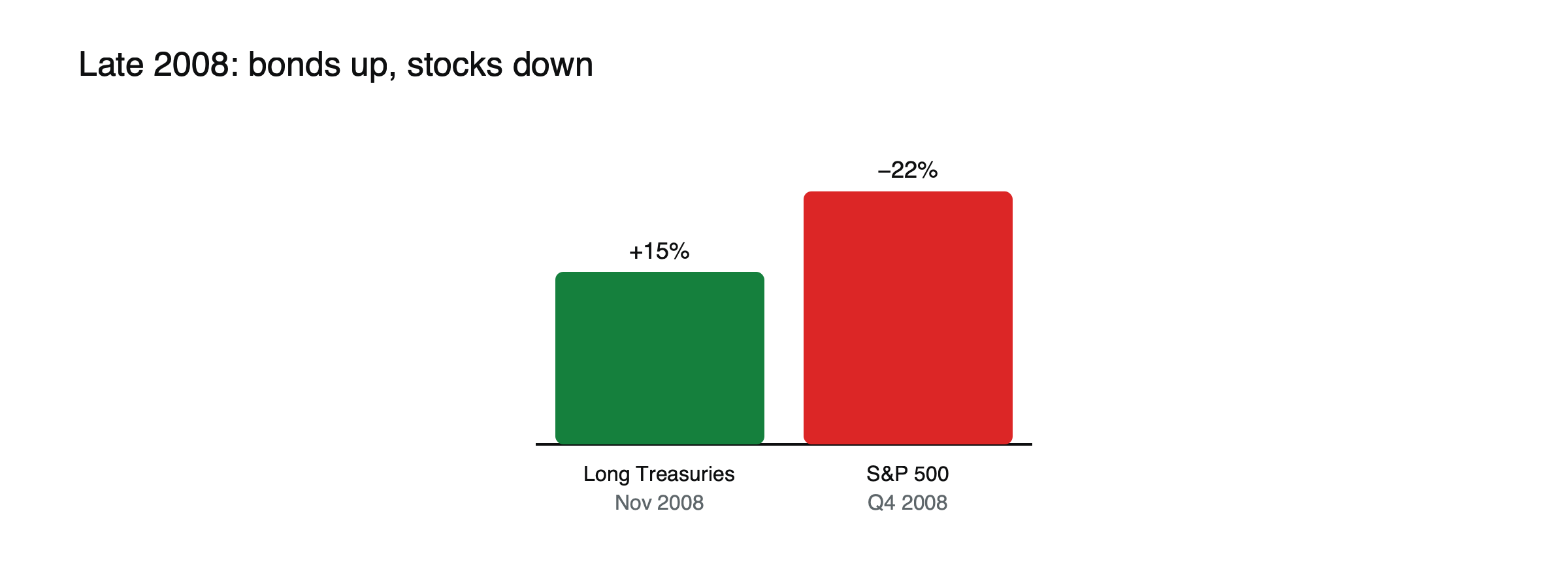
Figure: Bonds rallied as stocks fell in late 2008.
Early 2020. As the pandemic spread, Treasury yields hit repeated record lows; the 10-year entered March at 1.15%, already an all-time low.
A recession scare, illustrated
Suppose weak jobs data and falling manufacturing surveys raise fears of recession. (Illustrative scenario.) The S&P 500 falls 6% over two weeks, the 10-year Treasury yield drops from 4.3% to 3.8% and a long-Treasury fund rises about 8%. Credit spreads widen and cyclical shares fall more than defensive ones. Investors holding both shares and long Treasuries see the bond gains offset much of the equity losses, the classic pattern that makes high-quality bonds valuable diversifiers.
The message in the yield curve
When bonds rally on growth fears, short yields often fall faster than long yields as markets price rate cuts, steepening the curve from the front. That bull steepening signals expectations of central bank easing. If long yields fall more, flattening the curve, markets may be pricing a longer period of weak growth and low inflation. See what the yield curve is.
When it misleads
Liquidity panics. In mid-March 2020, a dash for cash briefly pushed Treasury yields sharply higher even as stocks fell, because investors sold everything they could.
Inflation regimes. When inflation is the main worry, bonds and stocks can fall together, as in 2022. See stocks vs bonds when inflation is falling.
Policy moves. Central bank buying can push yields down without a growth signal.
What the dollar adds
In growth scares, the dollar often strengthens as investors seek safety, and the yen and Swiss franc rise too. A bond rally with a weaker dollar may instead reflect expectations of US-specific rate cuts. Watching currencies alongside bonds helps distinguish a global flight to safety from a US-centered repricing. See why the yen often rises in market sell-offs.
How to read it
Check whether credit spreads are widening too; if so, the growth fear is broad. See what credit spreads tell equity traders. Also look at the yield curve and the dollar. For the wider relationship, read why the stock-bond correlation flipped after 2021.
What usually comes next
If the growth scare proves temporary, bond yields often rebound and stocks recover, unwinding the moves. If it marks the start of a recession, bonds may keep rallying as central banks cut rates, while stocks fall further before eventually recovering. In past cycles, the bond rally has often begun before the stock market’s worst point, which is one reason bond moves are watched as an early warning.
Using the signal
For traders, a sharp bond rally alongside falling stocks argues for caution in cyclical sectors and for checking exposure to credit-sensitive assets. For investors, it shows why holding some high-quality government bonds can cushion a portfolio in growth-driven downturns, as long as inflation is not the main threat.
Checklist
- Are credit spreads widening along with the bond rally?
- Is the yield curve steepening or flattening?
- What are the dollar and yen doing?
- Is inflation falling, or is it still the main concern?
2008 in more detail
In the fall of 2008, long-term Treasuries fell about 3.8% in October as investors sold almost everything to raise cash, then rose nearly 15% in November as the crisis deepened and the Fed signaled massive support. Over the six months from September 2008 to February 2009, they gained almost 8% while stocks collapsed. Ten-year yields fell more than 1 point as credit spreads widened, showing a classic flight to safety alongside a liquidity scramble.
Early 2020
As the pandemic spread in February and early March 2020, Treasury yields fell to record lows, with the 10-year entering March at about 1.15%, already an all-time low. Bonds rallied as stocks fell, until the dash for cash in mid-March briefly pushed yields sharply higher. The sequence showed both the diversifying power of Treasuries and its limits in an acute liquidity crisis.
Bond rallies without falling stocks
Bonds can also rally while stocks rise, when falling inflation lets central banks ease without signaling recession. In such periods, both benefit from lower rates. The distinction matters: a bond rally with rising stocks usually reflects easing inflation, while one with falling stocks usually reflects growth fears.
Gold in the same episodes
Gold often rises alongside Treasuries in growth scares, as falling real yields and fear support it. In acute liquidity panics, gold can also be sold to raise cash, as in parts of 2008 and March 2020, before recovering. See gold vs stocks in a crash.
Common misreadings
- Assuming the bond market is always right about recessions.
- Ignoring liquidity panics when relying on bonds as a hedge.
A balanced portfolio in a growth scare, illustrated
Suppose a portfolio holds 60% shares and 40% long Treasuries. (Illustrative mix.) In a growth scare where shares fall 15% and Treasury yields drop by 1 point, a long-Treasury holding with a duration of about 15 gains roughly 15%. The share portion loses 9% of the portfolio and the bond portion gains about 6%, a net fall of about 3% instead of 9%. In an inflation shock like 2022, by contrast, both portions can fall together, and the cushion disappears.
The role of central banks
Bond rallies in growth scares often anticipate central bank rate cuts. When the central bank confirms easing, the rally can extend; if it signals that inflation still requires high rates, bonds can give back gains even as stocks remain weak. Central bank communication is therefore a key part of reading the message from bonds. See how central bank meetings move markets.
Reading the signal in real time
In real time, it is hard to tell whether a bond rally reflects a passing scare or a lasting downturn. Traders look for confirmation across markets: widening credit spreads, weakening economic data, falling commodity prices and a steepening yield curve as rate cuts approach. The more of these signals align, the more seriously the bond market’s message deserves to be taken.
Long bonds versus short bonds in a scare
In growth scares, both short and long government bonds usually rally, but in different ways. Short yields fall as markets price rate cuts; long yields fall as investors seek safety and expect lower growth. Long bonds deliver bigger price gains because of their duration, while short bonds offer steadier, smaller gains. Investors using bonds as a hedge often choose longer maturities for that reason.
Depth of the Treasury market
The US Treasury market is the largest and most liquid bond market in the world, which is why it is the main destination for safety-seeking money. Its size allows huge flows to move in and out quickly, making Treasury yields one of the fastest-moving signals of changing sentiment. Other government bond markets, such as German Bunds, often play a similar role in their regions. During truly global shocks, investors often buy several of these markets at once, pushing yields down together across countries, which is itself a sign that fear is broad rather than local, and that the shock is likely to affect economies worldwide.
Frequently asked questions
Do bonds always rally when stocks fall?
No. In inflation-driven sell-offs, such as 2022, both can fall together, and in acute liquidity panics, even Treasuries can be sold briefly.
Which bonds rally most?
Long-dated government bonds, because their prices are most sensitive to falling yields.
This article is educational content and does not constitute financial, investment, legal or tax advice. Digital assets are volatile and you may lose the amount you invest.
Sources
- Revisiting the Fall of 2008 (long-term Treasuries −3.8% in October, nearly +15% in November; up almost 8% from September to February) — A Wealth of Common Sense
- March Market Madness (10-year at a record low 1.15% entering March 2020; dash for cash pushed yields up) — ETF.com
- The Only Market Indicator That Works (in 2008, 10-year yields fell more than 100 basis points as spreads widened) — Tim Melvin