
What Happens to Currencies When a Central Bank Pivots
When a central bank shifts direction, its currency often moves sharply. How pivots change rate gaps, with examples from the yen in 2022 and 2024 and the dollar.
A central bank pivot, a shift from raising rates to cutting or from easy to tight, often moves its currency more than any single decision, because it changes the expected interest rate gap with other countries. When the Bank of Japan unexpectedly loosened its bond-yield cap in December 2022, the yen had its biggest one-day surge since 1998.
Why pivots move currencies
Currencies are driven heavily by rate differentials: money flows toward currencies whose interest rates are expected to rise relative to others. A pivot changes that expected path all at once, and positions built on the old path unwind.
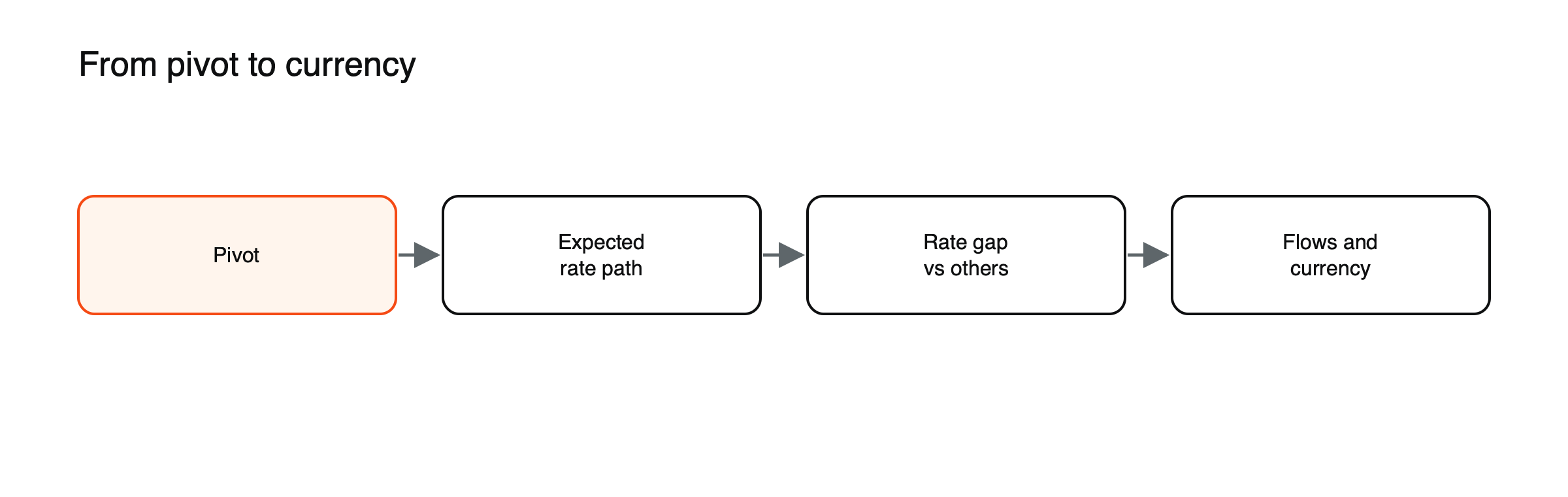
Figure: How a policy pivot reaches the currency.
A pivot and a currency pair, illustrated
Suppose US and euro-area policy rates are both expected to stay at 4% for a year, and EUR/USD trades at 1.0800. (Illustrative scenario.) The Fed then signals that it will cut by a full point over the next year, while the ECB signals no change. The expected rate gap swings 1 point in the euro’s favor, and investors move money toward euro assets. The pair might rise to 1.1100 over the following weeks, about 2.8%, as positions adjust to the new path. The decision itself may not even have happened yet; the signal is enough.
Examples
Bank of Japan, December 2022. The BoJ widened the band around its 10-year yield target from 0.25 to 0.5 percentage points. Markets read it as a hawkish turn; the yen surged and Japanese yields hit their highest since 2015. See why the Bank of Japan ended yield curve control.
Bank of Japan, July–August 2024. A rate hike to 0.25% plus US slowdown fears sent the yen up about 14% against the dollar in under a month, triggering a carry trade unwind. See why the yen rallies when global markets sell off.
The Fed in 2022. The fastest hikes in decades pushed the dollar index to a 20-year high near 114 in September 2022.
The Fed in 2024. After holding rates high through 2023, the Fed pivoted in September 2024 with a half-point cut, its first since 2020. Gold rose to a record as real yields fell, and the dollar weakened in the following weeks as markets priced further cuts.
The ECB in 2024. On June 6, 2024, the ECB cut its deposit rate from 4% to 3.75%, its first cut since 2019 and ahead of the Fed. Moving first, before the Fed, kept pressure on the euro for a time as the rate gap widened in the dollar’s favor. See how the ECB and the Fed differ in moving markets.
Why the first pivot matters most
The first change in direction typically moves currencies most, because it overturns assumptions that positions were built on. Later moves in the same direction are partly priced in and tend to have smaller effects, unless they come faster or slower than expected.
What to watch
- Changes in guidance and projections before the first move.
- Rate differentials with major trading partners.
- How crowded positions are: crowded trades unwind faster.
Limits. If other central banks pivot at the same time, the relative effect can be small. Inflation, growth and risk sentiment also matter. See how the ECB and the Fed differ in moving markets and what markets listen for in a central bank meeting.
Pivots that fail
Sometimes a central bank signals a pivot and then reverses course when inflation or growth surprises. Markets that rushed to price the new path must unwind it, often causing sharp reversals in currencies and bonds. Investors who traded the first signal aggressively can be caught out. Treating early pivot signals as probabilities rather than certainties reduces that risk.
Pivots and intervention
When a currency moves too far after a pivot, or after the lack of one, governments sometimes intervene. Japan repeatedly bought yen in 2022, 2024 and 2026 as the gap between Japanese and US rates kept the yen weak, including a record ¥15.4 trillion between July 30 and August 26, 2026, with the first joint US–Japan yen purchase since 1998. Intervention can slow a currency move but rarely reverses it unless policy changes too.
Pivots and other markets
A pivot affects more than currencies. A dovish pivot usually lowers short-term bond yields, supports shares and gold and can boost crypto; a hawkish pivot does the reverse. The size of each reaction depends on how much of the pivot was already priced. See what usually happens to gold when the Fed starts cutting.
Trading pivots with CFDs
Currency CFDs let traders position for expected pivots, but pivots often produce sharp, two-way moves around meetings and data releases. Many traders reduce leverage ahead of key decisions, wait for confirmation in guidance and projections, and size positions for large gaps. See what markets listen for in a central bank meeting.
Measuring the rate gap
Traders compare expected policy rates between two countries using futures markets or 2-year government bond yields. A widening gap in one currency’s favor tends to strengthen it; a narrowing gap tends to weaken it. Watching how the 2-year yield spread moves around a pivot shows how much the market has priced. See how interest rate differentials move currencies.
Pivots and carry trades
Carry trades borrow in low-yielding currencies to buy higher-yielding ones. A pivot that narrows the rate gap reduces the reward from these trades and can trigger rapid unwinding, as when the yen surged in 2024 after the Bank of Japan’s hike. The more crowded the carry trade, the sharper the reaction to a pivot. See what a carry trade is.
Pivots in emerging markets
Emerging market central banks often pivot earlier than major central banks, raising rates quickly when inflation rises and cutting when it falls. Their currencies can swing sharply on these moves, especially when global investors are positioned heavily in their bonds.
Common misreadings
- Trading the first hint of a pivot as a certainty.
- Ignoring what other central banks are doing.
A pivot checklist
- Has guidance changed, or only one official’s tone?
- How much of the pivot is already priced?
- Are other central banks moving the same way?
- How crowded are positions in the currency?
The 2022 surge and the turn
In 2022, as the Fed raised rates faster than most other central banks, the dollar index rose to about 114 in September, its highest in two decades. As US inflation began to ease and markets anticipated a slower pace of hikes, the dollar turned down in late 2022, well before the Fed actually stopped raising rates. The episode showed that currencies often respond to expected pivots months before they happen.
How long pivots take
The effects of a pivot on currencies can play out over weeks or months, as investors gradually adjust portfolios and as new data confirm or challenge the new path. Sharp moves in the first days are often followed by slower trends, which is why some traders wait for confirmation rather than chasing the first reaction.
Pivots and gold
Gold has often responded strongly to dovish pivots, as falling real yields and a weaker dollar reduce the cost of holding it. The Fed’s September 2024 cut sent gold to a record, showing how quickly gold can react to a change in direction.
Reading central bank language
Pivots are usually signaled through small changes in wording, such as removing a reference to further hikes or adding one about risks to growth. Traders compare statements line by line to spot these shifts.
Pivots and share markets
Shares usually welcome dovish pivots, as lower expected rates support valuations, but the reaction depends on why the central bank is pivoting. A pivot driven by falling inflation tends to lift shares; one driven by a sharp slowdown can coincide with falling earnings and weaker markets. Checking credit spreads and earnings forecasts around the pivot helps show which of the two stories the markets are really telling.
Frequently asked questions
What counts as a pivot?
A clear change in the expected direction of policy, from hiking to cutting or the reverse, usually signaled in guidance before the first move.
Do currencies always fall after a dovish pivot?
Not always. If other central banks pivot at the same time, or if the pivot reduces recession fears, the currency can hold up.
This article is educational content and does not constitute financial, investment, legal or tax advice. Digital assets are volatile and you may lose the amount you invest.
Sources
- Bank of Japan: Yield curve surprise (yen’s biggest one-day surge since 1998; JGB yields highest since 2015) — Principal Asset Management, December 2022
- Unexpected BoJ policy pivot (band doubled from 25 to 50 basis points) — MUFG, December 2022
- Carry Trade Unwind: Is It Really Over? (yen +14% against the dollar July 10 to August 5, 2024) — Schwab via Advisor Perspectives
- The Dollar Index (DXY near 114–115 in September 2022) — BIT Knowledge Hub
- Gold rises to record after Fed makes first rate cut since 2020 (half-point cut in September 2024) — BNN Bloomberg, September 2024
- ECB kicks off rate-cutting cycle (June 6, 2024: first cut since September 2019, when the deposit rate fell to −0.50%; deposit rate from 4% to 3.75%; ahead of the Fed and the Bank of England) — KBC, June 2024
- Japan spent record $96 billion in yen interventions (¥15.4 trillion between July 30 and August 26, 2026; first joint US–Japan yen purchase since 1998) — Kuwait Times / AFP, August 2026
- ECB cuts rates as expected (first deposit rate cut in five years) — Morningstar, June 2024