
What Is the Carry Trade?
The carry trade borrows in a low-interest currency to invest in a higher-yielding one, earning the gap. How it works, why it pays when calm and how it unwinds.
The carry trade is borrowing in a low-interest currency and investing in a higher-yielding one, earning the difference. For years, investors borrowed yen near 0% to buy assets abroad. It pays steadily in calm markets but can lose fast when the funding currency jumps, as in 2024, when the yen rose about 14% in under a month.
How it works
A carry trader borrows, or sells, a currency with low interest rates, such as the yen, and buys a currency or asset with higher rates, such as US dollars or bonds. The position earns the interest rate gap each day, through rollover on a spot or CFD position. See what forex rollover is. The trade makes money as long as the exchange rate does not move against it by more than the interest earned.
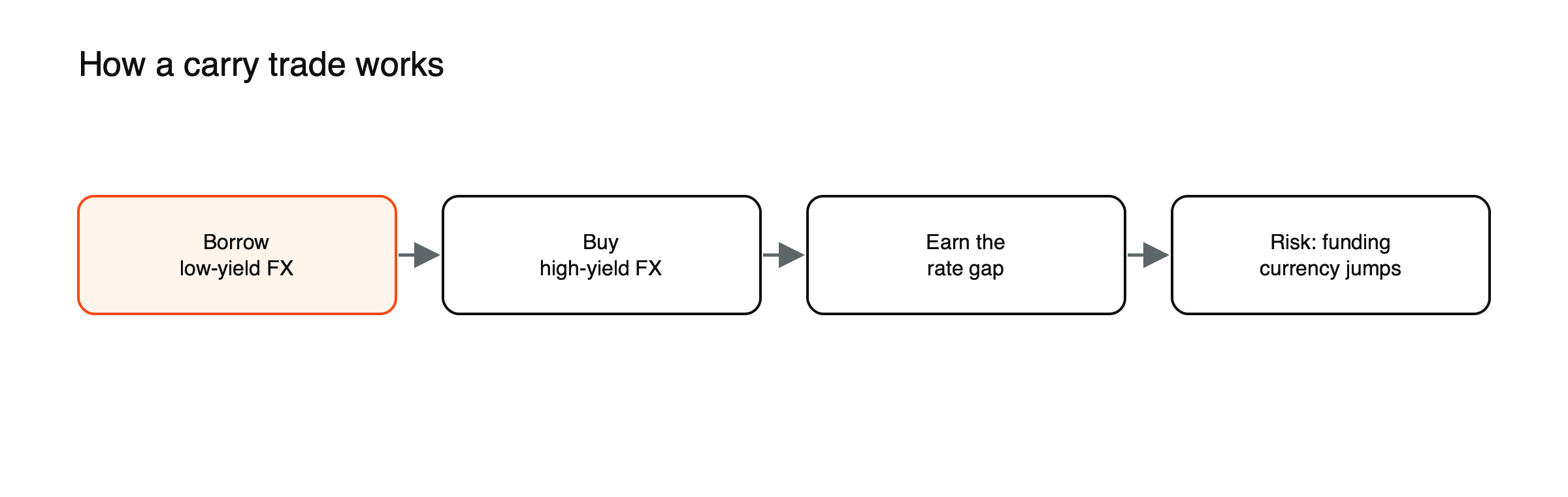
Figure: The carry trade, step by step.
A carry trade in numbers
Suppose a currency pair offers an interest rate gap of 4% a year and the broker’s fee takes 0.5%, leaving 3.5%. (Illustrative rates.) On one standard lot worth about $100,000, that is roughly $3,500 a year, or about $9.59 a night. The trade breaks even over a year if the exchange rate moves against it by about 3.5%; any larger move turns it into a loss, however much interest has accrued.
Carry and leverage
Leverage makes the income look large and the risk larger. If that $100,000 position is backed by $10,000 of equity, the $3,500 of annual carry is a 35% return on the money put up. But a 10% move against the position, which currencies can make in weeks, would wipe out the entire $10,000. Carry traders are, in effect, collecting small, regular payments in exchange for exposure to occasional large losses.
Why it works in calm markets
Rate gaps can persist for years, and steady inflows into the higher-yielding currency can push it up further, adding to returns.
Why it can unwind violently
If the low-yielding currency suddenly strengthens, losses on the exchange rate can wipe out months of interest. Many investors then close positions at once, pushing the funding currency higher still. In July 2024, the Bank of Japan raised rates to 0.25% as US growth worries rose; the unwind contributed to a 12.4% fall in Japan’s Nikkei on August 5. See what happened in the August 2024 yen carry trade unwind.
A short history of carry unwinds
Carry trades have built up and collapsed several times. In the years before the 2008 financial crisis, borrowing in yen to buy higher-yielding currencies such as the Australian and New Zealand dollars was widespread; when the crisis hit, those positions were closed in a rush, and the yen surged. After years of low rates in Japan, the pattern repeated in a more compressed form in July and August 2024. Each episode followed a long period of calm in which the trade seemed to offer easy income. See the 2024 yen carry trade unwind.
Key risks:
- Exchange rate moves larger than the interest earned.
- Crowding: everyone exits at once.
- Policy shifts that narrow the rate gap.
See carry trade mistakes that hurt in a risk-off move, how interest rate differentials drive currency pairs and what moves currency prices.
Funding and target currencies
| Role | Typical currencies | Why |
|---|---|---|
| Funding (borrowed) | Japanese yen, Swiss franc, at times the euro | Low or negative interest rates for long periods |
| Target (bought) | Australian and New Zealand dollars, US dollar, Mexican peso and other emerging market currencies | Higher interest rates |
The labels change as interest rates change. A currency that was a classic funding currency can lose that role once its central bank raises rates.
Measuring carry against risk
A simple way to compare carry trades is to divide the expected annual carry by the currency’s typical annual volatility. A trade earning 3.5% a year on a pair that usually moves about 10% a year has a ratio of 0.35; one earning 6% on a pair moving 20% a year has a lower ratio, 0.3, despite the higher income. Higher ratios mean more income for each unit of risk, though no ratio captures the risk of a sudden crash.
Carry beyond currencies
The same idea appears elsewhere. Bond investors earn carry by holding higher-yielding bonds funded at lower rates, and futures traders earn it when futures trade above spot prices, as in some crypto markets. In each case, the strategy collects a steady return for bearing a risk that shows up rarely but sharply. See what the crypto futures basis is.
Why carry should not work, but often does
Economic theory suggests carry trades should not pay on average: if one currency offers higher interest rates, it should be expected to fall by roughly the size of the rate gap, cancelling the extra income. In practice, studies over many decades have found that higher-yielding currencies have often held their value or even risen for long periods, which is why the strategy has attracted so much money. The catch is that the gains tend to arrive slowly and the losses all at once, so the average hides very uneven results.
Signs a carry trade is getting crowded
- Volatility in the target currency has been unusually low for a long time.
- Positioning data show speculators heavily short the funding currency.
- The trade is widely discussed as easy money.
- The funding currency’s central bank is starting to talk about raising rates.
None of these means a reversal is imminent, but together they suggest the trade is more vulnerable to a sudden unwind.
Choosing a carry pair
A sensible comparison starts with the rate gap the broker actually pays after its fee, not the headline central bank rates. Then come the pair’s typical volatility, how liquid it is during the hours you trade, the political and inflation risks behind the higher-yielding currency and the likely direction of both central banks. A pair with a modest but steady gap, low volatility and central banks unlikely to change course can be a better carry trade than one with a large gap that depends on an unstable economy. Checking the swap rates on two or three candidate pairs at the same broker takes minutes and often changes the answer.
Planning the exit
Because carry trades can lose quickly, the exit plan matters more than the entry. Some traders use stops based on the exchange rate, others cut positions when volatility rises above a set level, and many keep positions small enough that a sudden 10% move would be painful but survivable. Deciding these rules before the trade, rather than during a panic, is what separates a planned carry position from a hopeful one.
Frequently asked questions
Can retail traders do carry trades?
Yes. Holding a CFD or spot position in a pair with a positive rollover is a carry trade. The income depends on the broker’s swap rates, which include a fee, and the exchange-rate risk is the same as for any position.
Is a higher interest rate gap always better?
Not necessarily. Very high-yielding currencies often belong to economies with higher inflation and political risk, so the extra income may come with larger and more frequent currency falls.
This article is educational content and does not constitute financial, investment, legal or tax advice. Digital assets are volatile and you may lose the amount you invest.