
Commodities vs Stocks During Inflationary Periods
When inflation is high and rising, commodities have usually beaten stocks, as in the 1970s and 2022. The evidence, why it happens and where it misleads.
In the commodities vs stocks inflation comparison, commodities have usually won when inflation is high and rising. One study of eight such US periods since World War II found stocks averaged real returns of about −7% a year, while commodities averaged about +14%. In 2022, broad commodities rose about 18% as US stocks fell about 18%.
Why commodities tend to win
Commodity prices are a direct part of inflation: when energy, metals and food get more expensive, commodity holders benefit. Stocks suffer because input costs rise, profit margins get squeezed and higher interest rates reduce what investors pay for future earnings.
Side by side
| Commodities | Stocks | |
|---|---|---|
| High and rising inflation (post-war US average) | About +14% real a year | About −7% real a year |
| 1970–1981 | S&P GSCI up more than 700% | S&P 500 up just over 40% |
| 2022 | Broad commodities about +18% | S&P 500 about −18% |
| Long run, all periods | Lower, more volatile returns | Higher returns over time |
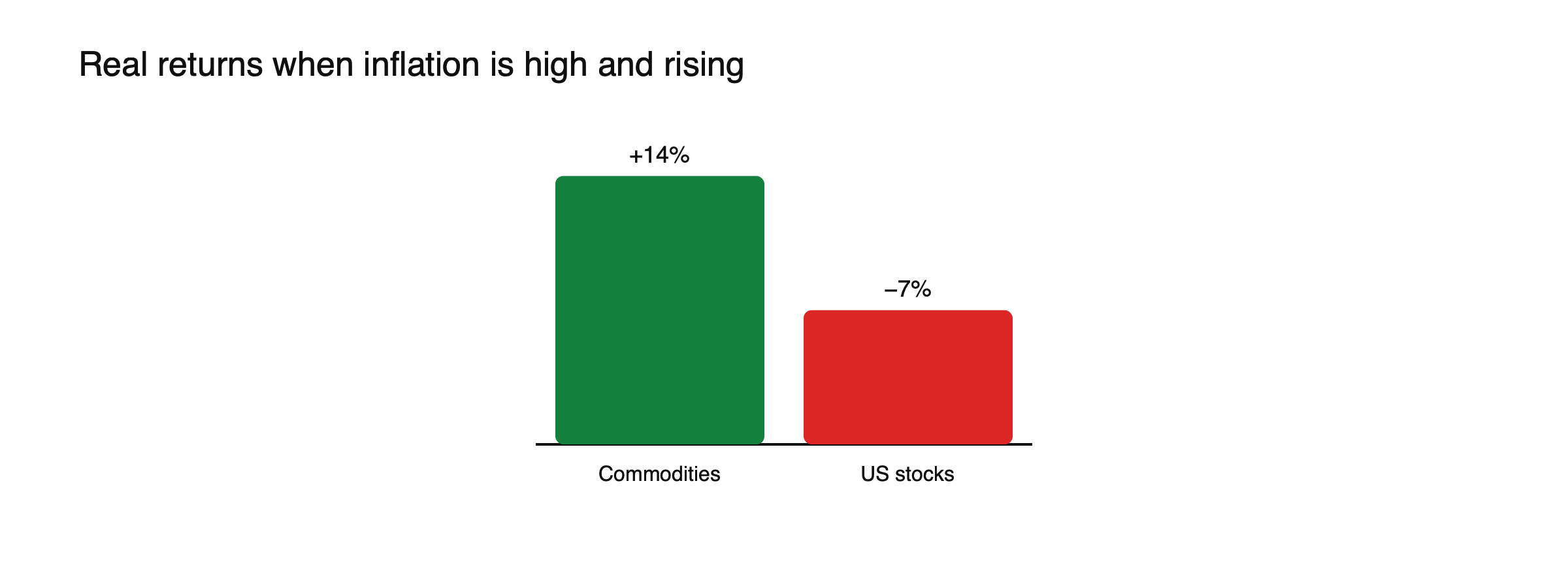
Figure: Real returns when inflation is high and rising. Source: Man Group/Duke study via Bloomberg.
The 1970s, in more detail
The 1970s brought two oil shocks, a weakening dollar and inflation that reached double digits. From 1970 to 1981, a broad commodity index rose more than 700%, while the S&P 500 rose just over 40% in price, far below inflation. Shareholders lost heavily in real terms, while holders of commodities were rewarded. The decade remains the main reference for how the two assets behave when inflation becomes entrenched. See what the 1970s taught markets about inflation.
Not all commodities behave alike
Energy has usually been the strongest inflation hedge, because it drives inflation directly. Industrial metals depend more on growth and can fall if inflation brings a recession. Agricultural commodities respond to weather and supply as well as inflation. Gold behaves differently from all of them, reacting to real yields and fear as much as to inflation. A broad commodity index blends all these behaviors.
Where the usual answer flips
Over long periods, stocks have far outperformed commodities, because companies grow and reinvest while commodities do not produce income. Commodities can also fall sharply when inflation is tamed and rates rise, as after 1980. Even sectors close to commodities, such as energy stocks, gave only slightly positive real returns in high-inflation periods in one study.
A hedge sized for a portfolio, illustrated
Suppose a portfolio holds 90% shares and 10% broad commodities in a year like 2022, with shares down 18% and commodities up 18%. (Illustrative calculation.) The portfolio falls about 14.4%, rather than 18%. In a typical year with low inflation, the commodity position might lag, reducing returns slightly. The trade-off is a modest drag in normal times for meaningful protection in inflation shocks.
How investors use the comparison
Commodities are mainly a hedge for inflation surprises, not a long-term growth engine. Timing matters: by the time inflation is obvious, commodities may already have risen a lot. See what 2022 taught investors about diversification and how energy shocks travel through inflation, rates and currencies. For the cycle view, read stocks, bonds and commodities across the rate cycle.
Which stocks hold up
Not all shares suffer equally in inflation. Energy and materials companies, which sell commodities, often do relatively well, as do firms with strong pricing power that can pass on higher costs. Companies with high debt, thin margins or profits far in the future tend to suffer most. Some investors prefer commodity-producing shares to commodities themselves, though the study cited above found energy shares gave only slight real gains in high-inflation periods. See what moves crude oil prices.
How to get commodity exposure
Investors usually access commodities through futures-based funds, commodity-producing shares or CFDs. Futures-based funds can suffer when futures curves are in contango, because rolling contracts costs money, so their returns can differ from spot prices. CFDs offer direct price exposure with leverage, but holding them for long periods incurs financing costs.
Surprise versus expected inflation
Commodities tend to do best when inflation is higher than markets expected. Inflation that is already priced in, through bond yields and commodity futures, offers less benefit, because prices have adjusted in advance. That is why commodities often jump early in an inflation shock and then stall once the shock is widely recognized, even if inflation stays high.
When commodities fall with shares
In demand-driven recessions, commodities usually fall alongside shares. In the second half of 2008, oil collapsed from above $140 a barrel to about $32 as the financial crisis crushed demand, while shares halved. Commodities protect against inflation shocks, not against recessions or financial crises. See what happened across markets in 2008.
The 2026 oil spike
After the Strait of Hormuz was effectively closed in early 2026, Brent crude rose from about $72 to around $120, before falling back to about $72 by early July as transit resumed. Investors who bought oil early in the shock gained quickly, while those who bought near the peak suffered as supply returned. The episode showed how quickly commodity hedges can reverse. See how energy shocks travel through markets.
Commodity currencies
Currencies of commodity exporters, such as the Australian and Canadian dollars and the Norwegian krone, often rise with commodity prices. Some investors use them as an alternative way to gain exposure to commodity cycles, with lower volatility than the commodities themselves but additional sensitivity to local interest rates.
Common misreadings
- Treating commodities as a hedge in every downturn.
- Buying after inflation is already widely expected.
After the inflation peak
When central banks finally brought inflation under control after 1980, with sharply higher interest rates, commodities entered a long slump while shares began a historic bull market. The reversal showed the other side of the comparison: commodities shine while inflation is rising, but can lose ground for years once it is tamed. Investors who held commodities as a permanent bet on inflation suffered badly in the decades that followed.
Other real assets
Commodities are not the only assets linked to inflation. Inflation-linked bonds adjust directly with prices; property and infrastructure can raise rents and fees over time, though they are also sensitive to interest rates. Each offers a different kind of protection, and mixing them can spread the risk of relying on a single hedge. See what real yield is.
Timing the switch
Shifting from shares toward commodities works best early in an inflation surprise, which is hard to spot in real time. Signals that investors watch include rising breakeven inflation, tightening supply in energy or metals and central banks falling behind the curve. Because those signals are imperfect, many investors hold a small permanent commodity allocation rather than trying to time the switch.
Trading inflation shocks with CFDs
Traders often express inflation views through CFDs on oil, gold, broad commodity indices and share indices with large commodity weights. Commodity CFDs can move sharply on supply news, and holding them for weeks adds financing costs. Positions sized for normal volatility can be overwhelmed when a supply shock hits, so position size and stop placement need to reflect the much wider ranges typical in inflationary periods.
A checklist
- Is inflation surprising on the upside, or already priced?
- Which commodities are driving it: energy, food or metals?
- Are central banks behind or ahead of the curve?
- Is growth holding up, or is a recession becoming likely?
The answers help decide whether commodities are likely to keep outperforming shares or whether the window has already closed.
Commodities and the dollar
Because most commodities are priced in dollars, a weaker dollar tends to lift their prices and a stronger dollar to weigh on them. In 2022, commodities rose despite a surging dollar, a sign of how powerful the supply shocks were. In more normal inflationary periods, the dollar’s direction can add to or subtract from commodity gains, so it is worth watching alongside inflation data. The two forces can reinforce each other when they point in the same direction. See how a strong dollar hits commodities, emerging markets and crypto.
Frequently asked questions
Are commodities a good long-term investment?
Over long periods they have trailed shares, because they produce no income. Their main role is as a hedge against inflation surprises.
Did gold beat stocks in inflationary periods?
Often, but not always. In 2022, gold was roughly flat while shares fell about 18%.
This article is educational content and does not constitute financial, investment, legal or tax advice. Digital assets are volatile and you may lose the amount you invest.
Sources
- Know a Good Inflation Hedge? (Man Group/Duke study: US stocks −7% real, commodities +14% real in eight high-inflation periods; energy stocks only slightly positive) — Bloomberg via Advisor Perspectives, April 2022
- High inflation not factored in (1970–1981: S&P GSCI up more than 700%, S&P 500 up just over 40%) — Vontobel
- Commodities are more than just an inflation hedge (2022: commodities +18%, US equities −18%) — WisdomTree
- Oil price swings (WTI above $140 a barrel in early July 2008, falling to $32.40 in December 2008) — Oxford Institute for Energy Studies, Oxford Energy Forum, November 2009
- OPEC+ decides on additional output increase as transit through the Strait of Hormuz resumes (Brent about $72 on July 3, down from about $120 after the conflict began) — FN News, July 2026