
How to Plan for Crypto Inheritance
Make sure your crypto can reach your heirs: list holdings, decide how access passes, leave clear instructions, get legal advice and review the plan regularly.
To plan for crypto inheritance, list what you hold and where, decide how your heirs will get access without exposing your keys today, write clear instructions they can follow, involve an estate lawyer who understands crypto and review the plan whenever your holdings change. Without a plan, self-custody crypto can be lost for good, because no bank can reset access.
Why it matters
When QuadrigaCX’s founder died in December 2018, the exchange said only he could access its cold wallets, leaving about 76,000 clients owed around CAD 215 million. Investigators later found the wallets had been emptied months earlier and that the losses came largely from fraud. The case is still a reminder of what happens when one person holds all the access.
What heirs actually face
Imagine a family a few weeks after a death. They know the person “had some bitcoin,” but not where. There may be an exchange account behind an email they cannot open, a small device in a drawer that asks for a PIN, and a sheet of words in a safe that nobody recognizes as important. Without guidance, the likely outcomes are that the funds are never found, that the device is wiped after too many wrong PIN attempts, or that a relative searches online for help and lands on a scammer offering “recovery.” Every part of a good plan is designed to prevent one of these outcomes.
Before you start
You need a full picture of your accounts and wallets, and ideally advice from a lawyer in your country. Inheritance and tax rules vary.
Building the plan
Make an inventory
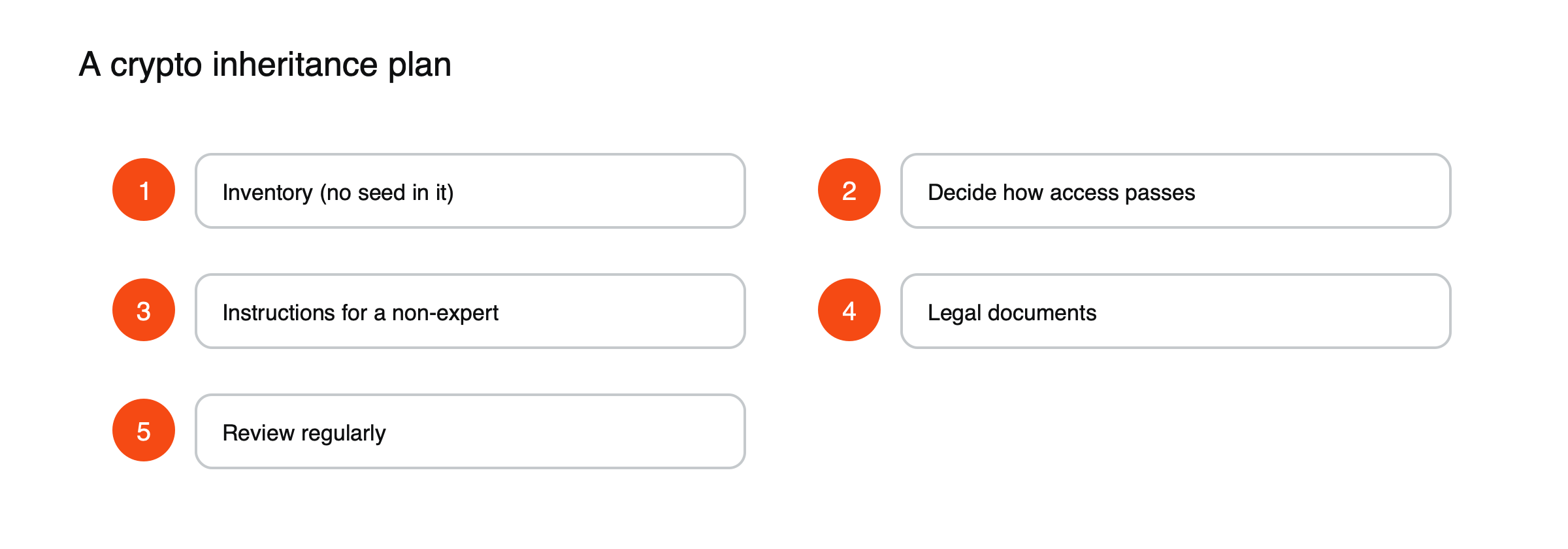
Figure: Five steps to make sure your crypto can be passed on.
List exchanges and brokers, self-custody wallets, hardware devices and which assets are where. Do not include seed phrases in this list.
Decide how access will pass
- Exchange accounts: heirs usually go through the platform’s estate process with documents such as a death certificate.
- Self-custody: options include a sealed copy of the seed phrase held with a lawyer or in a safe deposit box, or a multisig wallet where a trusted person holds one key but cannot move funds alone.
Write instructions for a non-expert
Explain where things are, what a seed phrase is, which wallet app to use and whom to ask for help. Warn heirs never to share the phrase with anyone offering “recovery.”
Put it in legal documents
Make sure your will or estate plan refers to your crypto and the instructions, without writing the seed phrase into a document that many people may see.
Review regularly
Update the plan when you change wallets, add assets or move house.
Comparing ways to pass on access
| Approach | How heirs get access | Main risk |
|---|---|---|
| Sealed seed phrase with a lawyer or in a safe deposit box | Released through the estate process | Anyone who opens it early can take the funds |
| Multisig with a trusted person or service holding a key | Heirs and the key holder sign together | More complex; every key holder must be reachable |
| Exchange or custodian account | Platform’s estate process with legal documents | Depends on the platform’s rules and solvency |
| Instructions split between people | Each holds part of the information | Losing one part can block access entirely |
There is no single right answer. Many people combine approaches, for example keeping long-term holdings in multisig and smaller amounts on an exchange with clear notes for the estate.
What a letter of instruction should cover
- Which assets exist, and on which platforms or devices.
- Where the seed phrase backups and devices are kept, without writing the words in the letter.
- Which wallet apps to use, and where to download them safely.
- Who to contact for help: a named lawyer, a technically capable relative or a professional service.
- A clear warning that nobody legitimate will ask for the seed phrase, and that anyone offering paid “recovery” should be refused.
Tax and legal points to raise with a lawyer
Inherited crypto may be subject to inheritance or estate taxes, and later sales may create capital gains, depending on where the person lived and where the heirs live. Some jurisdictions treat digital assets in specific ways in wills. A lawyer familiar with crypto can make sure the plan matches local law and that executors have the authority they need to deal with exchanges.
Choose an executor who is comfortable following written technical steps, or name a technically capable adviser to support them. The best plan still fails if the person carrying it out is overwhelmed by the first unfamiliar screen. A short meeting with them now is worth far more than detailed notes later.
Test the plan without exposing it
A plan that has never been tried may fail when it matters. One way to test it is a dry run with a small, separate wallet: give a trusted person the instructions you have written for that wallet only and see whether they can restore it and send a test transfer. Where they get stuck, the real instructions need more detail. The dry run reveals gaps in the explanation without revealing any of the secrets that protect your main holdings.
Common mistakes
- Telling no one that the crypto exists.
- Writing the seed phrase into the will.
- Leaving instructions that only an expert could follow.
- Keeping the hardware wallet PIN and the seed phrase in the same place as the device.
- Never telling the executor that a letter of instruction exists.
For safe storage, read how to back up a seed phrase safely and hot wallet vs cold wallet. For the basics, see what a crypto wallet is.
This article is educational content and does not constitute financial, investment, legal or tax advice. Digital assets are volatile and you may lose the amount you invest.
Frequently asked questions
Should I give my seed phrase to my family now?
Usually not. Anyone who holds the phrase can take the funds today, and secrets shared widely are hard to keep. Most plans keep the phrase secure while making sure the right people can reach it through the estate process when needed.
Do exchanges have a process for deceased users?
Most large exchanges do, typically requiring a death certificate, proof of the executor’s authority and identification. The process can take weeks or months, so clear records of which accounts exist make it far easier for the family.
Sources
- Quadriga’s missing money due to fraudulent trading by founder (76,000 clients owed CAD 215 million; OSC findings) — The Globe and Mail, June 2020
- Canadian cryptocurrency firm collapsed due to Ponzi scheme by late founder (OSC report) — Reuters via Investing.com, June 2020
- Seed Phrase (inheritance planning; multisig backup schemes) — LearnBitcoin