
Security Myths That Leave Crypto Accounts Exposed
Six crypto security myths, from "SMS 2FA is enough" to "a hardware wallet makes me safe," what is actually true and the habit that fixes each one.
The crypto security myths that cost people most are believing SMS codes are enough, that connecting a wallet is harmless, that a hardware wallet makes you untouchable, that support staff may need your seed phrase, that small accounts are not targeted and that stolen crypto can usually be recovered.
One theft, five beliefs
Most crypto thefts are not a single mistake. They are a chain, and each link is a belief that seemed reasonable at the time. Consider a composite case. (Illustrative scenario.)
Sam keeps a modest balance on an exchange and a larger one in a hardware wallet. Thinking the account is too small to interest anyone, Sam protects the exchange login with SMS codes. A criminal who found Sam’s number in a leaked database talks the mobile carrier into moving it to a new SIM, receives the reset code and gets into Sam’s email and exchange. Sam notices, panics and searches for help online. A «support agent» on social media offers to secure the hardware wallet if Sam confirms the recovery words through a form. Sam, who believes the hardware wallet makes those funds safe whatever happens, fills it in. Both balances are gone within the hour. A week later, a «recovery firm» promises to trace the funds for an upfront fee, and Sam pays that too.
Every step in that story depended on a myth. Each of these beliefs is understandable on its own. The danger lies in how they combine, because an attacker only needs one weak link to start and a second to finish. Breaking even one link in the chain can turn a total loss into a near miss. Fixing even just a single belief makes the next attack far more likely to fail.
The beliefs, one by one
«SMS codes are enough.» Text messages go to a phone number, and phone numbers can be moved. The FBI recorded more than $68 million in losses from SIM swaps in 2021 alone. An authenticator app, security key or passkey removes that weak point. See authenticator app vs SMS.
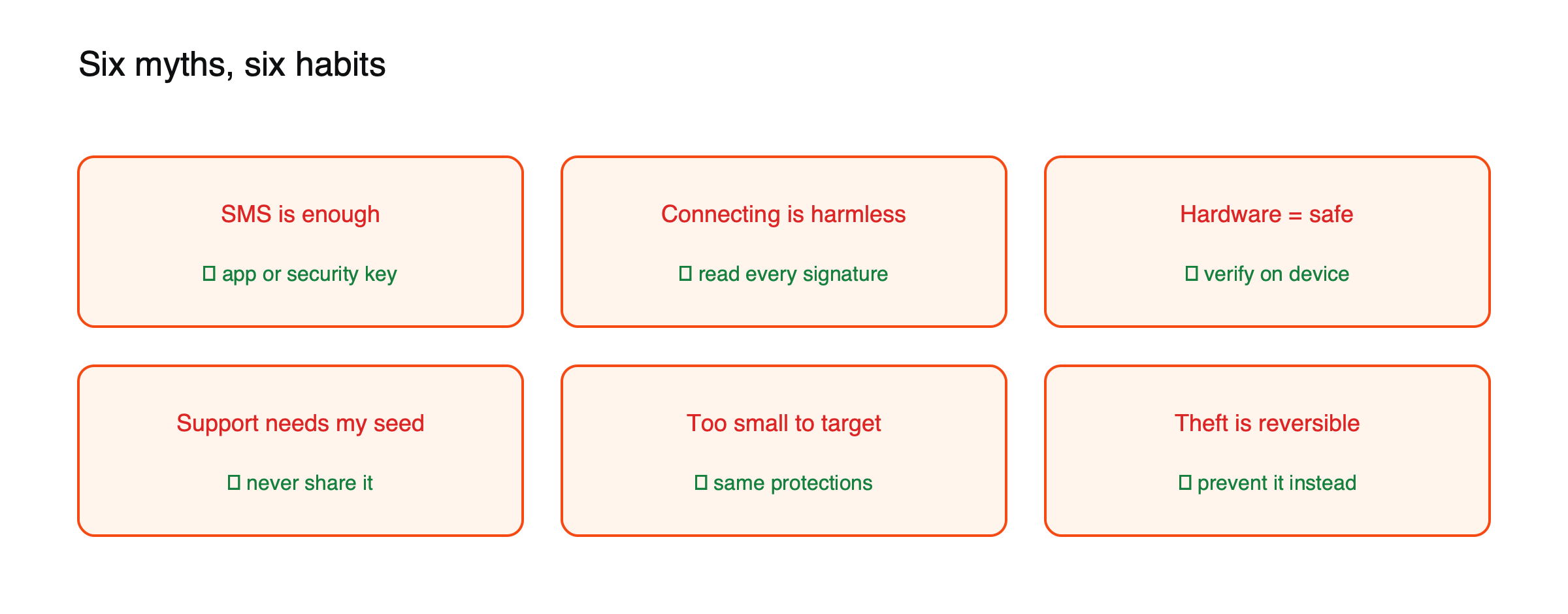
Figure: Six myths and the habit that replaces each.
«My account is too small to target.» Attacks are automated and run at enormous scale. Researchers counted about 270 million address poisoning attempts across two networks in two years. Bots do not check whether a victim is wealthy before trying. See what address poisoning is.
«Support might need my seed phrase.» No legitimate wallet maker, exchange or support team will ever ask for it. Requests for recovery words are always theft attempts, however official they look. See what a seed phrase is.
«A hardware wallet makes me untouchable.» It keeps keys away from malware, but it cannot protect a seed phrase you reveal or a malicious transaction you approve. See how to set up a hardware wallet safely.
«Connecting my wallet can’t hurt.» Connecting shares your address. The signature requests that follow can hand over your tokens. Wallet drainers took about $494 million from victims in 2024. See what a wallet drainer is.
«Stolen crypto can be recovered.» Blockchain transfers are usually final. Exchanges can sometimes freeze funds that reach them quickly, but most stolen crypto is never returned, and services promising recovery for a fee are frequently scams in their own right.
Myths that sound like good advice
Some of the most persistent myths are not careless at all. They are security tips that have been stretched too far.
«Storing my seed phrase in a password manager is safe.» Password managers are excellent for passwords, but they are online services that sync across devices. A seed phrase controls funds directly and with no reset button, so it belongs offline on paper or metal. See how to back up a seed phrase safely.
«A VPN keeps my crypto safe.» A VPN hides your internet traffic from your network provider. It does nothing against phishing sites, malicious approvals, fake apps or SIM swaps, which cause most losses.
«Antivirus software will catch it.» Security software helps against known malware, but phishing pages and drainer requests are legitimate-looking websites and transactions. Your own checks at the moment of signing matter far more.
«Changing passwords often keeps me safe.» Strong, unique passwords stored in a password manager, combined with strong two-factor authentication, beat frequent changes. Rotating weak passwords mostly creates new weak ones.
«My exchange insures my crypto.» Some exchanges hold insurance or reserves for specific events such as hacks of their own systems, but these rarely cover losses from your account being taken over, and no scheme protects against price falls. Read the platform’s terms rather than assuming.
Why myths spread
Myths survive because they are convenient. Each one removes an inconvenient step: setting up an app instead of SMS, reading a transaction before signing, keeping a separate wallet for new apps. Attackers rely on that convenience. Their best tools are not advanced code but ordinary beliefs that make people skip a check.
Testing a security tip before you follow it
A few questions separate good advice from myths. Does the tip depend on someone being able to reset or reverse things for you? In self-custody, nobody can. Does it ask you to share or type a secret anywhere? Genuine advice never does. Does it address how losses actually happen, through phishing, approvals, SIM swaps and exposed seed phrases, or only something that sounds technical? And who benefits if you follow it? Advice that comes with a product to buy or a service to pay deserves a second look.
A baseline that does not depend on any myth
- An authenticator app, security key or passkey on email and exchanges, with backup codes stored offline.
- A seed phrase on paper or metal, in two separate places, never typed anywhere but a wallet you are restoring.
- A hardware wallet for meaningful holdings, with every transaction checked on its screen.
- A separate, low-balance wallet for connecting to new apps.
- Withdrawal address whitelists on exchanges.
- Suspicion of any unexpected message about your accounts, however urgent.
If something does go wrong, follow how to recover a hacked crypto account, and for daily habits, read how to build a crypto security routine.
This article is educational content and does not constitute financial, investment, legal or tax advice. Digital assets are volatile and you may lose the amount you invest.
Sources
- Criminals Increasing SIM Swap Schemes (more than $68 million in 2021) — FBI IC3
- Cryptocurrency wallet drainers stole $494 million in 2024 — BleepingComputer
- Address Poisoning (270 million attempts, July 2022–June 2024) — Spark Research
- What is a seed phrase? (no legitimate wallet, exchange or support agent will ask for it) — btc.network