
Crypto vs Stocks: How the Risks Differ
A stock is a claim on a company's profits; most crypto is not. Compare crypto vs stocks on volatility, protections, trading hours and what can go to zero.

The core difference in crypto vs stocks is what you own. A share is a legal claim on a company’s assets and future profits, so its value can be tied to earnings. Most cryptocurrencies give no claim on any cash flow, so their price rests on demand for the network and on other buyers, and it swings far more.
What you actually own
A shareholder owns part of a business. The company reports revenue and profit, may pay dividends and must publish audited financial statements. If it is sold or wound up, shareholders receive whatever is left after creditors are paid.
A coin holder usually owns a unit of a network’s native asset. It may be needed to pay fees, to stake or to vote on changes to the protocol, but it rarely entitles the holder to a share of anything. Some tokens are designed to look like shares, with fees passed to holders, and those can attract securities regulation precisely because of that resemblance.
How each one is valued
Stock analysts start from cash. A company’s value can be estimated from the profits it is expected to earn in future, discounted back to today, and compared with peers through ratios such as price to earnings. Those tools are imperfect, but they give prices an anchor: when a stock trades far above what its earnings could ever justify, the gap eventually matters.
Crypto has no equivalent anchor. Analysts look at network activity, fees, the number of active users and supply schedules, but none of these produces a value that prices are pulled back toward. That is the deeper reason crypto swings more: there is less to stop a price from overshooting in either direction. See what gives cryptocurrency its value.
The risks side by side
| Stocks | Crypto | |
|---|---|---|
| What you own | A share of a company | A unit of a network’s asset |
| Cash flows | Earnings, often dividends | Usually none |
| Price swings | Large in single stocks, smaller in indices | Large even in the biggest coins |
| 2022 decline | S&P 500 fell 25.4% (January 3 to October 12) | Bitcoin fell about 77% (November 2021 to November 2022) |
| Trading hours | Exchange hours on weekdays | 24 hours a day, every day |
| Disclosure | Audited reports required by law | Varies; often voluntary |
| Broker-failure protection | SIPC covers securities at member brokers in the US | SIPC does not cover crypto that is not a registered security |
| Can it go to zero? | A single company can; a broad index rarely | Many tokens have; most stop trading entirely |
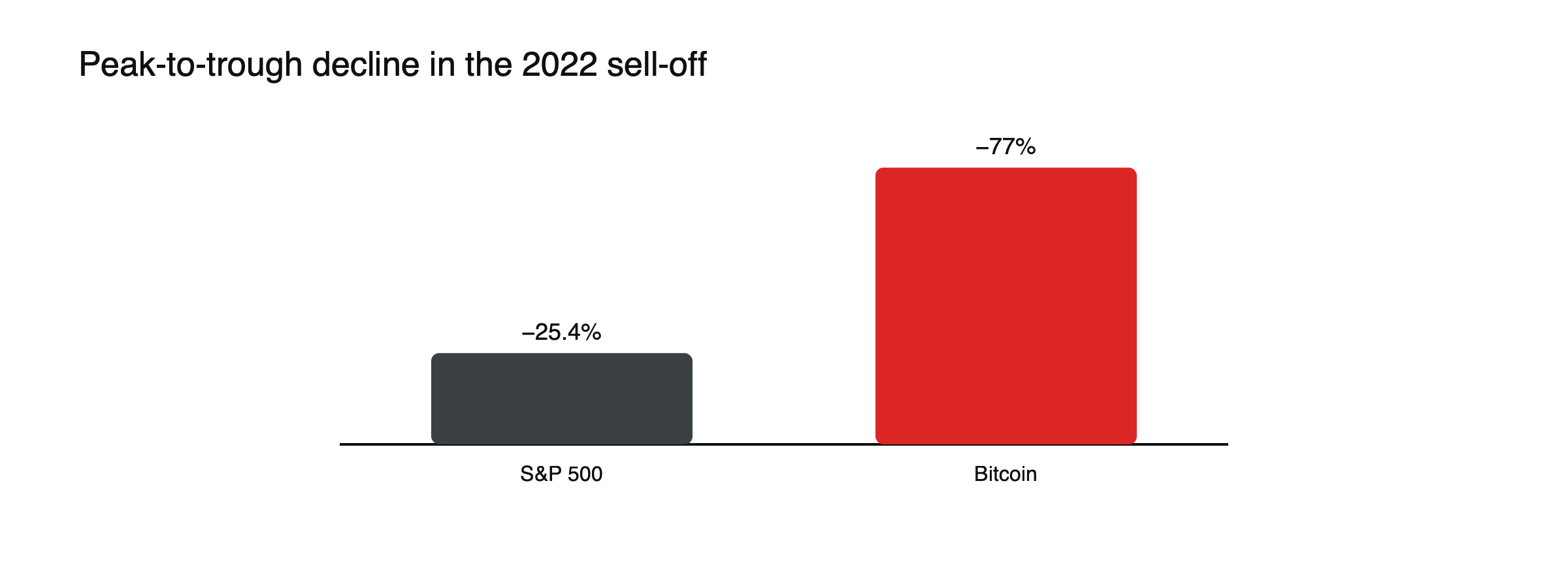
Figure: The 2022 declines side by side. S&P 500: January 3 to October 12, 2022 (AP); bitcoin: November 2021 peak to November 2022 low (Coin Metrics data via Analytics Insight).
What a crypto allocation does to a portfolio
Using the 2022 declines from the table gives a rough sense of how much a crypto slice changes a portfolio’s worst year. Suppose a portfolio held only an S&P 500 fund and bitcoin, and both fell by the amounts above. (Illustrative: the two declines did not happen over exactly the same dates.)
| Split | Approximate fall |
|---|---|
| 100% stocks | −25.4% |
| 90% stocks, 10% bitcoin | −30.6% |
| 50% stocks, 50% bitcoin | −51.2% |
A tenth of the portfolio in bitcoin added about five percentage points to the loss in a bad year. Half in bitcoin roughly doubled it. The point is not that crypto should or should not be held, but that its share of a portfolio, more than the choice of coin, decides how much a bad year hurts.
Protections are thinner in crypto
When a US brokerage fails, the Securities Investor Protection Corporation (SIPC) replaces missing securities and cash up to set limits. SIPC states that it does not protect crypto assets that are not securities, even when they are held at a member firm. Crypto held on an exchange depends on that exchange’s solvency and safeguards, as customers of FTX found in 2022. Neither SIPC nor any other scheme protects against a fall in market value.
Disclosure is the other gap. A listed company must publish audited results on a fixed schedule and report material events promptly, and misleading investors can bring legal penalties. Crypto projects face no single equivalent obligation: some publish detailed reports and on-chain data, while others say little about who controls the treasury, how many tokens insiders hold or when those tokens unlock. Checking that information yourself, through project documents and on-chain data, is part of the real cost of holding crypto rather than an optional extra. See what happened in the FTX collapse.
They often move together
Crypto is sometimes described as an alternative to stocks, but in practice the two have often fallen together, especially when interest rates rise and investors cut risk across the board. In 2022, both stocks and crypto fell sharply as the Federal Reserve raised rates. Holding both can diversify less than expected in exactly the conditions that matter most. See why crypto and tech stocks often trade as the same risk asset.
When a single stock is riskier than bitcoin
«Stocks are safer» holds for diversified indices, not for every stock. A small company with heavy debt can be as risky as a large cryptocurrency, and shares in companies tied to crypto often move as much as crypto itself. In the other direction, crypto’s round-the-clock trading means a holder can react to weekend news, while stock investors wait for Monday’s open, which can bring a gap.
Three ways to hold crypto exposure
The line between the two markets has blurred. Investors can now reach crypto in at least three ways, each with a different mix of risks:
- Holding coins directly, on an exchange or in your own wallet. You own the asset itself and can move or use it, but you are responsible for custody, and exchange failures or lost keys can wipe out holdings.
- Spot crypto ETFs, such as the US spot bitcoin funds that began trading on January 11, 2024. They sit in an ordinary brokerage account alongside shares and follow the price of the coin, with an annual fee and no need to manage keys. You cannot withdraw or spend the coins, and you can only trade during exchange hours. See bitcoin CFD vs bitcoin ETF.
- Crypto-related stocks, such as exchanges, miners and companies holding bitcoin on their balance sheets. These are shares with the usual protections, but their prices often move even more than crypto itself, because company-specific risks are added on top.
Which route fits depends on whether you want the asset, the price exposure or a business tied to the industry, and on how much operational responsibility you are willing to take on.
Which risk fits which purpose
Stocks suit long-term saving where returns are expected to come from company growth and dividends. Crypto suits people who want exposure to a specific network or a non-traditional asset and who can tolerate large drawdowns. Position size matters more than the choice itself: a holding that can halve without forcing a sale is one you can keep through normal crypto volatility.
For crypto’s own up and down phases, see crypto bull and bear markets, and for the basics, what cryptocurrency is.
This article is educational content and does not constitute financial, investment, legal or tax advice. Digital assets are volatile and you may lose the amount you invest.
Sources
- Barely a bear: Wall Street exits what turned out to be a fairly tame bear market (S&P 500 −25.4%, Jan 3 – Oct 12, 2022) — Associated Press via Barchart, June 2023
- Bitcoin Down 47% From $126,000 Peak (2022 drawdown of about 77%) — Analytics Insight, February 2026
- What SIPC Protects (digital assets that are not securities are not protected) — SIPC