
How Energy Shocks Travel Through Inflation, Rates and Currencies
An energy price spike lifts inflation, pushes central banks to tighten and moves currencies. How the 1973 and 2022 shocks spread through markets.
An energy shock spreads through markets in stages: higher fuel and gas prices lift inflation, central banks tighten or delay cuts, spending falls and energy importers’ currencies weaken. The 1973 oil embargo quadrupled oil prices within months; in 2022, European gas reached about ten times normal and the euro fell below parity.
The chain of effects
- Prices: fuel, heating and electricity costs rise directly; higher transport and production costs follow.
- Inflation: headline inflation jumps first; the risk is that it spreads into wages and other prices.
- Interest rates: central banks face a dilemma: tighten to fight inflation or ease to support growth.
- Growth: households and companies have less to spend on everything else.
- Currencies: energy importers’ currencies tend to weaken, which makes imported energy even more expensive.
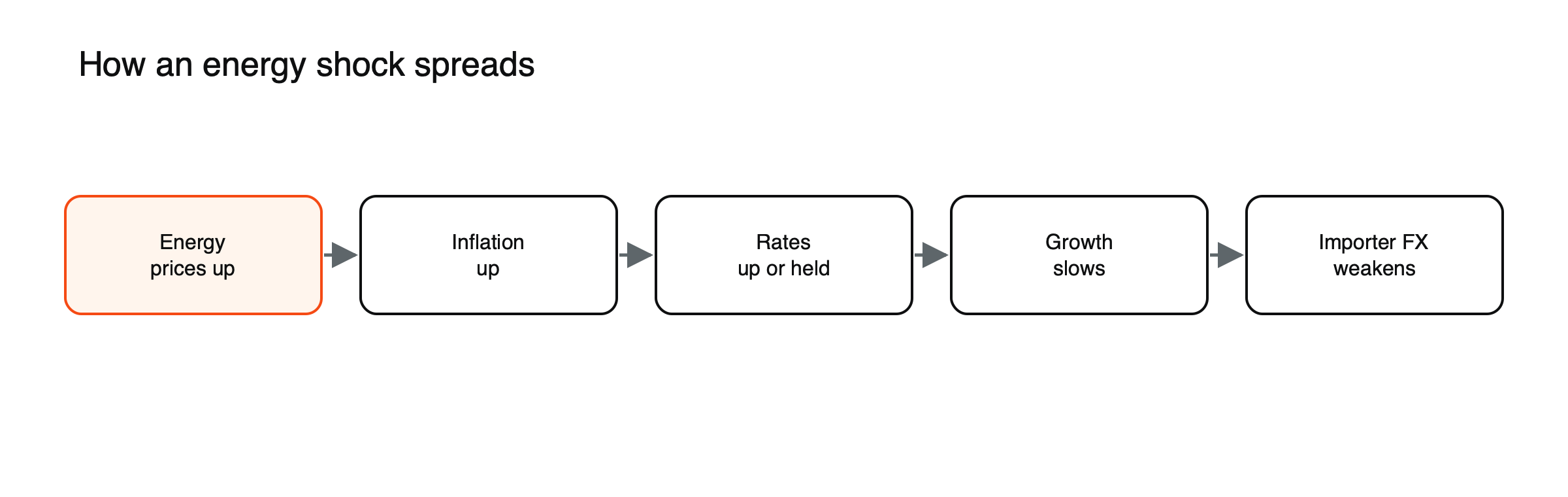
Figure: How an energy shock moves through the economy and markets.
1973 vs 2022
1973. After the October 1973 embargo, inflation rose sharply in the US and most large European economies, followed by falling output. European growth fell by as much as 8 percentage points between 1973 and 1975.
2022. After Russia’s invasion of Ukraine, European gas prices reached as much as $500 per barrel of oil equivalent, roughly ten times normal, and the euro fell below parity with the dollar. Economies were less dependent on oil than in the 1970s, which softened the hit, but more dependent on gas.
2026: the Strait of Hormuz
After military action in the Middle East on February 28, 2026, transit through the Strait of Hormuz, which normally carries about a fifth of global crude and fuel flows, was effectively closed. Brent crude rose from about $72 to around $120, and oil and fuel prices climbed sharply through the first quarter. As transit resumed and OPEC+ raised output, Brent fell back to about $72 by early July. The episode showed how quickly an energy shock can spread through inflation expectations, bond yields and currencies, and how quickly it can reverse when supply returns.
What markets do
Energy stocks and commodity exporters tend to gain; energy-intensive industries, consumer stocks and bonds tend to suffer. In 2022, commodities rose while both stocks and bonds fell. See commodities vs stocks during inflationary periods.
The inflation pass-through, illustrated
Suppose energy makes up about 8% of a country’s consumer price index and energy prices jump 40%. (Illustrative figures.) Headline inflation rises by roughly 3 percentage points from energy alone, before any second-round effects through transport, food and wages. If energy prices then fall back, headline inflation drops just as mechanically, which is why central banks focus on whether the shock spreads into core inflation.
The central bank dilemma
An energy shock raises inflation and weakens growth at the same time. Tightening fights inflation but deepens the slowdown; easing supports growth but risks letting inflation take hold. Central banks usually look through short, sharp shocks if inflation expectations stay anchored, but respond firmly if the shock lasts or starts to lift wages and expectations, as many did in 2022.
Limits. Each shock is different: supply cuts, demand surges and policy responses vary. Central bank credibility and energy efficiency now dampen effects compared with the 1970s. See when oil prices become a problem for the whole economy and stocks, bonds and commodities across the rate cycle.
Currencies of importers and exporters
Energy importers, such as the euro area, Japan and many emerging markets, pay more for imports when energy prices rise, worsening their trade balances and weakening their currencies. Exporters such as Norway and Canada often see their currencies strengthen. In 2022, the euro and yen fell sharply while commodity currencies held up better, a pattern traders watch whenever oil or gas prices surge. See what moves crude oil prices.
Bond markets
Energy shocks can push bond yields up through higher inflation expectations, or down if markets expect the shock to cause a recession and rate cuts. The first effect tends to dominate early, the second later. Watching breakeven inflation alongside real yields shows which is winning. See how to read breakeven inflation.
Sectors within stock markets
Energy producers, refiners and some materials companies tend to gain, while airlines, chemicals, transport and consumer discretionary companies suffer. Utilities can go either way, depending on how their prices are regulated. Indices with heavy energy weights, such as the FTSE 100, often outperform during energy spikes.
A watchlist for energy shocks
- Oil and gas prices and futures curves
- Breakeven inflation and central bank guidance
- Currencies of major energy importers and exporters
- Energy-sector and energy-intensive share prices
- Shipping and supply news from key routes
The 1979 shock
The Iranian revolution in 1979 disrupted oil supply and roughly doubled oil prices, adding to inflation that was already high after the 1973 shock. In the United States, inflation rose into double digits, and the Federal Reserve responded with very high interest rates, contributing to recessions in the early 1980s. The episode showed how a second energy shock on top of high inflation can force much harsher policy than the first.
Gas shocks and oil shocks
Oil shocks spread globally through fuel prices, because oil is traded worldwide. Gas shocks can be more regional, because gas often moves by pipeline or specialized ships, so prices can diverge sharply between regions. In 2022, European gas prices soared far above US levels, hitting European industry and households much harder than American ones.
Policy responses
Governments respond to energy shocks with strategic reserve releases, subsidies, price caps and efforts to boost supply. In 2022, the United States released large amounts of oil from its strategic reserve, and European governments spent heavily to shield households from gas and electricity prices. Such measures soften the shock but can add to government borrowing.
Shocks that fade
Not every spike lasts. When supply returns or demand falls, energy prices can drop as quickly as they rose, as Brent did in mid-2026 after the Strait of Hormuz reopened. Markets that priced a lasting shock then reverse, often sharply.
Common misreadings
- Assuming every energy spike leads to 1970s-style inflation.
- Ignoring how currencies amplify or soften the shock.
The view from households and companies
For households, higher energy bills reduce money left for other spending, hitting retailers, restaurants and travel companies. For companies, higher energy costs squeeze margins unless they can pass them on to customers. Energy-intensive industries, such as chemicals, steel and fertilizers, may cut output altogether if prices stay high, as some European producers did in 2022. These effects take months to show up in economic data but often move share prices immediately.
Trading energy shocks
Traders often respond to energy shocks across several markets at once: long oil or gas CFDs, short shares of energy-intensive companies, long commodity currencies and short importers’ currencies. Such positions can move very fast, and shocks can reverse abruptly when supply returns, so sizing for large swings and planning exits in advance matter. See when oil prices become a problem for the whole economy.
Inflation expectations
The biggest long-term risk from an energy shock is that it raises inflation expectations, leading workers and companies to build higher inflation into wages and prices. Central banks watch long-term inflation expectations closely for this reason, and markets watch central banks’ responses.
Energy and the dollar
Because oil is priced in dollars, an energy shock combined with a strong dollar hits importers twice, raising both the dollar price of energy and the local cost of each dollar. That combination squeezed many economies in 2022.
Lessons from repeated shocks
Each energy shock has taught markets something: in 1973 and 1979, that energy can trigger lasting inflation; in 2022, that gas dependence can be as dangerous as oil dependence; in 2026, that shocks can reverse quickly when supply returns. Traders who remember these patterns are less likely to assume that the current shock will follow the script of the last one. Each episode has its own mix of supply, demand, policy and currency effects, and reading that mix early is what matters most.
Frequently asked questions
Do energy shocks always cause recessions?
No. Many have slowed growth without causing recessions, especially when they were short-lived or offset by policy support.
Why are today’s economies less sensitive to oil?
They use less oil per unit of output than in the 1970s, though some, especially in Europe, became more dependent on natural gas.
This article is educational content and does not constitute financial, investment, legal or tax advice. Digital assets are volatile and you may lose the amount you invest.
Sources
- The stagflation beast is stirring (1973 embargo quadrupled oil prices in a few months; European growth fell by up to 8 points in 1973–1975) — Bank of Finland Bulletin, April 2022
- Does the private sector expect stagflation in the euro area? (inflation rise then output fall after 1973; lower oil dependence, higher gas dependence today) — European Central Bank, 2022
- Europe’s energy crisis (gas up to $500 per barrel of oil equivalent, about ten times normal) — Foreign Policy, August 2022
- Austerity follows Russian audacity (euro fell below parity with the dollar) — PKF Malta, September 2022
- Crude oil and petroleum product prices increased sharply in 1Q26 (after military action in the Middle East on February 28 and the de facto closure of the Strait of Hormuz) — US EIA, April 2026
- OPEC+ decides on additional output increase as transit through the Strait of Hormuz resumes (Brent about $72 on July 3, down from about $120 after the conflict began) — FN News, July 2026