
How Ethereum’s Fee Burn Affects ETH Supply
Part of every Ethereum fee is burned, so ETH supply falls when activity is high and grows when it is low. See what drives the burn and why supply rose in 2024.
The ETH burn removes the base fee of every Ethereum transaction from circulation, so ether’s supply depends on two flows: new ether paid to validators and ether burned in fees. When network demand is high, the burn can exceed issuance and supply falls. When demand for block space is low, as it was after 2024, issuance wins and supply grows.
Where the burn comes from
Since the London upgrade on August 5, 2021, every Ethereum fee has two parts. The base fee, set by the network according to demand, is destroyed. The priority fee, a tip, goes to the validator. Before London, the whole fee went to miners.
The burn is the reason ether has no fixed supply schedule. Issuance to validators adds coins every block; the burn removes coins every block. The net result changes with how busy the network is.
How the base fee is set
The base fee is not chosen by users or validators. The protocol sets it for each block based on how full the previous block was. Every block has a target size, half of its maximum. If a block is fuller than the target, the base fee for the next block rises, by up to 12.5%; if it is emptier, the fee falls by up to the same amount. A run of busy blocks can therefore raise the base fee quickly, and a quiet spell lowers it just as fast. Because the base fee is burned rather than paid to validators, they have no reason to stuff blocks to push it up.
The burn in one transaction
A simple ether transfer uses 21,000 units of gas. If the base fee is 20 gwei per unit and the sender adds a tip of 1 gwei, the transaction burns 0.00042 ETH and pays 0.000021 ETH to the validator. (Example values; a gwei is one billionth of an ether.) Multiply that across every transaction in a day, many of them far more complex than a transfer, and the burn can reach thousands of ether on busy days or fall to very little on quiet ones.
What decides how much is burned
Demand for main-chain block space
The single biggest factor is how much people want to transact on Ethereum’s main chain. Busy periods, such as token launches or market turmoil, push the base fee up and burn more ether. Quiet periods do the reverse.
Where activity happens
Activity that moves to layer 2 networks pays its own fees there. Those networks pay Ethereum only for posting their data, which costs far less than the transactions they bundle. A growing share of users on layer 2s therefore means a smaller burn on the main chain, even if total Ethereum-based activity is rising. See what Ethereum rollups are.
Blob fees
Since the Dencun upgrade on March 13, 2024, rollups post data in “blobs” with a separate fee market. Blob fees are burned too, but when blob space is plentiful they are tiny.
Issuance on the other side
Issuance to validators rises with the total amount of ether staked. The Merge cut issuance by about 87% compared with proof of work, which is why the burn suddenly mattered so much more to the overall supply.
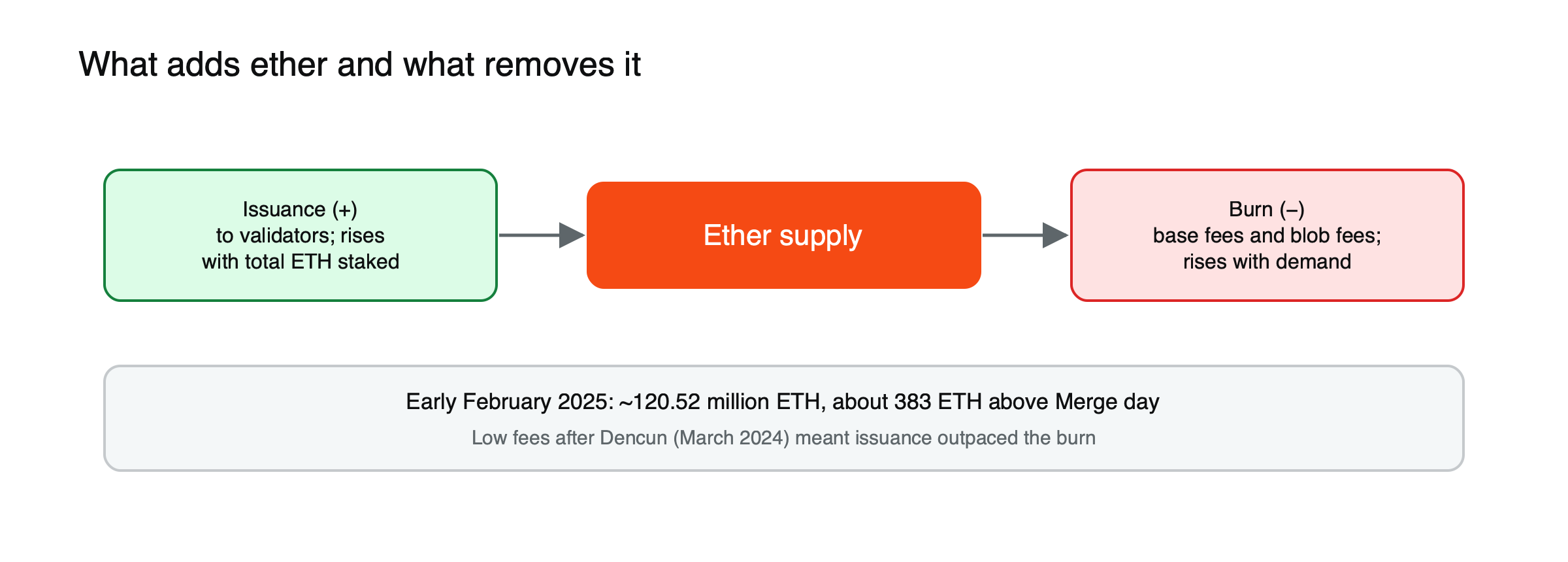
Figure: The two flows that set ether’s supply. Supply figure: ultrasound.money data via The Block, February 2025.
What happened after Dencun
Dencun made rollup data much cheaper, and base fees on Ethereum fell sharply as activity spread to layer 2 networks. Less fee was burned, issuance stayed, and supply started to grow. By early February 2025, ether supply stood at about 120.52 million ETH, roughly 383 ETH more than on the day of the Merge, according to ultrasound.money data reported by The Block. The deflation seen in 2022 and 2023 had been fully reversed.
The “ultrasound money” idea, that ether would steadily shrink, depended on high main-chain fees. Cheaper layer 2 activity is good for users but weakens that link.
Does the burn matter for price? A burn reduces supply only when it is larger than issuance, and even then the effect is small next to changes in demand. It is better read as a gauge of how much people are paying to use Ethereum’s base layer. A rising burn means block space is in demand; a falling burn means activity is cheaper or has moved elsewhere.
Burning vs buybacks
The burn is sometimes compared to a company buying back its own shares, since both reduce the number of units outstanding. The difference is who decides. A buyback is a choice made by a company’s management with its own cash, and it can be stopped at any time. Ethereum’s burn is automatic and written into the protocol: it happens with every transaction, scales with usage and requires no one’s decision. It also benefits no particular party; the burned ether is simply removed, which slightly increases every remaining holder’s share of the total supply.
A short history of ether’s supply
The London upgrade of August 2021 introduced the burn while Ethereum still used mining, so issuance remained high and supply kept growing. After the Merge in September 2022 cut issuance, busy periods in 2022 and 2023 burned more than was issued and the total supply fell. Dencun in March 2024 then made layer 2 data cheap, main-chain fees dropped, the burn shrank and supply resumed growing. By early February 2025 it had returned to slightly above its level on the day of the Merge.
What to watch
- Net supply change over weeks, not days, on public supply trackers.
- Base fee and blob fee levels, which show demand for each kind of block space.
- Layer 2 activity and how much those networks pay Ethereum for data.
- Total ether staked, which sets the issuance side.
For the fee mechanics themselves, read what a gas limit is. For how rollups post data, see what data availability means, and for the network as a whole, what Ethereum is.
This article is educational content and does not constitute financial, investment, legal or tax advice. Digital assets are volatile and you may lose the amount you invest.
Frequently asked questions
Is burned ether gone forever?
Yes. The base fee is not sent to any address; it is simply not credited to anyone, so it leaves circulation permanently. It is not stored somewhere that could later be recovered.
Where can I see how much ether is being burned?
Public dashboards track issuance, the burn and net supply change in real time, using data taken directly from the blockchain. Comparing several weeks of data gives a better picture than any single day, because the burn swings sharply with activity.
Sources
- Is Ethereum deflationary? (EIP-1559 activated August 5, 2021; issuance cut ~87% at the Merge) — growthepie
- Ethereum’s Dencun upgrade is making ETH inflationary again (Dencun March 13, 2024) — The Block, May 2024
- Ethereum supply climbs to pre-Merge levels (120,521,523 ETH; ~383 ETH above Merge day) — The Block, February 2025
- Ethereum hits longest inflationary period since Merge (base fees down ~90% after Dencun) — Blockworks, 2024
- Gas and fees (base fee adjusts by up to 12.5% per block; base fee burned, priority fee to validator) — ethereum.org Developer Docs