
How Market Makers Make Money
Market makers quote buy and sell prices and earn the spread, plus rebates and order-flow deals, while managing inventory risk. How the business works.
Market makers earn money mainly by buying at the bid and selling at the ask, capturing the spread between the two many thousands of times a day. They also earn exchange rebates and, in the US, pay brokers for retail orders that are cheaper to fill. Their main risk is holding inventory when prices move against them.
The spread
A market maker might quote a stock at $100.00 bid and $100.02 ask. If it buys from one customer and sells to another, it earns two cents per share. Spreads are tiny per trade but add up across huge volumes. Since US prices moved to decimals in 2000, quoted spreads have narrowed sharply; most share volume now trades in stocks quoted at less than 1.5 cents.
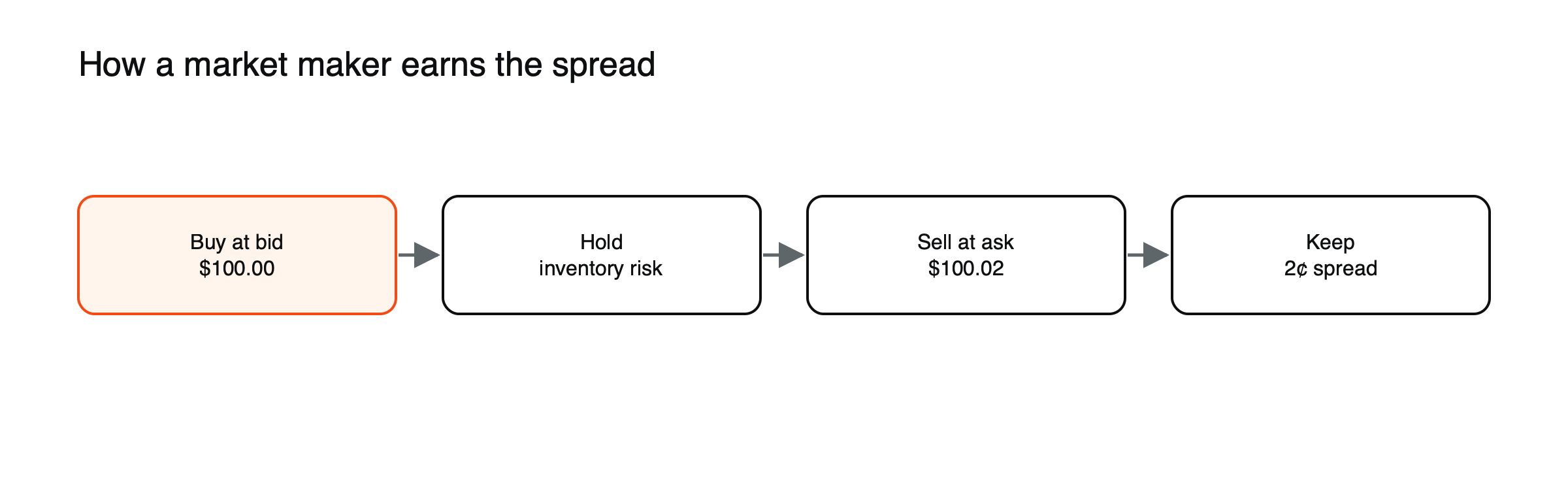
Figure: The basic market-making loop.
A trading day, illustrated
Suppose a market maker quotes a stock at $100.00 bid and $100.02 ask and trades 1 million shares in a day, half bought and half sold. (Illustrative scenario.) If it captures the full spread on matched trades, it earns about $10,000. But if prices fall 10 cents while it holds 50,000 shares it has not yet sold, it loses $5,000 on that inventory, wiping out half the day’s spread income. Market making profits depend on capturing many small spreads while keeping inventory losses small.
Retail order flow
Retail orders tend to be small and less informed about short-term moves, so they are cheaper to fill. US wholesalers such as Citadel Securities and Virtu pay brokers for this flow. See why payment for order flow is so controversial.
Inventory risk
A market maker that has bought shares it has not yet sold loses money if prices fall. Firms hedge quickly and adjust quotes to manage this risk, which is why spreads widen in volatile markets.
Exchange rebates
Many exchanges pay rebates to firms that post orders adding liquidity and charge fees to those who take liquidity, a model called maker-taker. Market makers earn rebates by posting quotes that others trade against. The rebates are tiny per share but meaningful at scale, and they influence where orders are routed.
Market makers in currencies and CFDs
In currency and CFD markets, the provider often acts as market maker itself, quoting prices to clients and taking the other side of their trades. It may hedge part of its exposure with banks or other liquidity providers and keep the rest. This creates a potential conflict of interest, because the provider can profit when clients lose, which is why regulators require conflict management, best execution policies and transparent pricing. See why best execution matters for traders.
Where risks come from
- Informed traders: someone who knows more than the market maker can trade against it profitably.
- Fast markets: prices can move before quotes are updated.
- Technology failures: automated quoting can go wrong quickly.
Why it matters to traders
Market makers provide much of the liquidity traders rely on. When they pull back in stress, spreads widen and depth thins. See why institutional traders care about market depth and how high-frequency trading changed spreads.
Adverse selection
A market maker’s biggest risk is trading with someone who knows more. If a large investor is selling because of information the market maker lacks, the market maker buys just before prices fall. To protect themselves, market makers widen spreads when they suspect informed trading, around news releases or in thinly traded markets. Retail order flow is attractive precisely because it is less likely to be informed about short-term moves.
Options market making
Options market makers quote prices on thousands of contracts and hedge their exposure by trading the underlying shares or futures. Busy options markets, such as those on major indices and large technology stocks, can generate large hedging flows that influence the underlying prices, especially around expiry dates.
How market makers lost money
Market making is not risk-free. In August 2012, a software error at Knight Capital, then a major US market maker, produced a pre-tax loss of about $440 million in a single morning. Large price gaps, such as currency moves after unexpected central bank decisions, have also caused heavy losses for providers. See how high-frequency trading changed spreads.
Internalization
Wholesale market makers often fill retail orders from their own inventory, a practice called internalization, rather than sending them to exchanges. They may offer prices slightly better than the best public quote, known as price improvement, while capturing part of the spread. Critics argue that internalization keeps a large share of trading away from public exchanges, where it would contribute to price discovery. See how ETFs changed price discovery.
Market makers in crypto
Professional market makers provide much of the liquidity on crypto exchanges, often under agreements with the exchange or token issuers. Their quotes keep spreads narrow in normal conditions, but they can withdraw quickly in sharp moves, as on October 10, 2025, when more than $19 billion of leveraged positions were liquidated. Arrangements between token projects and market makers are not always disclosed, which can make it hard to judge how much liquidity is organic.
Rules for market makers
Registered market makers on exchanges may have obligations to quote continuously within certain spreads in return for benefits such as lower fees. Wholesalers and CFD providers are subject to best execution rules and conduct supervision, though requirements vary by country.
Common misreadings
- Assuming a tight quote is available for any size.
- Believing market makers profit from predicting direction.
Volatility and quotes, illustrated
Suppose a market maker normally quotes a currency pair 0.6 pips wide for up to 5 million units. (Illustrative scenario.) Minutes before a major central bank decision, it may widen to 3 pips and cut size to 1 million units, because it cannot predict the move and does not want to be caught holding a large position. After the decision, once prices settle, spreads tighten again. Traders who place orders in the minutes around the announcement pay for that uncertainty through wider spreads and possible slippage.
Reading a quote
A quote shows the best bid and ask and, often, the size available at each. A narrow spread with small size means the price may move as larger orders arrive. A wide spread signals uncertainty or thin liquidity. Watching how spreads and sizes change through the day helps traders choose when to trade and which order types to use.
The economics of a market making firm
Large market making firms run thousands of strategies across many markets, earning small amounts on enormous volumes. Their costs include technology, data, exchange fees, payments for order flow and capital to hold inventory. Profits tend to rise in moderately volatile markets, when spreads widen but liquidity remains, and fall in very calm markets, when spreads are tight, or in chaotic ones, when losses on inventory can mount. Diversifying across asset classes and venues smooths these swings.
What it means for retail traders
For retail traders, market makers are the reason most trades fill instantly at quoted prices. The cost is the spread, which is usually small in liquid markets but can widen sharply around news, at the open and in less liquid instruments. Choosing liquid markets, trading during active hours and using limit orders when spreads widen help keep these costs down.
A checklist
- How wide is the spread now compared with usual?
- Is major news due?
- Is the instrument liquid enough for my order size?
Spread versus commission
A trader paying no commission but a 2-pip spread on a currency pair pays about $20 per standard lot; another paying a $7 commission with a 0.5-pip spread pays about $12. (Illustrative figures.) Comparing total costs rather than headline commissions shows which pricing model is cheaper for a particular trading style. Frequent traders in liquid pairs often favor tight spreads with commissions, while occasional traders may prefer simpler spread-only pricing. Checking a provider’s typical spreads at the times you trade gives a much more realistic comparison than published minimums.
Frequently asked questions
Do market makers trade against me?
They take the other side of trades to provide liquidity; whether that creates a conflict depends on the market and how the firm manages its risk.
Why do spreads widen around news?
Because market makers face more uncertainty and a higher risk of trading with better-informed participants.
This article is educational content and does not constitute financial, investment, legal or tax advice. Digital assets are volatile and you may lose the amount you invest.
Sources
- SEC Chair Gensler speaks on modernizing equity markets (decimalization in 2000; 74% of share volume quoted at less than 1.5 cents; 45% of volume in dark venues) — CLS Blue Sky Blog, October 2024
- Payment for Order Flow (market maker earns the spread; retail orders) — LearnSignal
- Robinhood gets boost as Congress declines ban (Citadel Securities and Virtu as market makers) — Fox Business
- Knight Capital Group provides update regarding August 1st disruption (erroneous orders in NYSE-listed securities; realized pre-tax loss of approximately $440 million) — Knight Capital Form 8-K, SEC, August 2, 2012
- DeFi TVL drops 39% in 2026 (October 10, 2025 crash erased more than $19 billion of leveraged positions) — Cointelegraph, June 2026