
What Is Impermanent Loss and How Do You Calculate It?
Impermanent loss is how much less a liquidity provider ends up with than if they had held. The formula, a worked ETH example and a table by price change.
Impermanent loss is the gap between what a liquidity provider holds after prices move and what they would have had by just holding. In a two-token pool it depends only on the price change: IL = 2 × √r ÷ (1 + r) − 1, where r is the new price divided by the old. A doubling costs about 5.7%.
Why it happens
In a constant product pool, traders buy the token that is getting more expensive and sell the one getting cheaper. The pool ends up holding less of the winner and more of the loser. Holding the tokens outside the pool avoids that rebalancing. The loss is called «impermanent» because it disappears if prices return to where they started; if you withdraw while prices are apart, it becomes permanent. See what a liquidity pool is for how pools work.
The formula
IL = 2 × √r ÷ (1 + r) − 1
where r = new price ÷ price when you deposited, measured for one token in terms of the other. Fees earned are ignored here; they offset part or all of the loss.
Worked example
You deposit 1 ETH and 3,000 USDC when ETH is worth $3,000. Your position is worth $6,000. ETH then doubles to $6,000, so r = 2.
If you had held: 1 ETH × $6,000 + 3,000 USDC = $9,000.
In the pool: the pool keeps ETH × USDC constant (1 × 3,000 = 3,000) and rebalances to the new price. You now hold about 0.7071 ETH and 4,242.64 USDC, worth 0.7071 × $6,000 + $4,242.64 ≈ $8,485.28.
Impermanent loss: $8,485.28 ÷ $9,000 − 1 ≈ −5.72%, or about $514.72. The formula gives the same answer: 2 × √2 ÷ 3 − 1 ≈ −5.72%.
You still made money compared with your $6,000 deposit. You just made less than by holding.
Impermanent loss by price change
| Price change of one token vs the other | Impermanent loss |
|---|---|
| Down 50% (r = 0.5) | −5.72% |
| Up 25% (r = 1.25) | −0.62% |
| Up 50% (r = 1.5) | −2.02% |
| Up 100% (r = 2) | −5.72% |
| Up 200% (r = 3) | −13.40% |
| Up 400% (r = 5) | −25.46% |
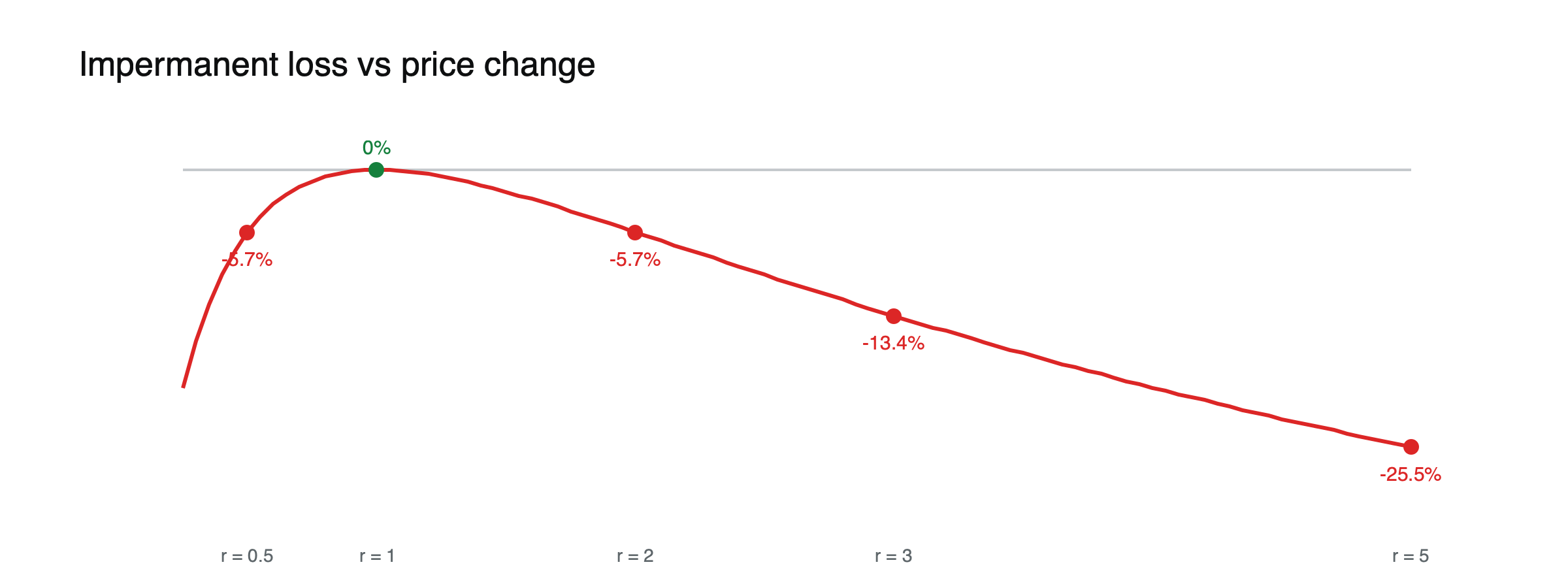
Figure: Impermanent loss grows with the size of the price move, in either direction (fees ignored).
The loss is the same whether the price goes up or down by the same ratio, and it grows quickly with large moves.
Adding fees back: how long to break even
Fees are what make providing liquidity worthwhile, so the real question is whether they cover the loss. Take the example above: a $6,000 position and an impermanent loss of about $514.72 if ETH doubles. Suppose the pool charges a 0.30% fee and trades a volume equal to 20% of its total value each day. (Illustrative figures.) The pool then earns about 0.06% of its value per day in fees, roughly $3.60 a day on your $6,000 share. It would take about 143 days of fees to cover the loss from a doubling. If the price move happened in a week, the fees earned in that week would cover only a small part of it.
Real results vary with volume, fee tier and how the pool’s value changes, but the logic holds: busy pools with modest price swings tend to reward liquidity providers; quiet pools with large swings tend to punish them.
What changes the result
- Fees: trading fees earned can outweigh the loss in busy pools.
- Concentrated liquidity: choosing a narrow price range earns more fees but makes impermanent loss larger when prices move.
- Correlated pairs: pools of assets that move together, such as two stablecoins, see little impermanent loss.
- Token rewards paid by protocols can offset the loss, but their value can fall.
Concentrated liquidity: higher fees, sharper losses
In concentrated-liquidity pools, you choose a price range for your funds. Inside that range your capital earns far more fees than it would in a full-range pool, because it handles more of the trading. The trade-off is that impermanent loss is magnified within the range, and if the price leaves the range entirely, your position is converted into just one of the two tokens, the one that has fallen in relative value, and stops earning fees until the price returns or you reposition. Active management, and the costs that come with it, become part of the strategy.
When does it become permanent?
The loss is «impermanent» only in the sense that it disappears if prices return to where they were when you deposited. Once you withdraw at a different price, the loss is locked in. For pairs that tend to drift apart over time, such as a volatile token against a stablecoin, waiting for prices to return can mean waiting indefinitely.
Impermanent loss is not the only cost
Liquidity providers also pay network fees to deposit, adjust and withdraw, which matter for small positions and for concentrated ranges that need frequent changes. Arbitrage traders take value from pools every time prices move, which shows up partly as impermanent loss. And the tokens in the pool carry their own risks, from depegs to smart-contract bugs.
Estimating before you deposit
Before adding liquidity, it helps to run a few scenarios: what happens to your position if the price rises 50%, doubles or halves, and how much fee income the pool has historically earned in similar periods. The formula above and the table give the loss; the pool’s recent volume and fee tier give a rough sense of income. Comparing the two shows whether the pool suits your expectations for the pair. In practice, many liquidity providers track their position against a simple benchmark, the value of the same tokens held in a wallet, and review it at least once a week.
For the pricing rule behind this, read what an automated market maker is. For the bigger picture, see what DeFi is.
This article is educational content and does not constitute financial, investment, legal or tax advice. Digital assets are volatile and you may lose the amount you invest.
Frequently asked questions
Can impermanent loss happen with stablecoin pairs?
Very little, as long as both stablecoins stay near the same value. If one loses its peg, the pool fills with the weaker stablecoin, and the loss can become large quickly.
Does impermanent loss mean I lose money overall?
Not necessarily. You can still finish with more than you deposited, as in the example above. Impermanent loss measures how much worse providing liquidity did than simply holding the same tokens.