
Why Payment for Order Flow Is So Controversial
Payment for order flow pays brokers to send retail orders to market makers. It funds zero-commission trading but creates a conflict. How US, UK and EU differ.
Payment for order flow (PFOF) is when a market maker pays a broker to send it customer orders. It funded zero-commission trading but gives brokers an incentive to route orders for payment rather than best price. The UK has banned it since 2012 and the EU fully from June 30, 2026; the US allows it with disclosure.
How it works
- A customer places an order through a broker.
- The broker sends it to a wholesaler, such as Citadel Securities or Virtu.
- The wholesaler fills it, often at a slightly better price than the public quote, and pays the broker a small fee, typically a fraction of a cent per share.
The economics of one order, illustrated
Suppose a customer buys 200 shares of a stock quoted at $50.00 bid and $50.02 ask. (Illustrative scenario.) The wholesaler fills the order at $50.015, half a cent better than the ask, giving the customer $1.00 of price improvement. It pays the broker $0.0015 a share, or $0.30, for the order. The wholesaler then manages its position, aiming to earn part of the remaining spread across many trades. The customer pays no commission, the broker earns $0.30 and the wholesaler earns a small expected profit. Whether the customer could have done better elsewhere is the heart of the debate.
The case for it
Supporters say retail customers get commission-free trading and price improvement. Some research found PFOF payments were tiny compared with the price improvement customers received.
The case against
Critics say brokers may route orders to whoever pays most, not whoever offers the best execution, and that the practice encourages frequent trading. PFOF made up 81% of Robinhood’s revenue in the first quarter of 2021, and Robinhood paid $65 million to settle SEC charges over its disclosures about it.
Options and order flow
Payments for options orders are usually much larger per contract than payments for share orders, because options spreads are wider. That makes options trading especially valuable to brokers that rely on order flow payments. Critics argue it gives brokers an incentive to promote options trading to inexperienced customers, who can lose money quickly. Supporters reply that customers still benefit from commission-free trading and competitive fills.
Disclosure in the US
US brokers must publish quarterly reports on where they route orders and what payments they receive, and market centers publish statistics on execution quality, including price improvement and execution speed. These disclosures were updated in 2024 to cover more firms and provide more detailed measures. They allow comparisons, though interpreting them takes care. See why best execution matters for traders.
How rules differ
| Approach | |
|---|---|
| United Kingdom | Banned since 2012; the FCA said in 2026 it would review its position |
| European Union | Banned under MiFIR; German exemption ended June 30, 2026 |
| United States | Allowed with disclosure; a 2022 SEC proposal was withdrawn in 2025 |
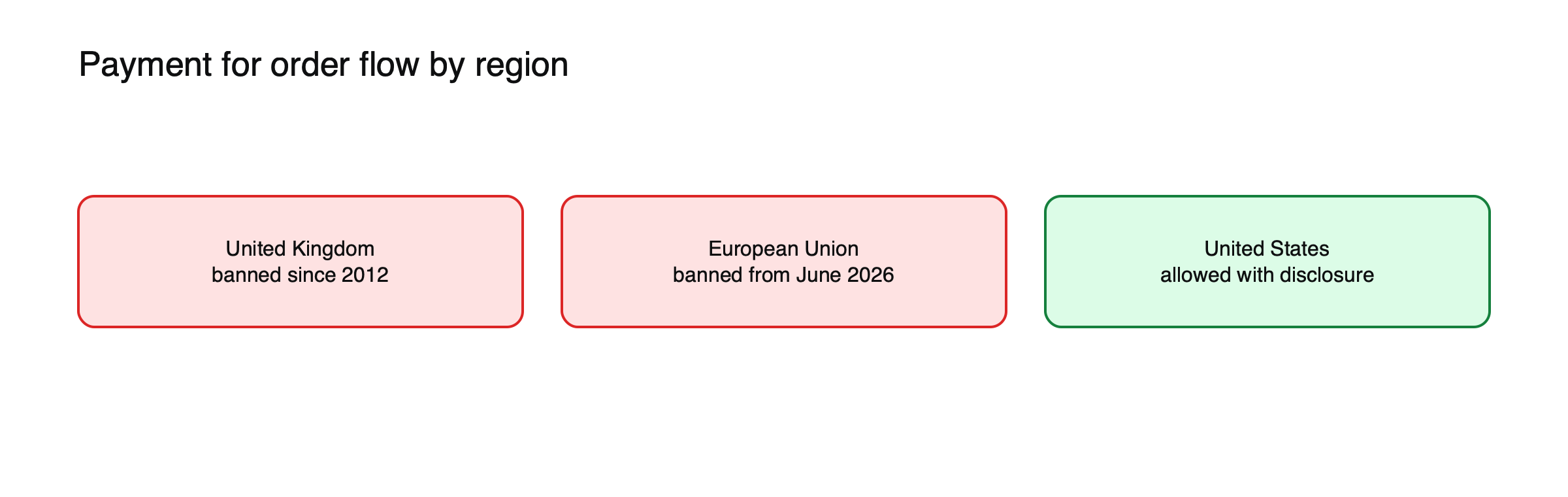
Figure: The same practice, three regulatory answers.
What changed after bans
Some EU brokers introduced subscription or other fees to replace lost PFOF revenue. One analysis found retail spreads did not widen significantly after the EU ban.
See why best execution matters for traders, how market makers make money and what zero-commission trading really changed.
The meme-stock spotlight
In January 2021, when Robinhood restricted purchases of GameStop and other stocks on January 28 amid the meme-stock frenzy, attention turned to its reliance on payment for order flow, which made up 81% of its revenue in the first quarter of 2021. Congressional hearings examined whether the model created conflicts, though Congress did not ban it. See what happened in the GameStop short squeeze.
How it compares with CFD pricing
CFD providers typically do not receive payment for order flow in the same way, because clients trade directly with the provider. Instead, the provider earns from spreads, commissions and financing. The conflict of interest takes a different form: the provider may profit when clients lose, which is why best execution and conflict management rules apply. See how market makers make money.
Questions to ask your broker
- Does the broker receive payment for order flow, and from whom?
- What price improvement do its execution reports show?
- Are options orders routed differently from share orders?
- What fees replace order flow payments where they are banned?
Competition among wholesalers
A few large wholesalers handle most US retail share orders. Brokers can compare them on price improvement, speed and payments, and many split orders among several. Critics argue that concentration limits competition and that more retail orders should interact on public exchanges, where other investors could trade against them. Supporters argue that wholesalers’ competition for order flow already delivers better prices than exchanges for most retail orders.
What changed in 2026
The EU’s ban took full effect on June 30, 2026, when a transition period allowing payment for order flow in Germany ended. In the UK, where it had been banned since 2012, the FCA said in 2026 that it would review its position. In the US, a 2022 proposal to change how retail orders are handled was withdrawn in 2025, leaving the practice allowed with disclosure.
Crypto and order flow
Some crypto apps route customer orders to market makers or earn from spreads in ways similar to payment for order flow, though disclosure rules are often less developed than for shares. Comparing the price received with prices on major exchanges is one way to judge execution.
Common misreadings
- Believing commission-free trading has no hidden costs.
- Assuming payment for order flow always means worse prices.
How much brokers earn
For some brokers, payment for order flow is a large share of revenue. At Robinhood, it made up 81% of revenue in the first quarter of 2021, at the height of the retail trading boom. Other brokers rely more on interest on client cash, margin lending or subscriptions. The mix matters, because it shapes which activities a broker has an incentive to encourage. See what zero-commission trading really changed.
Alternatives to order flow payments
Where payment for order flow is banned, brokers have adopted other models: small per-trade fees, monthly subscriptions, currency conversion charges, routing orders to exchanges with rebates passed on, or earning interest on cash. One analysis found that retail spreads did not widen significantly after the EU ban, suggesting that clients did not lose out on execution, though some faced new fees instead.
Reading execution statistics, illustrated
Suppose one broker reports average price improvement of $1.50 per 100-share order and receives $0.15 per order in payments, while another reports $0.80 of improvement with no payments. (Illustrative figures.) On these numbers alone, the first broker’s customers fare better despite the payments. But statistics depend on order types, sizes and market conditions, so comparisons work best across similar orders and periods. Reading both price improvement and payment data gives a more balanced view than either alone.
Why regulators disagree
Regulators weigh the same trade-offs differently. The UK and EU concluded that the conflict of interest outweighs the benefits and banned the practice. US regulators have relied on disclosure and best execution duties instead. Each approach reflects different market structures: the US has a large wholesale market-making industry, while European retail orders more often go to exchanges or to brokers acting as principal.
What it means for CFD and crypto traders
Payment for order flow mainly affects US share and options traders using commission-free brokers. CFD traders face a different structure, where costs appear in spreads, commissions and financing, and crypto traders often pay through spreads on apps. In each case, the practical question is the same: what is the total cost of a trade, and is the execution fair compared with the wider market? Comparing fills with independent price sources and reading a provider’s execution policy help answer it. The answer often matters far more than whether a visible commission is explicitly charged at all. See CFD trading costs.
Frequently asked questions
Is payment for order flow legal?
In the US, yes, with disclosure. It is banned in the UK and, after a transition, across the EU.
Does it make my trades more expensive?
Evidence is mixed: some studies find customers receive price improvement, others argue they could get better prices on exchanges.
This article is educational content and does not constitute financial, investment, legal or tax advice. Digital assets are volatile and you may lose the amount you invest.
Sources
- Payment for Order Flow Explained (UK banned since 2012; EU ban under MiFIR Article 39a with German transition to June 30, 2026; brokers added fees) — LearnSignal
- FCA eyes potential payment for order flow shake up (FCA review in 2026; EU full ban from June 30, 2026) — The TRADE
- Payment for order flow (SEC proposal withdrawn in 2025) — Wikipedia
- Robinhood gets boost as Congress declines ban (PFOF 81% of Robinhood’s Q1 2021 revenue) — Fox Business
- Payment for Order Flow (Robinhood $65 million SEC settlement) — University of Miami International and Comparative Law Review
- Regulators are missing the mark on PFOF (payments of $0.001–$0.002 per share vs price improvement) — IFLR
- Payment for Order Flow (retail spreads did not widen significantly after the EU ban) — Fin Still
- What were the biggest short squeezes in history? (Robinhood halted purchases on January 28, 2021) — IG