
What Quantitative Tightening Does to Market Liquidity
Quantitative tightening shrinks a central bank's balance sheet, draining reserves from the financial system. How QT works, what happened in 2019 and 2022–2025.
Quantitative tightening (QT) reverses quantitative easing: a central bank lets bonds it bought mature without replacing them, draining reserves from the banking system. Less cash can mean tighter funding markets and less support for asset prices. The Fed’s second round, from June 2022 to December 1, 2025, cut its balance sheet by about $2.5 trillion.
How QT works
When bonds held by the central bank mature, the government repays it, and the central bank does not reinvest. The money effectively disappears from bank reserves. Private investors must absorb the bonds the central bank no longer buys.
The first round (QT1)
October 2017 to 2019: the balance sheet shrank from about $4.5 trillion to about $3.8 trillion. In September 2019, short-term funding rates spiked, and the Fed began adding reserves again.
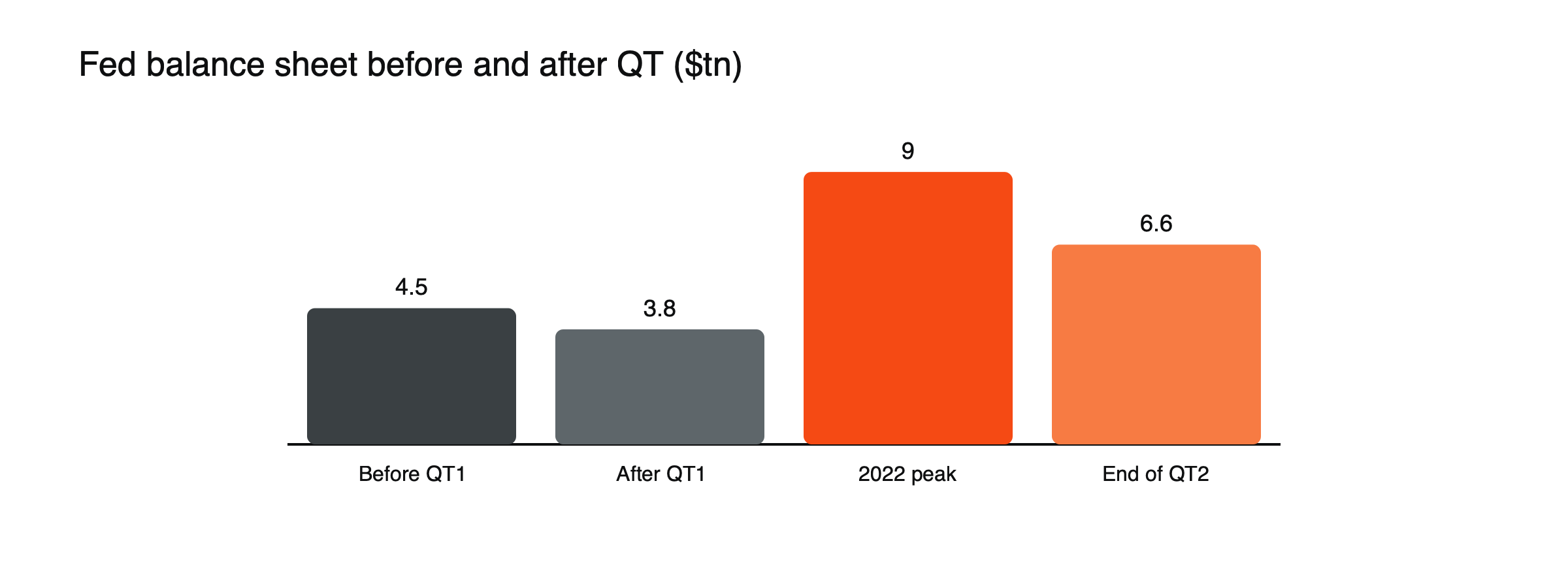
Figure: Two rounds of quantitative tightening ($ trillions). Sources: StockAlarm; MUFG.
The second round (QT2)
June 2022 to December 2025: after inflation peaked at 9.1%, the Fed shrank its balance sheet from about $9 trillion to about $6.6 trillion, alongside rate hikes, then ended QT effective December 1, 2025.
The September 2019 warning
In September 2019, overnight funding rates in the US repo market spiked far above the Fed’s target, as bank reserves had fallen further than banks were comfortable with. The Fed responded by injecting cash and later resumed buying bills to rebuild reserves. The episode showed that the level of reserves the banking system needs is uncertain and that QT can hit that limit suddenly.
QT in numbers, illustrated
Suppose a central bank allows $60 billion of Treasuries and $35 billion of mortgage bonds to mature each month without reinvesting. (Illustrative pace.) Over a year, its balance sheet shrinks by about $1.1 trillion, and private investors must absorb that much more debt. If the government is also running large deficits, the combined supply of bonds that markets must buy rises sharply, which can push long-term yields up.
What it does to markets
- Funding markets: fewer reserves can make overnight borrowing tighter, as in 2019.
- Bond yields: private buyers must absorb more supply, which can push term premiums up.
- Risk assets: less liquidity tends to weigh on valuations, though rates usually matter more.
QT and rates together
From 2022, QT ran alongside the fastest rate hikes in decades, which made its separate effect hard to isolate. Most economists believe rate changes had the larger impact on markets, but QT added to pressure on long-term yields by raising the supply investors had to absorb. Some estimated that years of QT were roughly equivalent to a modest additional rate rise.
QT elsewhere
Other central banks also shrank their balance sheets after 2022. The Bank of England went further than the Fed by actively selling gilts it had bought, not just letting them mature, while the European Central Bank reduced its holdings through maturities and the repayment of cheap loans to banks. Differences in pace affected bond yields and currencies across countries.
How uncertain it is
When QT2 began, the Fed chair stressed how uncertain its effects were. Its impact is harder to measure than a rate change, which is why many investors track bank reserves and funding rates. See how quantitative easing changed markets after 2008, why yield curve steepening can mean very different things and what markets listen for in a central bank meeting.
The end of QT2
The Fed ended QT2 effective December 1, 2025, with its balance sheet around $6.6 trillion, down from about $9 trillion. It aimed to stop before reserves became scarce, to avoid a repeat of 2019. From then on, the balance sheet was expected to stay broadly stable or grow slowly with demand for currency and reserves.
Signals to watch
- Bank reserves held at the Fed
- Overnight funding rates relative to the Fed’s target
- The size of the Fed’s reverse repo facility, a buffer of excess cash
- Treasury issuance plans and auction demand
What QT means for traders
QT tends to work slowly in the background, but it can matter suddenly when liquidity becomes scarce, as in 2019. Traders in rate-sensitive assets, such as long bonds, growth shares and crypto, watch liquidity measures alongside rate expectations. See how real yields connect gold, growth stocks and crypto.
Reserves, explained
Bank reserves are deposits that banks hold at the central bank. They are used to settle payments between banks and to meet regulatory liquidity requirements. QE creates reserves; QT drains them. When reserves are plentiful, banks lend to each other cheaply and funding markets are calm. When they become scarce, banks hoard them, and short-term borrowing rates can spike, as in 2019.
QT at a glance
| Round | Period | Balance sheet change |
|---|---|---|
| QT1 | October 2017 to 2019 | About $4.5 trillion to $3.8 trillion |
| QT2 | June 2022 to December 1, 2025 | About $9 trillion to $6.6 trillion |
QT and the dollar
By reducing the supply of dollar reserves, QT can tighten dollar funding conditions globally, especially when combined with rate hikes. That can support the dollar and weigh on assets that depend on cheap dollar funding, such as emerging markets. See how a strong dollar hits commodities, emerging markets and crypto.
QT and crypto
Crypto has been among the assets most sensitive to liquidity. Periods of central bank balance sheet expansion, such as 2020 and 2021, coincided with crypto booms, while QT and rate hikes in 2022 coincided with steep falls. Liquidity is not the only driver, but it has mattered.
Common misreadings
- Assuming QT has no effect because it works slowly.
- Treating QT and rate hikes as the same tool.
QT and bond yields, illustrated
Suppose a government needs to sell $2 trillion of bonds over a year, and the central bank, which used to buy $1 trillion of them, now buys none and lets $1 trillion of its holdings mature. (Illustrative figures.) Private investors must absorb $3 trillion instead of $1 trillion. To attract that demand, yields on long bonds may have to rise, especially if investors are worried about inflation. That is the main channel through which QT can push long-term rates up and steepen the yield curve. See why yield curve steepening can mean very different things.
The reverse repo buffer
During QE, a large amount of excess cash ended up in the Fed’s overnight reverse repo facility, where money market funds park cash. In the early part of QT2, much of the drain came from this facility rather than from bank reserves, which helped funding markets stay calm. As the facility shrank toward low levels, QT began to draw more directly on reserves, one reason the Fed chose to end QT in late 2025.
QT and share valuations
Less liquidity and higher long-term yields can reduce the valuations investors are willing to pay for shares, especially for companies whose profits lie far in the future. The effect is usually gradual and overshadowed by rate changes and earnings, but it can add to pressure on richly valued markets.
Lessons from two rounds
Two rounds of QT taught central banks that the safe level of reserves is hard to know in advance, that funding markets can tighten suddenly and that ending QT early is better than causing a liquidity squeeze. Future rounds are likely to be slower and more closely monitored.
QT and the Treasury
QT interacts with the government’s borrowing. When the Treasury issues more short-term bills, money market funds often absorb them using cash from the reverse repo facility, limiting the drain on bank reserves. When it issues more long-term bonds, the pressure falls more on long yields. Treasury announcements about issuance plans therefore matter for how QT affects markets. Watching issuance and reserves together gives a fuller picture of liquidity than watching the Fed’s balance sheet alone.
Frequently asked questions
Is QT the same as raising rates?
No. Raising rates changes the price of short-term money; QT reduces the quantity of reserves and increases the bonds private investors must hold.
Why stop QT?
To avoid draining reserves so far that funding markets become unstable.
This article is educational content and does not constitute financial, investment, legal or tax advice. Digital assets are volatile and you may lose the amount you invest.
Sources
- The End of QT (balance sheet from $9.0 trillion to $6.6 trillion; QT2 ended December 1, 2025; inflation peaked at 9.1%) — MUFG, December 2025
- Quantitative Easing and Stocks (2017–2019 runoff from about $4.5 trillion to $3.8 trillion; September 2019 repo spike) — StockAlarm
- The Fed’s Balance Sheet and Quantitative Tightening (repo volatility in 2019; QT from June 2022) — Congressional Research Service, April 2025
- The Fed Is Shrinking Its Balance Sheet (Powell: effects uncertain) — Richmond Fed, 2022