
What Is Margin in CFD Trading?
Margin is the deposit a provider requires to open and keep a leveraged CFD position. How initial margin, used and free margin work, and the risks.
CFD margin is the money a provider holds as a deposit to open and keep a leveraged position. It is a percentage of the position’s value: 3.33% at 30:1 leverage, 20% at 5:1. Margin is not a fee, but it is the amount at risk first: if losses eat into your account, the provider can close your positions automatically.
A deposit, not a fee
Margin is not spent. It is set aside while a position is open and released when you close it, adjusted for any profit or loss. Costs are separate: the spread, any commission and overnight financing. Confusing the two leads to two opposite mistakes: treating margin as the price of a trade, and treating it as the most you can lose. In fact it is neither; it is a security deposit sized to the position.
Initial and maintenance margin
Initial margin is what you need to open a position. A $15,000 share CFD position at 20% margin requires $3,000.
Maintenance requirements are the levels your account must stay above. Providers track this with the margin level. See equity, free margin and margin level explained.
Used and free margin
- Used margin: the total margin tied up in open positions.
- Free margin: what is left to absorb losses or open new trades, roughly equity minus used margin.
- Equity: your balance plus or minus open profits and losses.
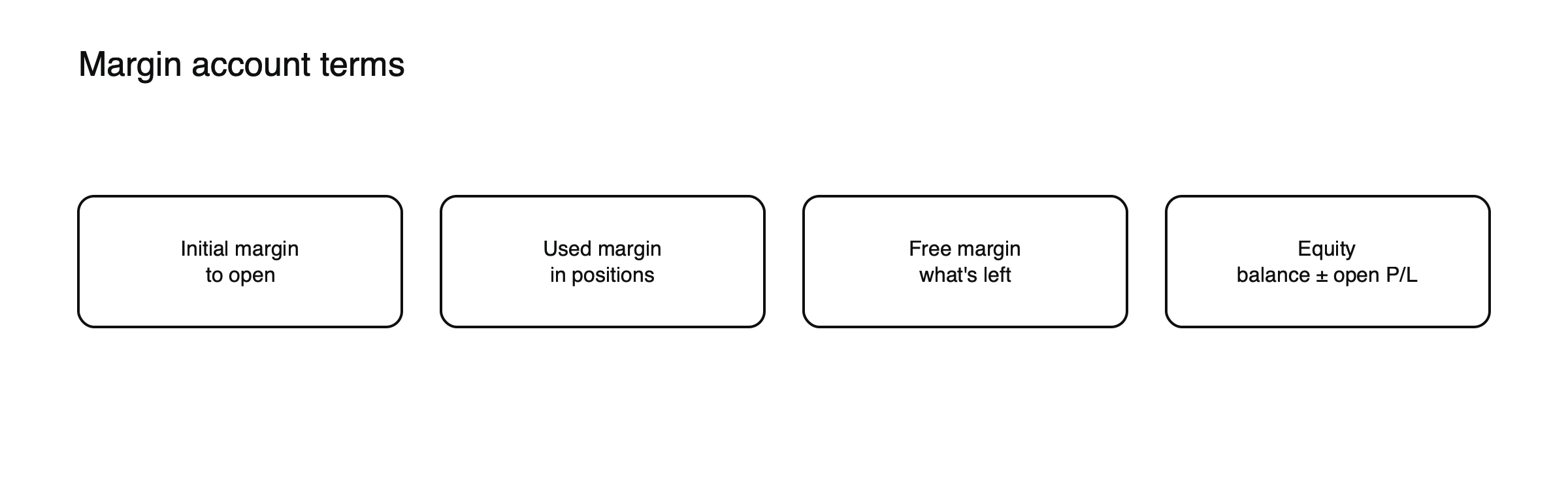
Figure: The four numbers that describe a margin account.
Because margin is recalculated as prices move, a position that grows in value can also tie up a little more margin over time, which is one more reason to review open trades regularly. Small changes can add up across several open positions.
Margin by asset class
| Asset | Minimum retail margin under EU rules | Equivalent leverage |
|---|---|---|
| Major currency pairs | 3.33% | 30:1 |
| Non-major pairs, gold, major indices | 5% | 20:1 |
| Other commodities, minor indices | 10% | 10:1 |
| Individual shares | 20% | 5:1 |
| Cryptocurrencies | 50% | 2:1 |
These are minimums. Providers can, and often do, ask for more on particular instruments or in particular conditions.
How providers set margin
Providers start from the regulatory minimum where it applies and add their own buffers based on an instrument’s volatility, liquidity and the size of the position. Many raise margin requirements ahead of events that can cause sudden moves, such as elections, central bank decisions or weekends, when markets are closed and prices can gap at the open. A position that met its margin comfortably on Friday can need more on Monday without any price change, so checking announced margin changes is part of managing open trades.
Margin across several positions
In most accounts, all open positions draw on the same pool of equity. Suppose you hold two trades, one using $2,000 of margin and one using $1,500. If the first loses $1,200, your equity falls by $1,200, and so does the free margin supporting both trades. A loss on one position can therefore push the whole account toward a margin call, even if the other position is profitable. Looking at the account as a whole, rather than position by position, shows the real risk.
What happens as losses grow
As a position loses money, equity falls, free margin shrinks and the margin level drops. Providers typically send a margin call around 100% margin level and start closing positions at a lower stop-out level, often 50%. See what happens in a margin call and a stop-out.
Margin and position size are different questions
Margin answers the question “how much must I deposit to open this?” Position size should answer a different one: “how much am I willing to lose if I am wrong?” A trader who opens the largest position the margin allows lets the provider’s leverage decide the risk. A trader who first sets the loss they will accept, then the stop distance, then the position size, usually ends up using far less margin than available. The spare margin is not wasted; it is what keeps the account away from margin calls when prices move against them. See how to size a CFD position using risk per trade.
A weekend margin change, illustrated
Suppose you hold an index CFD over a weekend with an important election on Sunday. On Friday the provider announces that margin on that index will double, from 5% to 10%, from Friday evening until Monday’s open. (Illustrative scenario.) Your position’s required margin doubles without any price change, and your free margin shrinks by the same amount. If the account was already close to its limits, it can be pushed toward a margin call before the market even reopens. Planning for announced margin changes, and for gaps at the open, is part of holding positions through events. See why prices gap over the weekend.
Hedged positions
Some providers reduce the margin required when you hold opposite positions in the same instrument, for example a long and a short of the same size. The combined position has little net price exposure, but it still incurs spreads and financing on both sides, and closing one leg can suddenly raise margin on the other. Hedging inside one account is rarely an efficient way to manage risk compared with simply reducing the position.
Common misunderstandings
- “I only risk my margin.” Losses are calculated on the full position, and gaps can cause losses beyond your margin where negative balance protection does not apply.
- “Unused cash is safe.” Free margin absorbs losses from all open positions.
To calculate margin for a trade, see how to calculate the margin for a CFD trade. For the bigger picture, read what leverage is in CFD trading.
Frequently asked questions
Do I get my margin back when I close a trade?
Yes, the margin is released back into your free balance when the position closes, adjusted by the trade’s profit or loss and any costs.
Why did my margin requirement change while the trade was open?
Margin is usually calculated on the position’s current value, so it changes as prices move. Providers can also change margin rates for an instrument, for example ahead of major events.
Leverage, margin and cost figures in this article are example values for illustration. Actual terms depend on the provider, the instrument and the rules in your country.
This article is educational content and does not constitute financial, investment, legal or tax advice. Digital assets are volatile and you may lose the amount you invest.