
How Overnight Financing Works on a CFD Position
Holding a cash CFD past the daily cut-off triggers a financing charge or credit: a benchmark rate plus a fee. How it works for indices, shares, FX and more.
CFD overnight financing is a daily charge or credit applied when you hold a cash CFD past the provider’s cut-off. Because the position is effectively funded with borrowed money, longs usually pay a benchmark rate plus a fee, while shorts receive the benchmark minus the fee, or pay if the fee is larger. Over weeks, it can outweigh the spread.
Why financing exists
When you buy a cash CFD, you gain exposure to the full value of the asset while only depositing margin. Economically, the rest is funded on your behalf, so you pay interest on it each night. A short position works the other way: you are effectively holding the cash from selling the asset, so you may earn interest, minus the provider’s fee. Financing is how CFD prices stay fair relative to owning or borrowing the asset itself over time.
How it is calculated
For index and share CFDs, a common structure is:
Daily financing = position value × (benchmark rate ± provider fee) ÷ 365 (or 360, depending on the currency)
- Long: benchmark + fee, charged.
- Short: benchmark − fee, credited if positive, charged if negative.
Benchmarks are overnight rates such as SOFR for US dollars or SONIA for sterling. Provider fees of around 2.5% to 3% a year are common.
By market
- Indices and shares: benchmark plus fee, as above. Shorting shares may add a borrowing charge.
- Forex: based on the interest rate difference between the two currencies (the tom-next rate) plus a fee; positions held through Wednesday’s cut-off are usually charged three days to cover the weekend.
- Commodities: cash CFDs reflect the market’s cost of carry plus a fee.
- Futures-based CFDs: no daily financing, because carry is in the futures price; costs appear at rollover.
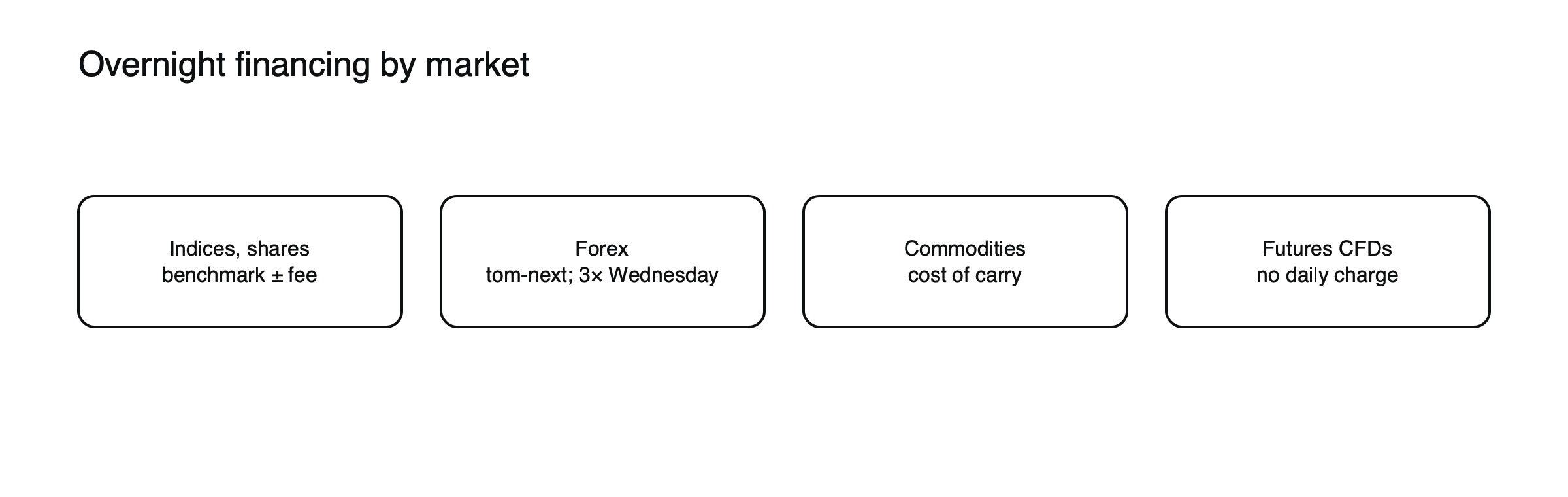
Figure: How overnight financing differs by market.
Where the benchmark comes from
Benchmarks track overnight lending rates in each currency, such as SOFR for US dollars, SONIA for sterling and €STR for euros. They move mainly with central bank policy rates. When central banks raise rates, financing for long positions rises and short positions may receive more; when they cut, long financing falls and short credits can turn into charges, because the provider’s fee is subtracted from a smaller benchmark.
Longs and shorts in different rate environments
| Benchmark | Fee | Long pays | Short receives or pays |
|---|---|---|---|
| 5.0% | 2.5% | 7.5% a year | Receives 2.5% |
| 2.5% | 2.5% | 5.0% a year | Neither, roughly |
| 1.0% | 2.5% | 3.5% a year | Pays 1.5% |
(Illustrative figures.) In low-rate periods both sides can pay, which makes holding any cash CFD for long periods more expensive.
Shorting shares has an extra cost
Short positions in individual share CFDs may carry a borrowing charge on top of financing, reflecting the cost of borrowing the shares in the underlying market. For heavily shorted stocks that charge can be high and can change at short notice.
Swap-free accounts
Some providers offer accounts without overnight interest, often for clients who cannot pay or receive interest for religious reasons. They usually replace financing with a fixed administration fee or wider spreads, so holding positions still has a cost.
When it applies
Only to positions open at the daily cut-off, often 10 p.m. UK time or 5 p.m. New York time. Closing before the cut-off avoids it.
Why it matters
A 6.5% annual rate costs about $17.81 a night on a $100,000 position. See how to calculate overnight financing before holding a trade and what a CFD trade really costs. For the basics, read what a CFD is.
Financing and longer-term holdings
Cash CFDs are designed for shorter-term trading. Someone who wants to hold an index or share for a year or more pays financing every night on the full position, which at typical rates can cost several percent of the position’s value a year, far more than the fees on owning the asset directly or through a fund. For long-term exposure, buying the asset itself is usually cheaper. See CFD vs owning the asset.
Seeing it on your statement
Financing appears as a separate daily line on most account statements, often labelled as swap, rollover or overnight funding, with the instrument and amount. Reviewing these lines regularly shows how much holding positions actually costs, which is easy to overlook when each night’s charge is small.
Holidays and unusual weeks
Around public holidays, when settlement days shift, providers may charge extra nights on a different day from usual. Checking the provider’s holiday schedule avoids surprises when holding positions through those periods.
Cash CFDs or futures-based CFDs?
For short holding periods, cash CFDs are usually cheaper, since you pay financing only for the nights you hold. For positions held for weeks or months, futures-based CFDs can work out cheaper, because the carrying cost is built into a futures price that may be lower than the nightly charges added together, though they have wider spreads and need rolling at expiry. Comparing the expected financing on a cash CFD with the spread and roll cost of the futures version shows which suits a planned holding period.
Frequently asked questions
Is financing charged on weekends?
Yes, through the extra nights charged on one weekday, usually Wednesday for currencies, which covers the weekend settlement period. Other markets may apply weekend charges on Friday.
Does financing affect my margin?
Financing is taken from or added to your account balance, so it changes equity and therefore margin level, even though it does not change the margin requirement itself.
A month of financing across three positions
Suppose an account holds three positions for 30 nights: a $50,000 long index CFD at 6.5%, one lot of a currency pair long with a swap of −$7 a night, and a $10,000 short share CFD earning a net 1%. (Example values.)
- Index: about $8.90 a night, $267 for the month
- Currency pair: $7 a night, $210 for the month
- Share short: a credit of about $0.27 a night, $8 for the month
Net financing is roughly $469 for the month. None of these charges looks large on a single night, but together they are a real cost that needs to be earned back by price moves before the account makes money.
Questions to ask your provider
- What benchmark and fee apply to each market, and how often do they change?
- What time is the daily cut-off, and which day carries weekend charges?
- Are there borrowing charges for short share positions?
- How are holidays handled?
- Are there swap-free options, and what do they charge instead?
Answers to these questions are usually in the provider’s own published contract details, but asking directly removes any remaining doubt before you hold positions for several weeks.
Leverage, margin and cost figures in this article are example values for illustration. Actual terms depend on the provider, the instrument and the rules in your country.
This article is educational content and does not constitute financial, investment, legal or tax advice. Digital assets are volatile and you may lose the amount you invest.
Sources
- Why is overnight funding charged and how is it calculated (admin fee ± SONIA/SOFR ÷ 365/360; tom-next for FX; Wednesday triple funding; commodity cost of carry) — IG
- How is funding on other markets calculated (benchmark ± 2.5% by currency) — IG Switzerland
- What are swap rates (applied past the daily cut-off; triple Wednesday) — ActivTrades