
Common Stock vs Preferred Stock
Common stock gives votes and full upside; preferred stock pays fixed dividends first and ranks ahead in liquidation, usually without votes. A comparison.
Common vs preferred stock differ in rights and priority. Common stock usually carries votes and the full benefit of growth, but dividends are not guaranteed and holders are paid last in a liquidation. Preferred stock usually pays a fixed dividend first and ranks ahead of common stock, but typically has no votes and limited upside.
Side by side
| Common stock | Preferred stock | |
|---|---|---|
| Voting rights | Usually yes | Usually no |
| Dividends | Variable, not guaranteed | Fixed, paid first |
| Liquidation priority | Last | Ahead of common, behind creditors |
| Price volatility | Higher | Lower |
| Upside | Full | Limited |
| Callable by issuer | No | Often |
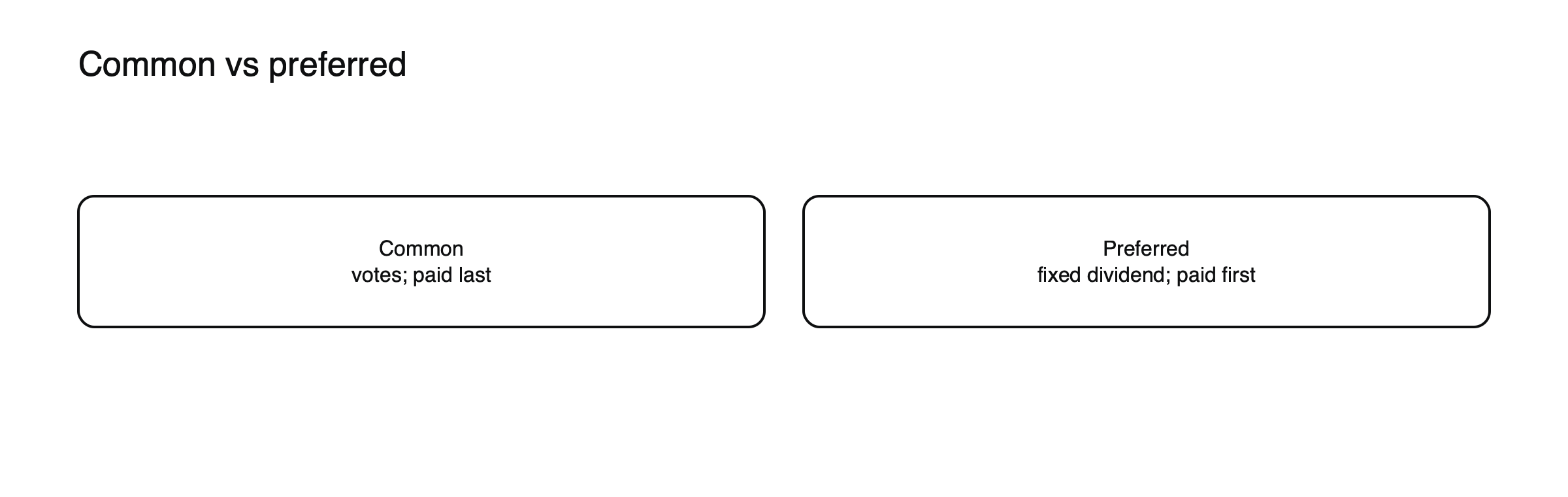
Figure: Rights and priority compared.
Dividend priority, illustrated
Suppose a company has preferred shares paying a fixed $5 a year on each $100 of face value, and common shares. In a good year, it pays the preferred dividend and raises the common dividend as profits grow. In a bad year, it may cut or suspend the common dividend, but it must usually pay the preferred dividend first before paying anything to common holders. Common holders get whatever is left, which may be far more in good years and nothing in bad ones. (Illustrative figures.)
Who issues preferred stock
Banks, insurers, utilities and real estate trusts issue most preferred shares, often to raise capital without diluting voting control.
Why preferreds behave like bonds
With fixed dividends, preferred shares tend to fall when interest rates rise, much as bonds do. Many are also callable, so the issuer can redeem them when rates fall.
Preferred shares and rates, illustrated
A perpetual preferred share with a $25 face value paying 5% a year, $1.25, trades near $25 when similar securities yield 5%. If yields on comparable securities rise to 6%, investors will pay only about $20.83 for the same $1.25 a year, a fall of about 17%, even though the company is unchanged. (Illustrative figures.) This makes preferred shares sensitive to interest rates in much the same way as long-term bonds.
Cumulative and non-cumulative preferreds
With cumulative preferred shares, any skipped dividends build up and must be paid before common shareholders receive anything. With non-cumulative shares, skipped dividends are lost. Cumulative terms give holders more protection and are worth checking before comparing yields.
Convertible preferred shares
Some preferred shares can be converted into common shares at a set ratio, giving holders a fixed dividend plus a share in the upside if the common shares rise. They often trade at lower yields than ordinary preferreds because of that conversion right.
What most traders trade
Most stock CFDs reference common shares, the class that trades actively and reacts to earnings. See how stock CFDs work.
When preferred is not safe
«Preferred is safer» holds against common stock, but preferred holders still rank behind bondholders and can lose heavily if a company fails.
See how to calculate dividend yield and what moves stock prices.
Share classes with different voting rights
Some companies issue more than one class of common stock, with different voting rights, so that founders keep control. Alphabet and Meta, for example, have share classes carrying extra votes held mainly by insiders, and Berkshire Hathaway has class A and class B shares at very different prices. CFD traders usually trade the most liquid class, but the existence of other classes affects governance and, sometimes, index inclusion.
The order of payment
If a company is liquidated, its assets are paid out in a set order: secured creditors first, then other lenders and bondholders, then preferred shareholders and finally common shareholders. In most failures, common shareholders receive little or nothing, and preferred holders may receive only part of their face value.
Call risk, illustrated
Suppose a preferred share with a $25 face value pays 6% a year, $1.50, and can be called by the company at $25 after five years. If rates fall and similar securities yield 4%, the share might be worth more than $25, but the company is likely to call it and refinance more cheaply, paying holders $25. Investors therefore gain little when rates fall and lose when they rise, an uneven trade-off that is part of what the higher yield compensates for. (Illustrative figures.)
Preferred yields compared
Preferred shares usually yield more than the same company’s bonds, because they rank lower in a liquidation, and more than its common dividend yield, because they offer little upside. Comparing a preferred’s yield with the company’s bond yields and with similar preferreds from other issuers helps judge whether it pays enough for its risks.
Bank capital securities
Banks issue several kinds of hybrid securities that count toward their regulatory capital, some of which can be written down or converted into common shares if the bank’s capital falls too low. In 2023, when Credit Suisse was rescued, some of its capital securities of this kind were written off entirely while shareholders still received something, a ranking that surprised many investors. Such instruments can behave very differently from traditional preferred shares in a crisis.
Trading preferred shares
Preferred shares trade on exchanges but often with low volume and wider spreads than common shares, and CFDs on them are rarely offered. Investors who want them usually buy the shares directly or through funds that hold many issues.
Common misreadings
- Treating preferred dividends as guaranteed.
- Ignoring call features when comparing yields.
- Assuming preferred shares cannot fall far.
Preferred shares versus bonds
Preferred shares and bonds both pay fixed income, but bonds are debts that must be repaid on a set date, and missing a bond payment is a default. Preferred dividends can usually be suspended without default, and many preferreds have no maturity date. In exchange for that weaker position, preferreds usually pay higher yields than the same company’s bonds.
Who buys preferred shares
Preferred shares appeal mainly to income-focused investors, including individuals seeking higher yields than bonds offer and institutions that receive favorable tax treatment on dividends in some countries. Their prices tend to be steadier than common shares in normal markets, which suits investors who value income over growth.
Taxes on preferred dividends
Depending on the country and the type of preferred share, dividends may be taxed as dividends or as interest, which can make a large difference to after-tax returns. Some hybrid securities that look like preferred shares are treated as debt for tax purposes. Checking how a specific issue is taxed is part of comparing its yield with alternatives.
Reading a preferred share’s terms
- Dividend rate, fixed or floating, and how often it is paid.
- Cumulative or non-cumulative dividends.
- Call date and price, when the issuer can redeem the shares.
- Conversion rights, if any.
- Ranking relative to other preferred issues and debt.
- Maturity, if there is one.
These terms, set out in the offering documents, determine how the shares behave far more than the headline yield does. Two preferred issues from the same company can behave very differently if one is cumulative and callable soon while the other is non-cumulative with no call for years, so comparing terms side by side is worthwhile.
Frequently asked questions
Why would anyone choose common stock over preferred?
Because common stock carries the full benefit of a company’s growth and usually voting rights. Over long periods, successful companies’ common shares have delivered far higher returns than their preferred shares.
Can preferred dividends be cut?
Yes, though usually only after common dividends have been suspended. Cumulative preferreds must later be paid any missed amounts before common dividends resume.
This article is educational content and does not constitute financial, investment, legal or tax advice. Digital assets are volatile and you may lose the amount you invest.