
How to Size a Crypto CFD Position for High Volatility
Size from risk, not margin: coins = risk ÷ stop distance. On $10,000 risking 1% with an 8% stop on bitcoin at $60,000, that is about 0.02 BTC. Worked examples.
To size a crypto CFD position, start from the loss you accept, not the margin available: coins = risk amount ÷ stop distance per coin. On a $10,000 account risking 1%, or $100, with a stop 8% below a $60,000 bitcoin entry ($4,800 per coin), that is about 0.02 BTC, a $1,250 position.
The formula
- Risk amount = account × risk %
- Stop distance per coin = entry − stop (wider for more volatile coins)
- Coins = risk amount ÷ stop distance per coin
Worked example 1: bitcoin
- Account $10,000, risk 1% = $100
- Entry $60,000, stop 8% lower = $4,800 per coin
- Size: 100 ÷ 4,800 ≈ 0.0208 BTC (round down to 0.02)
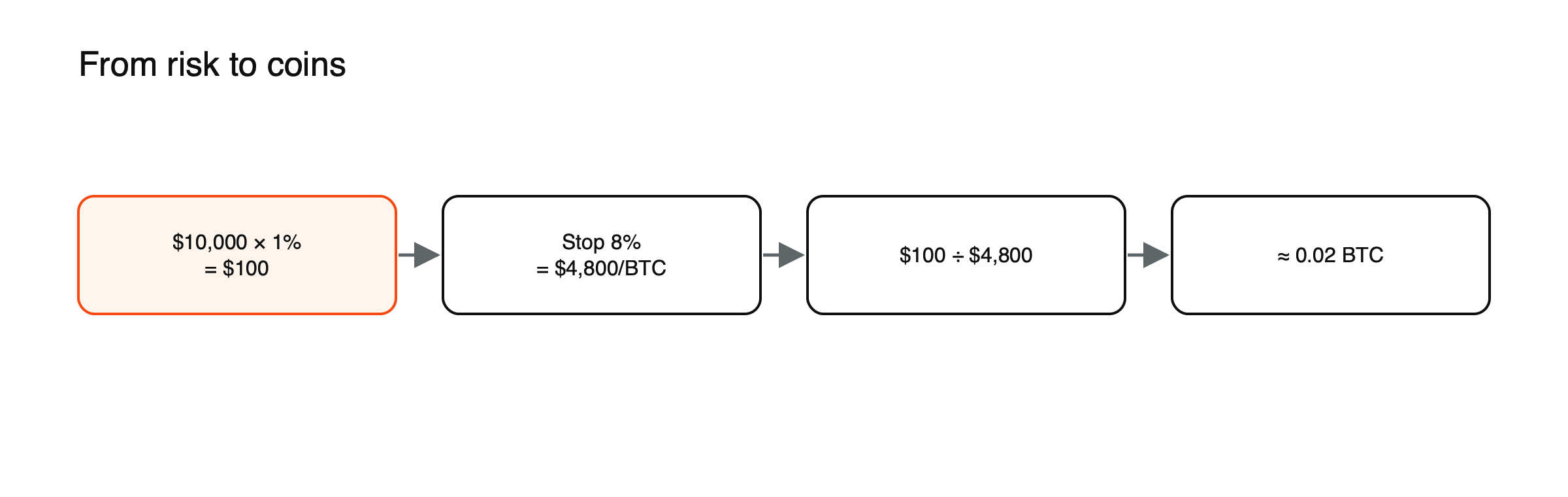
Figure: Sizing from risk (example values).
Worked example 2: an altcoin
- Same $100 risk; coin at $2.00, stop 15% lower = $0.30
- Size: 100 ÷ 0.30 ≈ 333 coins, a $666 position
The more volatile coin needs a wider stop and therefore a smaller position. (Example values.)
Worked example 3: setting the stop from volatility
Rather than choosing a stop percentage by feel, some traders base it on recent volatility, such as the average daily range. Suppose bitcoin’s average daily range over the past two weeks is about 4%. A stop at twice that, 8%, gives the trade room to survive normal swings. With the same $100 risk and a $60,000 entry, the size is again about 0.02 BTC. If volatility doubles to an 8% average range, the stop widens to 16% and the size halves to about 0.01 BTC. (Example values.) Sizing from volatility keeps risk steady as markets change.
Allowing for gaps, worked through
Crypto can gap through stops. A trader who assumes a stop might fill at up to twice its distance can size for that worst case: with a $100 maximum loss and an 8% stop, the assumed worst fill is 16% below entry, $9,600 per coin, so the size is about 0.0104 BTC. This halves the position but makes a gap far less damaging. (Example values.)
Why not size by margin
At 2:1, $10,000 could open a $20,000 position; an 8% fall would then lose $1,600, 16% of the account. See how leverage changes the math on a forex trade for the same logic.
Several positions at once
Because crypto prices tend to move together, each position’s risk should be added to the others. A trader risking 1% on each of bitcoin, ether and a third coin effectively risks close to 3% on one crypto-wide move. Many traders set a cap on total risk across all open crypto positions, such as 2% or 3%, and size each trade to fit within it. See why altcoin CFDs are more volatile than bitcoin.
Gaps and costs
Stops can fill beyond their level in crypto crashes, and financing adds up. Build in a margin of safety. See how to set stop-losses on crypto CFDs when prices gap and what a crypto CFD is.
Rounding and minimum sizes
The calculated size rarely matches the provider’s size steps exactly. Rounding down keeps the risk within the limit; rounding up exceeds it. If the minimum size is larger than the calculated size, the trade carries more risk than planned, and skipping it may be the right choice.
Choosing a risk percentage
Many traders risk between 0.5% and 2% of their account per trade. Lower percentages suit volatile markets such as crypto, where losing streaks and gaps are common. Risking 1% means ten consecutive losses leave the account about 10% smaller, painful but recoverable; risking 10% would leave it about 65% smaller.
Costs in the sizing
Financing and spreads add to losses and reduce gains. For trades held for weeks, including expected financing in the risk calculation, or widening the stop slightly to allow for it, keeps the real risk close to the planned amount. See how much it costs to hold a bitcoin CFD for a month.
After a losing run
Because size is a percentage of the account, it shrinks automatically after losses, slowing further damage. Resisting the urge to increase size to win back losses is one of the most important habits in volatile markets.
Sizing three positions together, worked through
A trader with a $10,000 account caps total crypto risk at 2.5%, $250, and wants positions in bitcoin, ether and a smaller coin. Allocating about $83 of risk to each, with stops of 8%, 10% and 15%, gives position values of about $1,040, $830 and $555. (Example values.) If all three stops are hit together in a crypto-wide fall, the loss is about $250, within the cap. Sizing each at 1% instead would risk $300 on the same move.
Sizing a hedge
A hedge is sized from the exposure it offsets rather than from a risk percentage. To protect 0.5 BTC held in a wallet, a short CFD of 0.5 BTC offsets price moves almost fully; a short of 0.25 BTC halves the exposure. The hedge’s margin and financing need to be covered, and its size reviewed if the holding changes. See how to hedge crypto holdings with CFDs.
Measuring volatility
Common ways to judge how far a coin typically moves include the average daily range over recent weeks, the standard deviation of daily returns and implied volatility from options, where available. Each gives a sense of how wide a stop needs to be to avoid normal noise, and therefore how large a position can be for a given risk.
As the account grows
With risk set as a percentage, position sizes grow automatically as the account grows and shrink after losses. Recalculating size from the current account balance before each trade keeps the method consistent.
Common misreadings
- Sizing every coin the same in dollars.
- Ignoring correlation between positions.
Short positions
The same method applies to shorts, with the stop above the entry. Because a short’s losses grow as the price rises, and crypto can jump sharply on good news, many traders use slightly wider stops and smaller sizes for shorts than for longs in the same coin.
A leverage check after sizing
After calculating size from risk, divide the total position value of all open positions by account equity. If effective leverage creeps above 1, the account is more exposed to a crypto-wide fall than its risk percentages suggest, especially if stops could be skipped by gaps. See how leverage limits work for crypto CFDs.
A sizing worksheet
- Account balance today
- Risk per trade, as a percentage and in money
- Entry price and stop price
- Stop distance per coin
- Size = risk ÷ stop distance, rounded down
- Position value and margin required
- Worst-case loss if the stop gaps to twice its distance
- Total risk across open crypto positions
Filling in these lines before each trade takes a minute and turns sizing into a habit rather than a judgment made under pressure. Many platforms also show the potential loss at the stop on the order screen, which provides a final check.
Testing the size
Before committing real money, trying the sizing method on a demo account over a few weeks shows whether the resulting positions feel manageable through crypto’s normal swings. If they do not, the risk percentage is probably too high for your temperament.
Frequently asked questions
Should I use the same size for every coin?
No. More volatile coins need wider stops and therefore smaller positions for the same risk.
Is 1% risk too cautious for crypto?
Many experienced traders use 1% or less in crypto precisely because volatility and gaps make larger risks dangerous.
Leverage, margin and cost figures in this article are example values for illustration. Actual terms depend on the provider, the instrument and the rules in your country.
This article is educational content and does not constitute financial, investment, legal or tax advice. Digital assets are volatile and you may lose the amount you invest.