
How to Set Stop-Losses on Crypto CFDs When Prices Gap
Place stops beyond normal swings, size for slippage, avoid thin weekend hours, consider guaranteed stops and review around events: stop-losses on crypto CFDs.
To set stop-losses on crypto CFDs when prices can gap, place them beyond normal daily swings, size so a fill well past the stop is survivable, avoid relying on them in thin weekend hours, use guaranteed stops where offered and review them before events. A standard stop becomes a market order, filling at the next price.
Before you start
Look at the coin’s typical daily range and recent largest moves; altcoins need wider stops than bitcoin.
Setting them, step by step
Place the stop where the idea is wrong
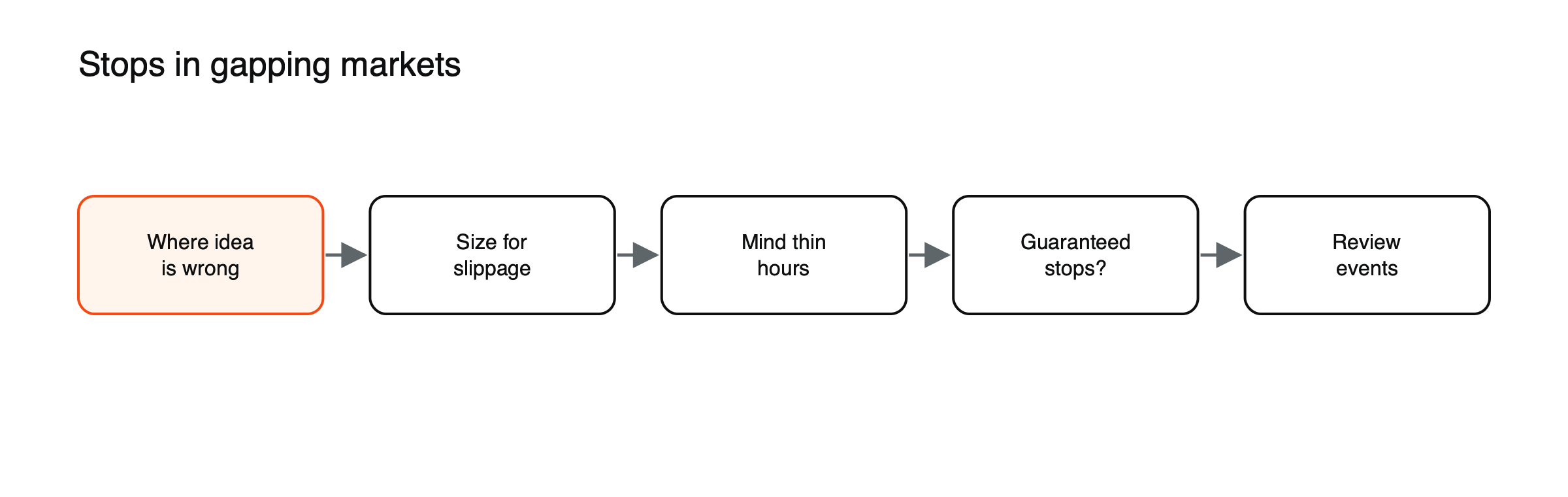
Figure: Setting stops when prices gap.
Not just a round percentage; use levels the market respects, outside normal noise.
Size for slippage
Assume a fill beyond the stop in a fast market and make sure that loss is acceptable. See how to size a crypto CFD position for high volatility.
Mind thin hours
Brief weekend or overnight spikes can trigger stops in thin markets. See what changes when you trade crypto CFDs on weekends.
Consider guaranteed stops
Some providers offer stops that fill exactly at the level for a premium; availability and cost vary.
Review around events
Large announcements and market-wide liquidations can cause gaps; in October 2025, prices diverged sharply between venues during the crash.
A stop based on volatility, illustrated
Suppose bitcoin’s average daily range over the past two weeks is about 4%, and a trader buys at $60,000. (Example values.) A stop at about twice that range, 8% below entry at $55,200, sits outside most normal swings. If recent support sits at $56,000, the stop might go just below it, around $55,500, so that it is triggered only if the level breaks. Basing stops on both volatility and price structure, rather than a fixed percentage, makes them less likely to be hit by noise.
Allowing for slippage, worked through
A trader risks $200 with a stop 8% below a $3,000 ether entry, $240 per coin, giving a size of about 0.83 ETH. If a fast market could fill the stop at twice that distance, $480 below entry, the loss would be about $400. A trader unwilling to lose more than $200 even in that case would halve the size to about 0.42 ETH. (Example values.) Allowing for slippage in sizing is the main protection against gaps.
Guaranteed stops, illustrated
Some providers offer guaranteed stops that fill exactly at the chosen level, for a premium charged when the stop is triggered or when it is placed. Suppose the premium is 0.3% of the position’s value: on a $6,000 bitcoin position, that is about $18. (Illustrative premium.) For a trade held through a major event or a weekend, that cost can be small compared with the protection against a large gap. Guaranteed stops usually require a minimum distance from the current price.
Common mistakes
Stops so tight that normal swings trigger them, and assuming a stop guarantees the exit price. See how stop-loss orders work and what a crypto CFD is.
Trailing stops
A trailing stop moves with the price when it moves in the trade’s favor, locking in part of a gain. In crypto, trailing stops set too tight are triggered by normal pullbacks, so the trailing distance usually needs to be at least as wide as the original stop. They protect profits but cannot prevent gaps from skipping them.
Mental stops
Some traders keep stops in their head rather than placing them, to avoid being triggered by brief spikes. This requires discipline and constant attention, which is hard in a market that trades around the clock. For most traders, a placed stop, sized for slippage, is more reliable than an intention to act later.
Stops and the close-out level
A stop should sit well before the account’s close-out level, so the trader decides when to exit rather than the provider’s margin rules. If a planned stop is beyond the close-out price, the position is too large for the account. See how volatility changes the margin on a crypto CFD.
Stops on short positions
A stop on a short sits above the entry and is triggered by the ask price. Because crypto can jump sharply on good news or short squeezes, short stops are often skipped in rallies. Placing them above clear resistance levels, and sizing for a fill well beyond the stop, makes sudden rallies survivable. See how shorting bitcoin with a CFD works.
Managing the stop as the trade develops
Once a trade has moved well in its favor, many traders move the stop to the entry price, removing the risk of a loss on that trade, or trail it behind new support levels. Moving a stop further away from the price to avoid being stopped out, by contrast, turns a planned loss into an unplanned one and is one of the most damaging habits in volatile markets.
Time stops
Some trades fail not by hitting the stop but by going nowhere while costs accumulate. A time stop closes a trade if it has not developed within a set period, such as a week. In crypto, where financing applies every night, time stops limit the cost of ideas that do not work out.
Placement errors, illustrated
A trader buys bitcoin at $60,000 and places a stop at $59,500, less than 1% away, because it keeps the loss small. (Illustrative scenario.) Bitcoin dips to $59,400 within an hour, triggering the stop, then rises to $64,000. The idea was right but the stop was inside normal noise. A wider stop, with a smaller position for the same risk, would have kept the trade.
Common misreadings
- Treating a stop as a guaranteed exit price.
- Choosing stop distance by how much you want to lose, rather than by where the idea fails.
Stops around news
Before scheduled events, such as US inflation data or regulatory decisions, spreads widen and prices can jump through stops. Options include reducing size before the event, widening the stop and sizing for it, using a guaranteed stop where available or closing the position until the event has passed. Each trades some opportunity for lower gap risk.
Stops on altcoins
Altcoins swing more than bitcoin, so stops need to be wider, often twice as wide or more, and positions correspondingly smaller. Thin order books also mean slippage on altcoin stops can be larger. See why altcoin CFDs move more than bitcoin CFDs.
A stop checklist
- Is the stop where the idea is proven wrong?
- Is it outside the coin’s normal daily range?
- Is the size safe if the stop fills at twice its distance?
- Is it well before the account’s close-out level?
- Are major events or a weekend coming?
Guaranteed stop or smaller size?
Two ways to limit gap risk are a guaranteed stop, which caps the loss at the stop level for a premium, and a smaller position, which keeps any gap affordable without extra cost. On a $6,000 bitcoin position, a guaranteed stop at a 0.3% premium costs about $18; halving the position costs nothing but halves the potential gain. (Illustrative figures.) For trades through known events, guaranteed stops often make sense; for routine trades, smaller sizes are usually cheaper. Many traders use guaranteed stops only when a specific gap risk, such as a weekend announcement, justifies the premium. Over a year of trading, tracking carefully how often stops were hit by gaps, and how much each gap cost, shows whether guaranteed stops would have paid for themselves in your own trading over time.
Frequently asked questions
Why did my stop fill below its level?
Because a standard stop becomes a market order when triggered, and in a fast market the next available price may be worse.
Should I remove stops at weekends?
Some traders reduce position size instead, which limits risk without relying on stops in thin markets.
This article is educational content and does not constitute financial, investment, legal or tax advice. Digital assets are volatile and you may lose the amount you invest.