
How Volatility Changes the Margin on a Crypto CFD
Crypto CFD margin moves with price and big swings eat equity fast. A worked example: at 2:1, a 0.1 BTC position reaches a 50% stop-out after a 33% fall.
Crypto CFD margin is a share of the position’s current value, 50% at 2:1, so used margin moves with price while profits and losses change equity. Crypto can move 10% or more in a day, so equity can near the close-out level fast: on 0.1 BTC bought at $60,000 with $3,000, a 33% fall reaches the 50% stop-out.
The formulas
- Used margin = coins × price × margin rate
- Equity = deposit + unrealized P&L
- Margin level = equity ÷ used margin × 100%
Worked example
- Buy 0.1 BTC at $60,000; deposit $3,000 (margin 50%)
- Bitcoin falls to $45,000: loss $1,500 → equity $1,500; used margin $2,250 → margin level 67%
- Bitcoin falls to $40,000: loss $2,000 → equity $1,000; used margin $2,000 → margin level 50% → stop-out
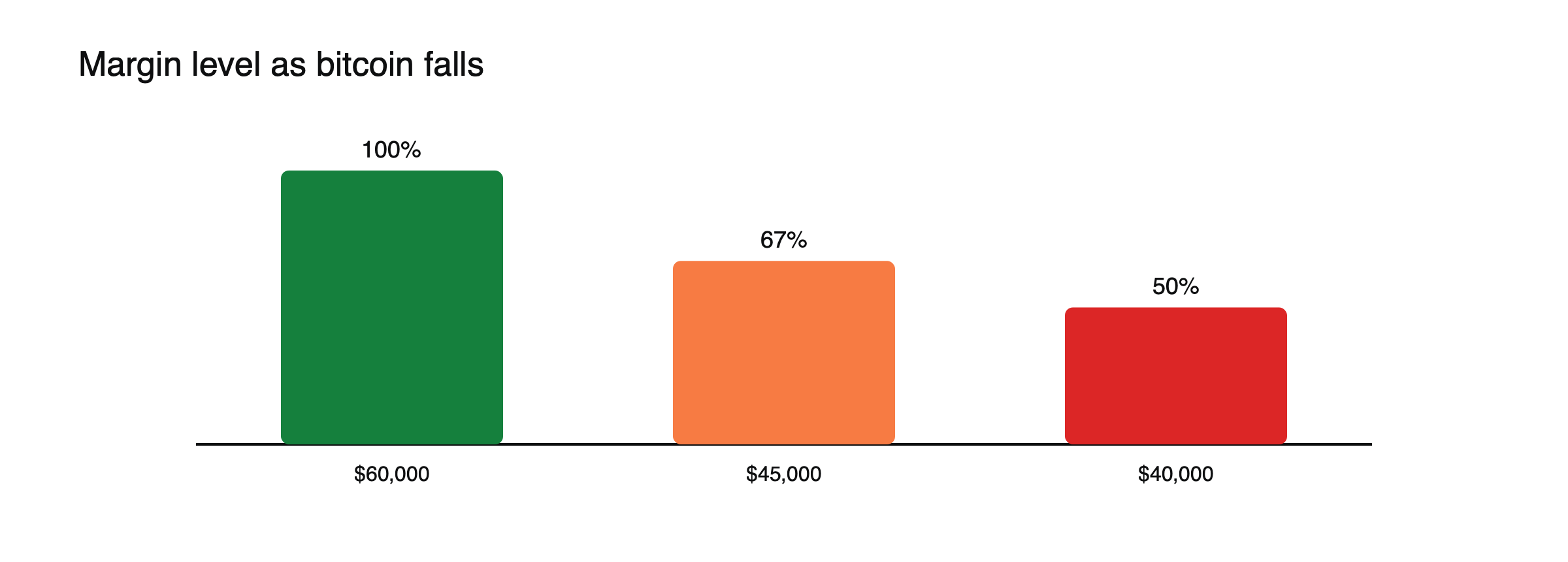
Figure: Margin level as bitcoin falls (example values).
(Example values; close-out rules depend on your provider and jurisdiction.)
The margin level as the price falls
| Bitcoin price | Equity | Used margin | Margin level |
|---|---|---|---|
| $60,000 | $3,000 | $3,000 | 100% |
| $55,000 | $2,500 | $2,750 | 91% |
| $50,000 | $2,000 | $2,500 | 80% |
| $45,000 | $1,500 | $2,250 | 67% |
| $40,000 | $1,000 | $2,000 | 50%, close-out |
(Example values, with the $3,000 deposit above.) Used margin falls as the price falls, because it is a share of the position’s current value, while equity falls twice as fast in percentage terms.
With a cash buffer, worked through
Suppose the trader deposits $4,000 instead, keeping $1,000 spare. Equity is then $4,000 plus the position’s profit or loss, and close-out comes when equity falls to half of used margin. Solving for the price gives about $26,667, a fall of about 56%, compared with 33% without the buffer. The extra $1,000 makes the position far more able to survive volatility, though it also means more money is at risk in the account. (Example values.)
Why volatility matters
A 33% fall would be extreme for a major currency but has happened in bitcoin within weeks. Gaps can also skip past the close-out level.
Providers may raise margin
In volatile periods, some providers increase margin requirements above the regulatory minimum, which can reduce free margin suddenly.
A margin increase, illustrated
Suppose a provider raises the margin rate on bitcoin from 50% to 60% during a volatile week. On the 0.1 BTC position at $50,000, used margin rises from $2,500 to $3,000, while equity, $2,000 at that price in the original example, is unchanged. The margin level falls from 80% to about 67% without any price move. Traders with little spare cash can find themselves much closer to close-out overnight.
Rising prices and margin
When bitcoin rises, equity grows and used margin rises too, because the position is worth more. The margin level improves, but adding new positions on the strength of the gains increases exposure at higher prices, where a reversal would hurt more.
How to keep a buffer
Deposit more than the minimum, use smaller sizes and set stops well before close-out. See equity, free margin and margin level explained, how to size a crypto CFD position and what a crypto CFD is.
Weekend and overnight moves
Crypto trades around the clock, and some of the largest moves happen at weekends or overnight in Europe and the Americas, when traders may not be watching. A position that is safe at Friday evening’s price can approach close-out by Sunday. Setting alerts at chosen margin levels helps react in time.
Several positions share one pool of equity
Margin and equity are calculated across the whole account. A loss on an ether position reduces the equity supporting a bitcoin position, and vice versa. Because crypto prices often move together, several positions can push the margin level down at the same time, much faster than any single position would.
A monitoring routine
- Check the margin level at least daily, and before weekends.
- Know the price at which close-out would occur.
- Keep a cash buffer above the minimum.
- Reduce size when volatility rises.
Free margin, worked through
Free margin is equity minus used margin, the amount available for new positions or to absorb losses. In the example, at $55,000, equity is $2,500 and used margin $2,750, so free margin is −$250: no new positions can be opened, even though the close-out level is still some way off. Keeping positive free margin is a useful early warning that the account is running out of room. See equity, free margin and margin level explained.
Margin calls and close-outs
Some providers send a margin call warning when the margin level falls to a set point, such as 100% or 80%, before the 50% close-out. A warning is not an obligation to act, but it is a signal to reduce positions, add funds or tighten risk. Ignoring repeated warnings in a falling market usually ends in a close-out at a worse price.
Volatility clusters
Volatile days in crypto tend to follow volatile days. After a large move, the chance of further large moves rises for a while. A margin buffer that was adequate in a calm week may be too thin after a sharp move, which is why many traders reduce size after volatility increases rather than waiting for it to subside.
Protecting margin with a hedge
A trader holding coins elsewhere, or a long CFD, can open a partial short to reduce net exposure during a volatile period. The hedge reduces swings in equity but also needs its own margin and incurs costs, so it is a temporary tool rather than a permanent fix.
Common misreadings
- Watching only price, not the margin level.
- Assuming a margin call warning gives plenty of time.
Different coins, different margins
Regulatory limits set a minimum margin, but providers can require more for smaller or more volatile coins. Suppose bitcoin requires 50% and a smaller coin 75%. A $2,000 position in the smaller coin then uses $1,500 of margin, against $1,000 for bitcoin. (Illustrative rates.) Mixing coins with different margin rates makes it important to check used margin across the whole account rather than assuming every position uses the same share.
Financing chips away at equity
Each night’s financing charge reduces equity, even if the price does not move. On a $6,000 position at 18%, about $89 a month leaves the account. Over several months, these charges can lower the margin level noticeably, bringing a position closer to close-out without any adverse price move. Including financing in margin planning avoids that slow squeeze.
Adding funds or cutting size
When the margin level falls, there are two ways to restore room: add cash or reduce positions. Adding cash keeps the position but puts more money at risk in the same trade; reducing size lowers exposure and locks in part of the loss. Deciding in advance which response fits your plan, rather than in the middle of a fast market, avoids emotional choices such as repeatedly adding money to a losing position. Whichever approach is chosen, the lesson is the same: a position that needs constant rescuing is usually too large for the account, and should be resized before the next volatile spell arrives.
Frequently asked questions
Why did my margin level drop when the price did not move?
Possibly because the provider raised the margin rate, or because financing charges reduced equity.
Can a close-out happen above the 50% level?
The rule sets a minimum. A gap can push the margin level well below 50% before positions are closed.
Leverage, margin and cost figures in this article are example values for illustration. Actual terms depend on the provider, the instrument and the rules in your country.
This article is educational content and does not constitute financial, investment, legal or tax advice. Digital assets are volatile and you may lose the amount you invest.