
What Changes When You Trade Crypto CFDs on Weekends
Crypto trades 24/7, but CFD providers may widen spreads, raise margin, charge weekend financing or pause trading at weekends. What changes and what to check.
Crypto trades around the clock, so many providers offer crypto CFDs at weekends too, but conditions change: liquidity thins, spreads can widen, some providers raise margin or charge weekend financing, and maintenance breaks may pause trading. Sharp weekend moves can also gap other markets on Monday.
What usually changes
- Liquidity: fewer institutional traders and liquidity providers are active.
- Spreads: may be wider than on weekdays. See why crypto CFD spreads widen at certain times.
- Financing: applied for each night, including weekends, by many providers.
- Margin: some providers increase it over weekends.
- Maintenance windows: brief pauses for system updates.
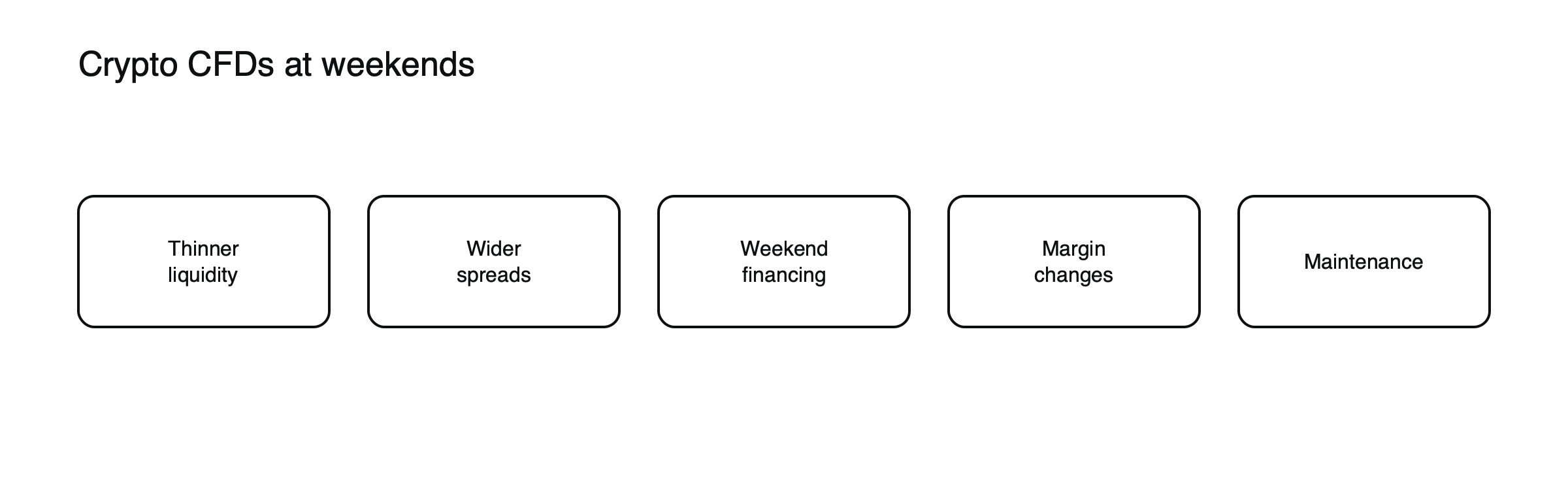
Figure: What changes at weekends.
A weekend, illustrated
Suppose a trader holds 0.1 BTC long from Friday afternoon at $60,000. (Illustrative scenario.) On Saturday, trading is quiet and the spread widens from $60 to $120. Early on Sunday, news of an exchange problem triggers a 7% fall within an hour, and a stop at $57,000 fills near $55,800, a loss of about $420 rather than the planned $300. By Sunday evening, bitcoin recovers half its fall. Three nights of financing at 18% have added about $8.88. Each weekend feature, thin liquidity, wider spreads, sudden moves and continuing financing, shows up in one position.
Why weekend moves matter
Large weekend crypto moves happen while stock, currency and futures markets are closed. Bitcoin ETFs and crypto-related shares then gap when markets reopen. See why prices gap over weekends.
Margin changes over weekends
Some providers raise margin requirements before weekends to protect against large moves while liquidity is thin. Suppose margin on a $6,000 position rises from 50% to 60% on Friday evening: used margin increases from $3,000 to $3,600, reducing free margin by $600 with no price change. Traders with little spare cash can find their margin level close to the close-out threshold before the weekend even starts.
What to check with your provider
Trading hours and breaks, weekend spreads, financing treatment for Saturday and Sunday, and whether margin rules change.
Stops in thin markets
A stop placed close to the price can be triggered by a brief spike in thin weekend trading that reverses within minutes. Wider stops, sized smaller to keep the same risk, are less likely to be hit by noise. Some traders avoid relying on stops at weekends altogether by reducing positions on Friday instead.
How to manage weekend risk
Reduce size before the weekend, keep extra free margin, and avoid placing stops in thin weekend markets where a brief spike can trigger them.
See what a crypto CFD is and bitcoin CFD vs bitcoin ETF.
Monday in other markets
Because crypto keeps trading while stock exchanges are closed, weekend crypto moves show up as gaps when Monday’s markets open in shares of crypto companies, in bitcoin ETFs and sometimes in broader risk sentiment. Traders holding those instruments can use crypto’s weekend price as an early guide to Monday’s open.
Alerts and monitoring
Price alerts and margin-level alerts on a phone allow a trader to react to weekend moves without watching screens all day. Setting them before Friday evening, at levels that would require action, is a simple way to manage weekend exposure.
Why liquidity thins
On weekdays, banks, funds, trading firms and market makers provide much of the liquidity in crypto, alongside individual traders. At weekends, many professional participants are less active, and traditional markets used for hedging, such as futures on regulated exchanges and currency markets, are closed. Providers that hedge their CFD exposure find it harder and costlier to do so, and order books on crypto exchanges are thinner. The result is wider spreads and larger moves on modest orders.
Weekend financing, worked through
A position held from Friday evening to Monday morning is usually charged for three nights. On a $6,000 position at an illustrative 18% a year, that is about $8.88, three times the daily charge of about $2.96. On many other CFDs, weekend financing is concentrated on one weekday, but crypto CFDs, trading every day, are typically charged night by night. Over a year, weekend nights make up nearly 30% of total financing.
When the provider pauses, illustrated
Suppose a provider pauses crypto CFD trading from Saturday morning to Sunday evening for maintenance, while bitcoin falls 6% on exchanges. (Illustrative scenario.) When the CFD reopens, its first price reflects the fall, and any stop orders are filled at that price, not at their levels. A position that seemed protected by a stop 3% away takes the full 6% loss. Knowing the provider’s schedule turns this from a surprise into a planned risk.
Holidays
Public holidays in major financial centers, such as Christmas and New Year, can bring weekend-like conditions on weekdays: thinner liquidity, wider spreads and occasional sharp moves. The same precautions apply.
A Friday checklist
- Is the provider open all weekend, or are there pauses?
- How much financing will the weekend add?
- Is there enough free margin for a 10% move?
- Are stops wide enough for thin markets, or should size be reduced instead?
- Are alerts set?
Common misreadings
- Assuming weekend prices are as reliable as weekday prices.
- Forgetting that financing runs every night.
Weekend moves and leverage, illustrated
A trader with a $4,000 account holds $6,000 of bitcoin exposure, using $3,000 of margin at 2:1, over the weekend. (Illustrative figures.) A 15% fall on Saturday night costs $900, leaving $3,100 of equity against $2,550 of used margin, a margin level of about 122%. A 30% fall, rare but possible, would cost $1,800, leaving equity of $2,200 against $2,100 of used margin, with free margin almost exhausted before Monday. Holding less exposure over the weekend, or more spare cash, keeps such moves survivable.
Trading the weekend deliberately
Some traders actively look for opportunities at weekends, when crypto can react to news while other markets are shut. Doing so successfully requires accepting wider spreads, planning for thin order books and avoiding large market orders that could move the price. Others treat weekends as a time to step back, closing or reducing positions on Friday and reassessing on Monday.
Weekend nights and weekday nights
Weekday nights in Europe and the Americas are also quieter for crypto, though Asian trading keeps markets active. Weekends are usually thinner across all regions at once, which is why their conditions are more pronounced.
Weekend news
Regulatory announcements, exchange incidents and statements from large holders sometimes arrive at weekends, when fewer traders are watching and liquidity is thin. Such news can move prices further than it would on a weekday, before more participants return on Monday and the move is reassessed.
Reviewing weekend trades
Comparing results from positions held over weekends with those closed on Friday shows whether weekend exposure has added to or subtracted from returns. Many traders find that weekend holds add more risk than reward, while others find specific opportunities worth the extra cost. Keeping a simple tally of weekend gains and losses over a few months turns that impression into evidence, which is a better basis for deciding whether to hold crypto CFDs over weekends in future, rather than on memory of a few weekends.
Frequently asked questions
Are crypto CFDs always available at weekends?
No. It depends on the provider; some trade crypto every day, others pause or limit trading at weekends or during maintenance.
Is financing charged for Saturday and Sunday?
Many providers charge financing for every night a crypto CFD is held, including weekends. Check the provider’s schedule.
This article is educational content and does not constitute financial, investment, legal or tax advice. Digital assets are volatile and you may lose the amount you invest.