
Cyclical vs Defensive Stocks
Cyclical stocks rise and fall with the economy; defensive stocks sell essentials and hold up better in downturns. How each behaves, with 2022 as an example.
Cyclical vs defensive stocks differ in how closely their profits follow the economy. Cyclical companies, such as carmakers, airlines, industrials and luxury retailers, earn much more in booms and much less in recessions. Defensive companies sell things people buy regardless, such as groceries, utilities and healthcare, so their profits are steadier. In 2022, defensive sectors outperformed the overall US market.
Side by side
| Cyclical | Defensive | |
|---|---|---|
| Profit sensitivity to economy | High | Low |
| Typical sectors | Consumer discretionary, industrials, materials, energy | Consumer staples, utilities, healthcare |
| In expansions | Often outperform | Often lag |
| In downturns | Often fall more | Often hold up better |
| Dividends | Variable | Often steady |
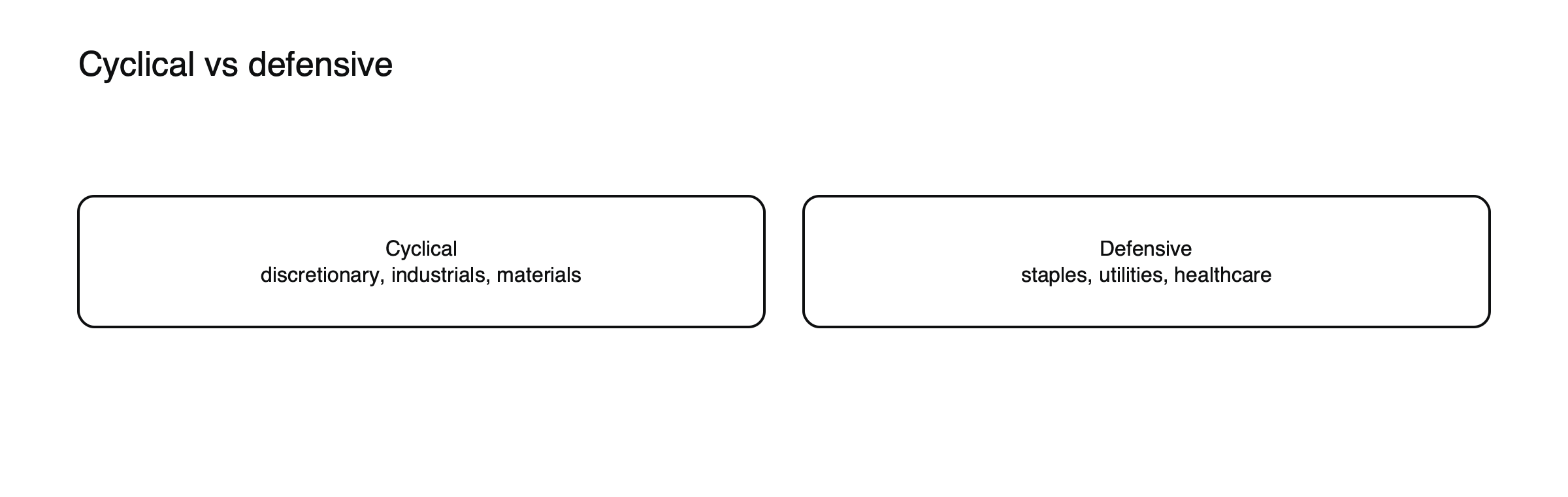
Figure: Which sectors fall in each group.
Why it happens
When incomes and confidence rise, people buy cars, travel and new gadgets; when they fall, those purchases are delayed. Spending on food, power and medicine changes much less.
Earnings through a recession, illustrated
Suppose a recession cuts consumer spending. A carmaker earning $4 a share in good times sees earnings halve to $2, as sales fall and fixed costs weigh on margins. A food producer earning $3 a share sees earnings slip only about 5%, to about $2.85, because people keep buying groceries. (Illustrative figures.) The carmaker’s share price may fall 40% or more; the food producer’s may barely move. In the recovery, the pattern usually reverses: the carmaker’s earnings rebound sharply, while the food producer’s grow slowly.
2022 as an example
As rates rose and recession fears grew in 2022, utilities, healthcare and consumer staples outperformed the broader US market, while growth and cyclical stocks lagged.
Beta and the cycle
Cyclical shares usually have a beta above 1, meaning they have tended to move more than the market, while defensive shares often have betas below 1. Beta is measured from past prices, so it can change, but it gives a quick sense of how much a share might move in a market swing. See what beta measures.
When defensive shares disappoint
Defensive stocks often carry debt and behave like bonds, so they can fall when interest rates rise sharply even if the economy is fine. See how interest rates affect stock prices.
See what sector rotation is and what moves stock prices.
Signals of a turning cycle
Investors watch leading indicators to anticipate shifts between cyclical and defensive leadership: purchasing managers’ surveys, consumer confidence, new orders, the shape of the yield curve and credit spreads. Cyclicals often start to recover before the economy itself, as markets look ahead, which is why waiting for official confirmation of a recovery usually means missing the early part of the move.
The valuation puzzle
Cyclical shares often look cheapest on P/E at the top of the cycle, when earnings are highest, and most expensive at the bottom, when earnings are depressed. Experienced investors often buy cyclicals when their P/Es look high on depressed earnings and sell when P/Es look low on peak earnings. See stock valuation mistakes.
Commodity-linked cyclicals
Energy and materials companies are cyclical in a different way: their profits follow commodity prices, which depend on supply as well as global demand. They can rise during periods of inflation or supply shocks even when the wider economy is slowing, as energy shares did in 2022.
Using the distinction as a trader
Traders often adjust their mix of cyclical and defensive positions as economic data change, and size cyclical positions smaller because of their larger swings. Around major economic releases, cyclical shares typically react more strongly. See what sector rotation is.
Defensive does not mean low risk
Defensive shares tend to fall less in recessions, but they are not immune to losses. Regulation can hit utilities and drug makers, competition can erode the brands of consumer staples companies and high debt can make them vulnerable to rising rates. Paying a very high valuation for defensiveness also reduces the protection it offers, because the share has further to fall if the market reassesses.
The early recovery, illustrated
Suppose a recession ends and economic surveys start to improve. (Illustrative scenario.) Cyclical shares, beaten down during the downturn, rise 30% over the following six months as investors anticipate rising earnings, while defensive shares gain 5%. Much of that cyclical rally happens before reported earnings recover, which is why investors watch leading indicators rather than waiting for results.
Common misreadings
- Assuming defensive shares cannot fall.
- Buying cyclicals on low P/Es at the top of the cycle.
- Ignoring interest rates when judging defensive sectors.
Balancing the two
Many investors hold a mix, leaning toward cyclicals when the economic outlook improves and toward defensives when it darkens. Because turning points are hard to time, gradual shifts usually work better than switching entirely from one group to the other.
Sizing cyclical positions
Because cyclical shares move more, a position of the same value carries more risk than a defensive one. Traders often hold smaller cyclical positions, or use wider stops sized for their larger daily ranges, so that the risk per trade stays consistent.
Finding which group a share belongs to
Standard sector classifications, published by index providers and shown on most financial websites, are the quickest guide: consumer discretionary, industrials, materials and energy are mostly cyclical, while consumer staples, utilities and healthcare are mostly defensive. Individual companies can differ from their sector, so it helps to look at how their earnings behaved in the last downturn. Earnings history is a far better guide than any single label on its own.
Frequently asked questions
Are technology shares cyclical or defensive?
Many have cyclical elements, such as semiconductors, whose demand rises and falls with spending on equipment. Some software companies with subscription revenue are more defensive. It depends on the business.
Do defensive shares ever fall a lot?
Yes, especially when interest rates rise sharply, because their steady dividends compete with bond yields.
This article is educational content and does not constitute financial, investment, legal or tax advice. Digital assets are volatile and you may lose the amount you invest.