
How to Read an Economic Calendar
Convert times to your zone, check impact ratings, note forecast and previous, then compare actual with forecast: how to read an economic calendar, step by step.
To read an economic calendar, convert release times to your time zone, focus on high-impact events for the currencies you trade, note the forecast and the previous result, and when the data comes out, compare the actual figure with the forecast. The surprise, not the level, is what moves prices.
What a calendar shows
- Time of the release.
- Currency or country affected.
- Event, such as inflation, jobs or a central bank decision.
- Impact rating, usually low, medium or high.
- Previous, forecast (consensus) and actual figures.
Using it, part by part
Set your time zone
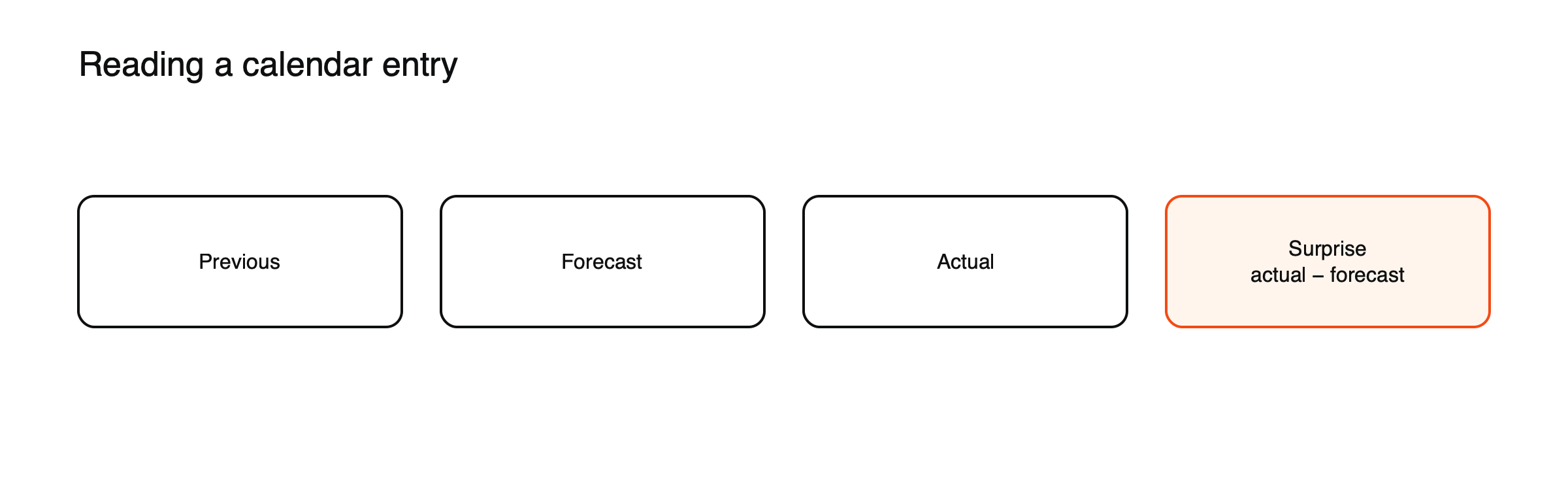
Figure: The surprise is what moves prices.
Release times shift with daylight saving in each country; check that the calendar uses your local time.
Filter by currency and impact
Focus on high-impact events for the currencies in your pairs: central bank decisions, inflation, jobs, growth and purchasing manager surveys. See what moves currency prices.
Note the forecast
The forecast is what markets already expect. Prices before the release reflect it.
Compare actual with forecast
A result well above or below forecast is a surprise; the bigger the surprise, the bigger the typical reaction. Revisions to the previous figure also matter.
Check the time to the next event
Several releases close together can make moves choppy. Plan positions and stops around them.
High-impact events by currency
| Currency | Events that usually move it most |
|---|---|
| US dollar | Jobs report, inflation, Federal Reserve decisions, retail sales |
| Euro | ECB decisions, euro area flash inflation, business surveys |
| British pound | Bank of England decisions, UK inflation and labor data |
| Japanese yen | Bank of Japan decisions, Tokyo inflation, official comments on the yen |
| Australian dollar | Reserve Bank of Australia decisions, jobs, inflation, Chinese data |
| Canadian dollar | Bank of Canada decisions, jobs, inflation, oil inventories |
Impact ratings in calendars are a starting point; what matters most changes with the economic story.
Reading a surprise, illustrated
Suppose the calendar shows euro area flash inflation with a previous figure of 2.4% and a forecast of 2.3%. (Illustrative figures.) The actual comes in at 2.6%. The surprise of 0.3 percentage points above forecast is large for this release, so markets reprice expectations for the ECB and the euro is likely to rise. Had the actual been 2.3%, the euro might barely move, even though inflation would still be above the ECB’s target.
Revisions and details
Many calendars show a revised previous figure once new data arrive. A strong headline can be offset by a downward revision to last month, and the details behind a headline, such as core inflation or wage growth, often matter more than the headline itself. Experienced traders look at the full release before deciding what it means.
Common mistakes
- Reacting to the headline without checking revisions or details.
- Ignoring that spreads widen around major releases. See what spread widening is.
See how inflation data moves currencies, how nonfarm payrolls moves the dollar and how the forex market works.
A weekly routine
At the start of each week, list the high-impact events for the currencies you trade, convert their times to your own time zone and note the forecasts. Mark central bank meetings and speeches by key officials. Decide in advance which events you will avoid, which you will hold through with smaller positions and which, if any, you plan to trade. Ten minutes on Sunday evening or Monday morning prevents most surprises.
Beyond the calendar
Calendars list scheduled events, but markets also move on unscheduled news: political developments, comments by officials, geopolitical events and market stress. Some data providers publish surprise indices that track whether recent releases have been beating or missing forecasts, which helps judge whether an economy is doing better or worse than expected overall. Combining the calendar with an awareness of these broader trends gives a fuller picture.
What the consensus really is
The forecast shown in a calendar is usually the median of a survey of economists, not a single prediction. Behind it sits a range of estimates, sometimes wide. A result outside that whole range is a bigger surprise than one that simply differs from the median. Some calendars show the high and low forecasts, which helps judge how surprising a figure really is. Markets also form their own expectations, which can drift away from the published consensus in the days before a release if other data point in a different direction.
Time zones, worked through
US data released at 8:30 a.m. New York time usually arrive at 1:30 p.m. in London. For a few weeks each spring and autumn, when the United States and Europe change their clocks on different dates, the gap shrinks by an hour, and the same release arrives at 12:30 p.m. London time. Traders in other regions face similar shifts. Setting the calendar to your own time zone, and double-checking around clock changes, avoids being caught by a release an hour earlier than expected.
Speeches, testimony and minutes
Calendars also list speeches by central bank officials, testimony to parliaments and the release of meeting minutes. These rarely carry fixed forecasts, but they can move currencies sharply when an official signals a change in thinking. Speeches by the chair or governor, and by officials known to influence decisions, deserve the most attention.
Releases that matter less than their label
Impact ratings are set in advance and do not change with circumstances. A release rated high may move markets little if the central bank has already signalled its next decision, while a medium-rated release can become important if it touches on whatever markets are currently worried about. Watching how markets reacted to the last few releases of each type gives a better sense of current importance than the rating alone.
Holidays and thin weeks
Public holidays in major centers reduce trading activity, and calendars mark them. Thin markets can make even modest releases move prices more than usual, and spreads may be wider all day. Weeks with few major releases can produce quiet, range-bound trading, while weeks packed with central bank meetings and data can be volatile from start to finish.
Linking the calendar to your journal
Recording which events were on the calendar when each trade was opened and closed helps explain results later. A run of losses may turn out to have come mostly from trades held through major releases, which suggests a simple change of habit. See how to keep a trading journal.
A calendar week, illustrated
A typical busy week for a trader focused on EUR/USD might look like this. (Illustrative schedule.)
- Monday: euro area business surveys; few US releases.
- Tuesday: German business sentiment; US job openings.
- Wednesday: US consumer inflation in the morning New York time.
- Thursday: ECB decision and press conference; US weekly jobless claims.
- Friday: euro area flash inflation; US retail sales.
With an inflation report on Wednesday and an ECB decision on Thursday, the trader might reduce positions before Wednesday’s release, reassess afterward and decide whether to hold through the ECB press conference. Laying the week out in advance turns a crowded calendar into a sequence of planned decisions rather than a series of surprises, and makes it easier to see when two events for the same pair fall close together. If a central bank speaker is scheduled the evening before the decision, or a major release from another region lands the same morning, those belong on the plan, since they can shift expectations shortly before the main event. Small additions like these often explain moves that otherwise seem to come from nowhere.
Frequently asked questions
Where does the forecast in the calendar come from?
It is usually the median of economists’ forecasts collected by data providers before the release. Different calendars may show slightly different forecasts.
Should I avoid trading around every high-impact event?
Not necessarily, but it is wise to decide in advance. Many traders reduce or close positions before the biggest events and wait for spreads to normalize afterward.
This article is educational content and does not constitute financial, investment, legal or tax advice. Digital assets are volatile and you may lose the amount you invest.