
What Is Spread Widening in Forex?
Spreads widen when liquidity thins: at rollover, in quiet hours, around news and in crises. Why it happens, how it affects stops and margin, how to plan for it.
Spread widening is when a pair’s buy-sell gap grows larger than usual. It happens when liquidity thins: around the 5 p.m. New York rollover, in quiet hours, around major data and central bank decisions, and in crises. Wider spreads raise costs and can trigger stops or margin calls even if the mid-price barely moves.
When spreads widen
- Rollover time: liquidity drops briefly around 5 p.m. New York time. See what forex rollover is.
- Quiet sessions: late New York and early Asian hours. See forex trading sessions.
- News releases: jobs, inflation and central bank announcements.
- Shocks: in January 2015, after the Swiss National Bank removed its euro floor, average EUR/CHF spreads reached thousands of pips.
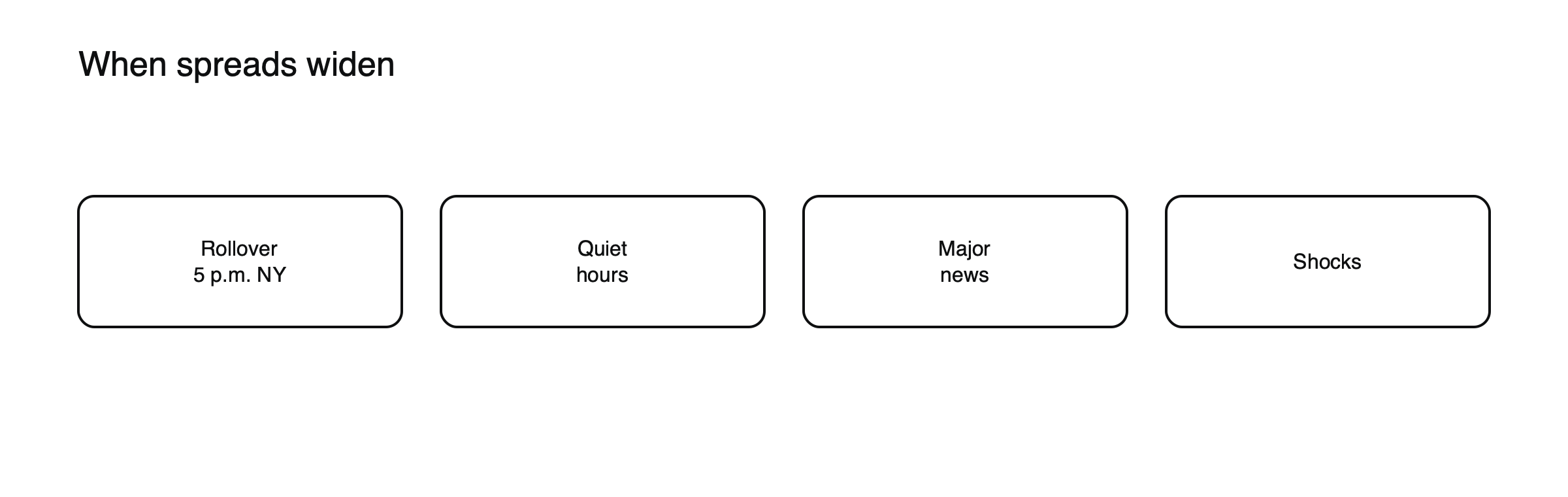
Figure: When to expect wider spreads.
A widening, in numbers
Suppose EUR/USD normally trades with a 0.6-pip spread, about $6 per standard lot. In the seconds around a major US jobs report, it widens to 3 pips, about $30 per lot. (Illustrative figures.) A trader entering at that moment pays five times the usual cost, and a long position with a stop just below the market can be closed because the bid drops by the extra spread, even if the mid-price barely moves. Once liquidity returns, often within a minute or two, the spread narrows again, but the stop has already been filled.
Why it happens
Market makers widen quotes when they are less certain about prices or when fewer counterparties are trading, to protect themselves against sudden moves.
How it affects positions
- Stops: a sell stop is triggered by the bid price; a wider spread can push the bid to your stop without the market really moving.
- Margin: equity is calculated at current bid and ask, so wider spreads reduce it and lower your margin level. See equity, free margin and margin level explained.
- Costs: entering during wide spreads costs more immediately.
Long and short positions are affected differently
Long positions are closed at the bid, so a wider spread pushes their exit price down; their stops are triggered when the bid falls to the stop level. Short positions are closed at the ask, so a wider spread pushes their exit price up; their buy stops are triggered when the ask rises to the stop level. Many charts show only the bid, which means a short position can be stopped out without the chart line ever touching the stop. Checking which price your platform uses for triggers avoids confusion.
How long it lasts
Around scheduled news, spreads usually return to normal within a few minutes as dealers update their prices. Around the daily rollover, wider spreads can last from several minutes to around an hour, depending on the pair. In genuine crises, such as the Swiss franc shock of 2015, spreads can stay extremely wide until markets stabilize, and some quotes may disappear entirely for a while.
Fixed and variable spread accounts
Some brokers offer fixed spreads that do not change in normal conditions, usually at a slightly higher average cost. Others pass on variable spreads that track the market. Fixed spreads give predictability, but terms often allow them to change in extreme conditions, and orders may be requoted. Variable spreads are usually cheaper on average but more expensive exactly when markets are busiest. Reading the broker’s terms shows which you have.
How to plan for it. Avoid opening trades just before major releases or at rollover, leave room between stops and normal price swings, and keep extra free margin. See how much the spread costs on a forex trade and what moves currency prices.
Watching the spread yourself
Most platforms can display the current spread on screen or as a line on the chart. Keeping an eye on it before placing an order, and noting the typical spread at the hours you trade, makes unusual widening obvious. Some traders log the spread paid on each trade in their journal, which over time shows whether they are regularly trading at expensive moments. See how to keep a trading journal.
A short checklist
- Is a major release or central bank decision due in the next few minutes?
- Is it close to the daily rollover or a quiet session?
- Is the current spread well above its usual level?
- Would a stop placed just beyond normal noise still survive a wider spread?
- Is there enough free margin to absorb a temporary drop in equity?
Spread widening and slippage
Spread widening and slippage often happen together but are not the same. A wider spread is visible before you trade: the quoted bid and ask move apart. Slippage happens when your order fills at a different price from the one quoted, because the market moved between the order and the fill. Around news, both can add to the cost of the same trade. Limit orders avoid slippage on entry but may not fill; market orders fill but accept whatever price is available.
Crosses and exotics
Spread widening is usually more severe in less traded pairs. A cross that normally quotes a 2-pip spread may widen to 10 or more in quiet hours, and exotic pairs can widen dramatically around local news or political events, sometimes with quotes paused altogether. Positions in these pairs need larger buffers between stops and the market, and smaller sizes.
Spreads in crises
In extreme events, spreads can widen far beyond normal ranges. After the Swiss National Bank removed its euro floor in January 2015, average EUR/CHF spreads reportedly reached thousands of pips for a time, and in the October 2016 sterling flash crash, quotes in thin early Asian trading jumped around wildly for several minutes. In such moments, stops may fill at prices that seemed impossible minutes earlier. See the 2015 Swiss franc floor removal and the 2016 pound flash crash.
How brokers price around news
Brokers usually take prices from several banks and liquidity providers, which widen their own quotes when uncertainty rises. When those providers pull back just before a major release, fewer prices are available and the best bid and ask drift apart. Some brokers add their own buffer at these moments; others pass on the market spread directly. Many regulated brokers publish their average spreads by pair and time of day, and their order execution policy explains how they handle fast markets. Comparing those documents across brokers says more about real trading costs around news than the minimum spreads shown in advertising, which usually reflect the quietest and most liquid moments rather than the busy minutes that matter most. Checking them takes only a few minutes.
Planning orders around news
A simple approach is to avoid opening new positions in the few minutes before and after major scheduled releases, and to check that existing stops are not so close that a brief widening would trigger them. Traders who want to trade the news itself usually accept wider costs as part of that strategy and size positions accordingly. See how to trade forex news.
Common misreadings
- Assuming the advertised spread applies at all times.
- Blaming market manipulation for stops hit during normal widening.
- Ignoring spread costs when comparing short-term strategies.
Frequently asked questions
Can a broker widen spreads whenever it wants?
On variable-spread accounts, spreads reflect market conditions and the broker’s pricing policy, which should be described in its terms. Regulated brokers are expected to apply their policies consistently.
Why did my stop trigger when the chart never reached it?
Often because the chart showed the bid while your stop was triggered by the ask, or because the spread widened briefly. Checking which price the platform uses for each order type explains most of these cases.
This article is educational content and does not constitute financial, investment, legal or tax advice. Digital assets are volatile and you may lose the amount you invest.