
ETF CFDs vs Buying ETF Shares
Buying ETF shares gives ownership with no financing cost; an ETF CFD gives leveraged exposure and easy shorting with daily financing. A side-by-side comparison.
ETF CFDs vs buying ETF shares comes down to ownership, leverage and holding costs. Buying ETF shares gives you a stake with dividends and no financing cost, suiting long-term investing. An ETF CFD tracks the price on margin and allows easy shorting, suiting shorter trades, but charges financing and gives no ownership.
Side by side
| ETF shares | ETF CFD | |
|---|---|---|
| Ownership | Yes | No |
| Leverage | None (unless margin account) | Yes, capped for retail |
| Short selling | Requires borrowing | Built in |
| Holding cost | Expense ratio only | Expense ratio built into price plus daily financing |
| Dividends | Paid to you | Cash adjustments |
| Best for | Long-term holding | Short-term trading, hedging |
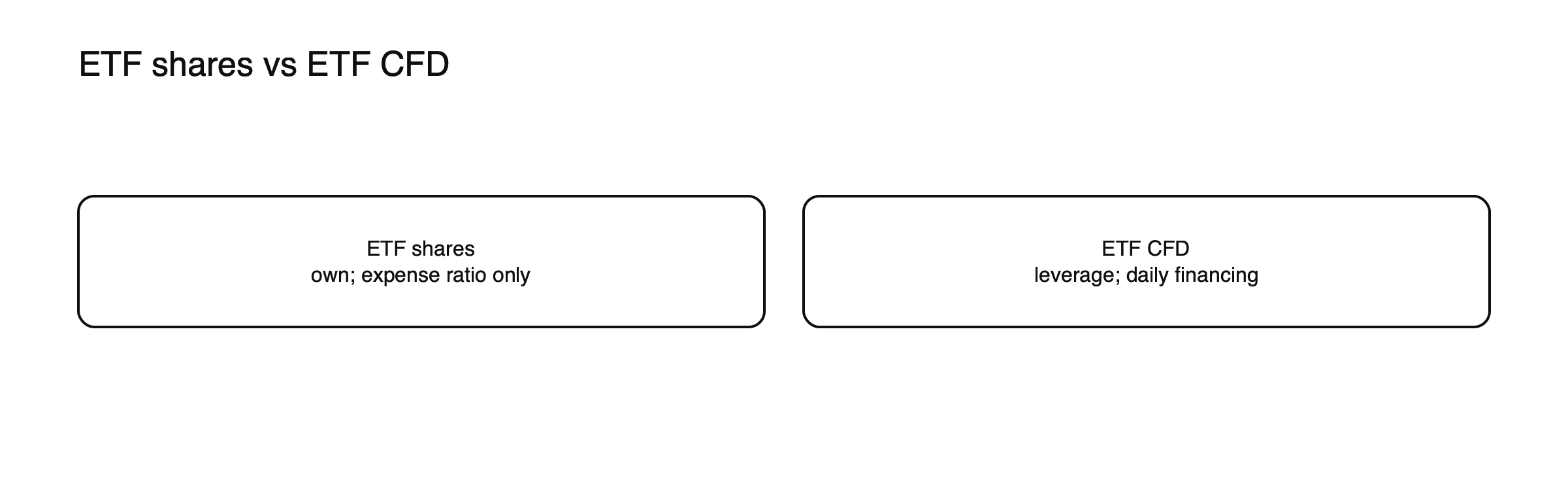
Figure: Ownership vs leveraged exposure.
Cost over time
For long holds, financing on a CFD can far exceed the ETF’s tiny expense ratio, which can be as low as 0.03% a year. See how much an ETF’s expense ratio costs over 10 years.
Costs over a month and a year, illustrated
Suppose a trader wants $10,000 of exposure to an S&P 500 ETF charging 0.03% a year. (Example values.) Owning the shares costs about $3 a year in fees, plus any commission and the spread when buying and selling. A CFD on the same ETF, with financing at an illustrative 7% a year, costs about $58 for a month and about $700 for a year, plus spreads. For a trade lasting a few days, the CFD’s financing is a few dollars and may be outweighed by its flexibility; for a year-long holding, it costs more than 200 times the fund’s fee.
Leverage risk
Leverage magnifies gains and losses; a leveraged position in a broad ETF behaves like a leveraged index trade. See how leverage changes the math on a trade.
Leverage, worked through
In the EU, retail leverage on ETF CFDs is generally capped at 5:1, the same as for single shares. A $10,000 position then needs about $2,000 of margin. A 10% fall in the ETF loses $1,000, half the margin, while the same fall on $10,000 of shares bought outright would also lose $1,000 but on $10,000 of capital. Leverage does not change the loss per dollar of exposure; it changes how much exposure a given amount of money can control, and therefore how quickly an account can be depleted. (Example values.)
Dividends
Shareholders in a distributing ETF receive its dividends in cash. A long CFD position on the same ETF receives a cash adjustment equal to the dividend, usually net of any withholding allowance, while a short position is debited. Accumulating ETFs reinvest income inside the fund, so their price already reflects it and no adjustments arise. See accumulating vs distributing ETFs.
Going short
Shorting ETF shares requires borrowing them through a broker, which may not always be possible or cheap. A CFD makes going short as simple as going long, which is useful for expressing a negative view on a market or sector, or for hedging.
When CFDs are not the cheaper route
“CFDs are cheaper” can hold for brief trades thanks to no commission or stamp duty in some markets, but not for long holds.
See what an ETF is and CFD trading vs owning the underlying asset.
Hedging a portfolio, illustrated
An investor holds $40,000 of shares broadly similar to the S&P 500 and expects a volatile two weeks around a central bank decision. Rather than selling the shares, they short $40,000 of an S&P 500 ETF through a CFD. If the market falls 5%, the portfolio loses about $2,000 and the short gains about $2,000. Two weeks of financing on the short costs relatively little compared with the protection, and the shares are kept. (Example values.)
Taxes and transaction charges
Tax treatment differs between owning ETF shares and trading CFDs, and between countries. In some markets, share purchases carry transaction taxes that CFDs do not, while gains on CFDs may be taxed differently from gains on investments. Checking local rules before choosing matters, especially for larger sums.
Which suits whom
| Goal | Usually better fit |
|---|---|
| Long-term investing | ETF shares |
| Short-term trading | ETF CFD |
| Short selling or hedging | ETF CFD |
| Receiving income | Distributing ETF shares |
| Avoiding leverage | ETF shares |
Margin calls on an ETF CFD
Because a CFD is leveraged, losses reduce account equity, and if equity falls far enough relative to the margin required, the provider can close positions. With $2,000 of margin on a $10,000 ETF position and no spare cash, EU retail rules require positions to be closed when equity falls to half the margin, after a loss of about $1,000, a 10% fall in the ETF. Holding extra cash in the account, or a smaller position, leaves more room. Owning ETF shares outright involves no such risk of forced sale. (Example values.)
Trading hours
CFDs on ETFs usually follow the trading hours of the exchange where the ETF is listed, unlike some index CFDs that trade almost around the clock. Positions held overnight can therefore gap at the next open, just like the ETF shares themselves.
Choosing in practice
Investors building long-term portfolios usually buy ETF shares and hold them, accepting no leverage in exchange for minimal costs. Traders who want short-term exposure, the ability to short or hedges around events tend to use CFDs, keeping holding periods short to limit financing. Some do both: shares for the core, CFDs for tactical positions.
Common misreadings
- Comparing CFD costs with ETF fees without considering holding period.
- Forgetting that leverage can force positions to close.
Dividend adjustments, worked through
A trader holds a long CFD on 200 shares of a distributing ETF that pays $1.50 per share. On the ex-dividend date, the price falls by about $1.50, reducing the position’s value by about $300, and the provider credits about $300 as an adjustment, sometimes slightly less to reflect withholding tax. A short position on the same ETF would be debited about $300. (Example values.)
Spreads on ETF CFDs
CFD spreads on large, liquid ETFs are usually close to the underlying ETF’s own spread, sometimes with a small markup or commission. For smaller or specialized ETFs, spreads can be wider, especially outside the busiest trading hours. Checking the spread in money at your usual size shows the real cost of each trade.
Corporate actions
If an ETF splits its shares, changes its name or is closed, CFD positions are adjusted or closed by the provider to reflect the change. Shareholders receive the equivalent treatment through their broker, including the proceeds if a fund is wound up.
A short-term trade, illustrated
A trader expects a sector ETF to rise after strong earnings from its largest members and buys a $5,000 CFD position, using $1,000 of margin at 5:1. Four days later the ETF is up 4%, a gain of $200; financing at 7% for four days costs about $4, and spreads a few dollars. Buying the shares would have produced a similar gain but tied up $5,000. (Example values.)
A quick checklist
- How long will you hold?
- Do you need to go short?
- Can the account absorb a 10% fall?
After the trade
Recording entry, exit, financing, spreads and any dividend adjustments for each ETF CFD trade shows the true net result and whether CFDs are adding value compared with simply owning the shares. Over time, that record clearly reveals which holding periods suit CFDs and which are better served by simply owning the ETF shares.
Frequently asked questions
Do I own the ETF when I trade its CFD?
No. You hold a contract on its price with the provider; you have no shares, votes or claim on the fund’s assets.
Is the ETF’s fee charged on a CFD too?
Indirectly. The fee is reflected in the ETF’s price, which the CFD follows, but the CFD’s financing is usually a far larger cost.
This article is educational content and does not constitute financial, investment, legal or tax advice. Digital assets are volatile and you may lose the amount you invest.