
How Lot Size Changes Your Risk per Pip
Standard, mini and micro lots are 100,000, 10,000 and 1,000 units. How lot size sets pip value and risk, with examples for a 30-pip stop on EUR/USD.
Forex lot size is the number of currency units in a trade, and it sets each pip’s value. A standard lot is 100,000 units, a mini 10,000 and a micro 1,000: on EUR/USD, $10, $1 and $0.10 per pip, so a 30-pip loss costs $300, $30 or $3. Choosing the lot size is choosing the risk.
Lot sizes and pip values (EUR/USD, US dollar account)
| Lot | Units | Value per pip | 30-pip move |
|---|---|---|---|
| Standard | 100,000 | $10 | $300 |
| Mini | 10,000 | $1 | $30 |
| Micro | 1,000 | $0.10 | $3 |
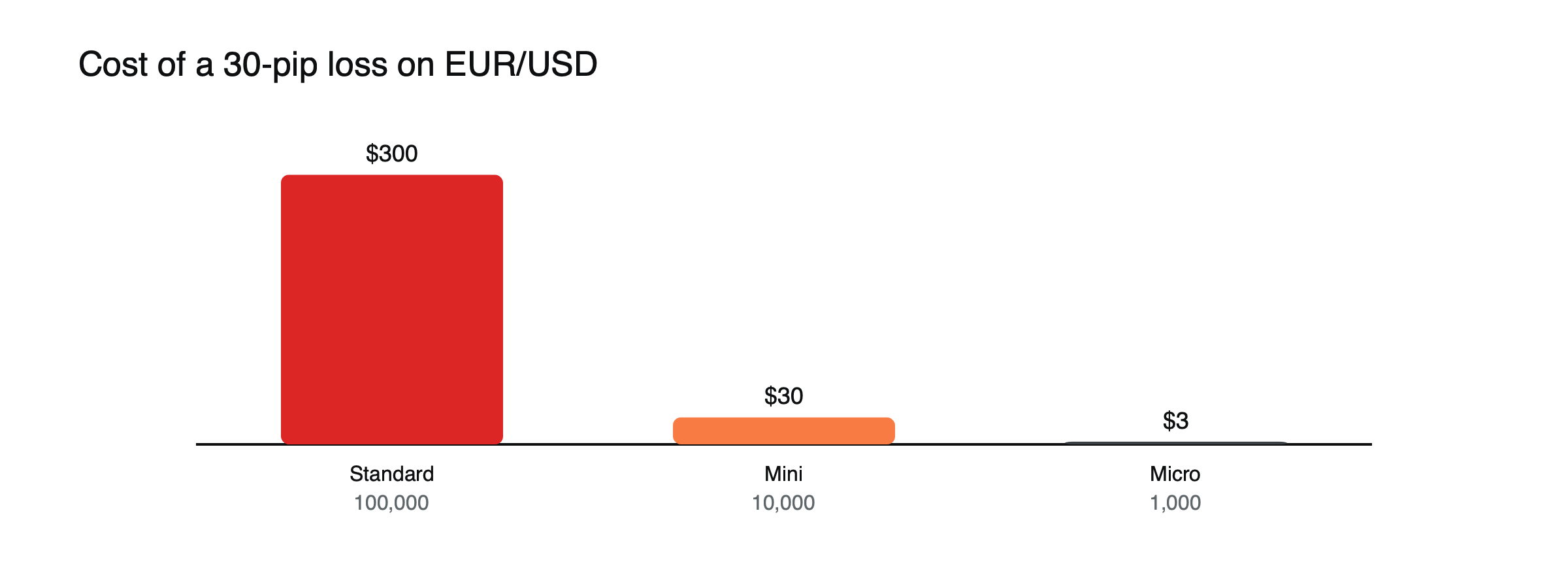
Figure: Lot size sets the cost of the same 30-pip move.
Many platforms let you trade fractions such as 0.2 or 0.05 lots: 0.2 lots is 20,000 units, or $2 per pip.
Lots on a trading platform
Most platforms express position size as a volume in lots, usually with two decimals. A volume of 1.00 is one standard lot, 0.10 is a mini lot and 0.01 a micro lot, often the smallest step allowed. Some brokers offer nano lots of 100 units for testing strategies with very small amounts. The same volume can mean different things on other instruments: on many platforms one lot of gold is 100 ounces and one lot of an index CFD is a set number of contracts, so checking the contract size in the instrument’s specification before trading avoids sizing errors.
Lot size and margin
Margin scales with lot size too. At 30:1 and EUR/USD at 1.1000, one standard lot needs about $3,667; a mini lot about $367. See how to calculate the margin for a CFD trade.
Margin for smaller lots
The same scaling applies at every size. A micro lot of EUR/USD at 1.1000, 1,000 units, needs about $36.67 of margin at 30:1; 0.05 lots, 5,000 units, about $183. Small lots make it possible to keep both margin and risk per pip modest on a small account, which is the main reason they exist.
Choosing a lot size
Work backwards from risk:
- Decide the most you will lose on the trade, for example 1% of a $10,000 account = $100.
- Set the stop where the idea fails, say 50 pips.
- Lot size = $100 ÷ (50 × $10 per standard lot) = 0.2 lots.
See how to size a CFD position using risk per trade.
The same risk on different pairs
Because pip values differ, the same lot size carries different risk on different pairs. With a dollar account, a 50-pip stop on 0.2 lots of EUR/USD risks about $100. On 0.2 lots of USD/JPY at 150, where a pip on a standard lot is worth about $6.67, the same stop risks about $67. On 0.2 lots of EUR/GBP at a GBP/USD rate of 1.27, about $127. Keeping risk constant means adjusting the lot size for each pair, not reusing the same number. See how to calculate pip value.
Lot size as the account grows
If risk per trade is set as a percentage of the account, lot sizes should change as the account does. With 1% risk and a 50-pip stop on EUR/USD, a $5,000 account trades 0.1 lots, a $10,000 account 0.2 lots and a $20,000 account 0.4 lots. Recalculating periodically keeps risk consistent through winning and losing periods rather than letting it drift.
Minimum sizes and rounding
Calculated sizes rarely land exactly on an allowed step. Rounding down keeps the actual risk at or below the plan; rounding up quietly increases it. If the smallest allowed size still risks more than your limit for a given stop, the trade needs a tighter stop, a different pair or to be skipped.
Common mistakes
- Using the same lot size on every pair, though pip values differ. See how to calculate pip value.
- Choosing lots by available margin instead of by risk.
For the basics, read what a pip is and how the forex market works.
From account to lot size: a worked plan
An account holds €15,000, and the trader risks 1% per trade, €150. (Example values.) The setup is a long EUR/USD trade with a stop 40 pips away. One standard lot of EUR/USD moves $10 a pip, about €9.09 at 1.1000. Lot size = €150 ÷ (40 × €9.09) ≈ 0.41 lots, rounded down to 0.41 or 0.40 depending on the broker’s step. Margin at 30:1 is a little under €1,400, well within the account. The steps never change: risk in money, stop in pips, pip value in the account currency, then lots.
Lots and leverage together
Lot size also sets effective leverage. One standard lot of EUR/USD, worth about $110,000, on a $10,000 account is effective leverage of about 11 to 1, even though the broker might allow 30 to 1. The same account trading 0.1 lots runs at about 1.1 to 1. Looking at lots this way shows how much of the account a normal move can take, not just how much margin a position needs.
Starting small
Micro lots exist so that new traders, or experienced traders testing a new approach, can trade with real money at very small risk. Each pip is worth about ten cents on EUR/USD, so mistakes in order entry, sizing or platform use cost little while they are being learned.
A quick sizing checklist
- How much will I lose if the stop is hit, in my account currency?
- Is the stop placed where the idea is wrong, not where the size feels comfortable?
- Have I used the right pip value for this pair?
- Is the rounded size at or below my risk limit?
Changing size during a trade
Adding to or reducing a position changes the lot size and therefore the risk per pip. Closing part of a winning trade lowers risk; adding to a losing one raises it. Each change should be checked against the same risk limit as the original entry, before the order is placed.
Frequently asked questions
What lot size should a beginner use?
There is no single right size, but the answer comes from risk, not from the account balance alone. Many beginners start with micro lots so that each pip is worth only a few cents while they learn how prices and costs behave.
Is one lot the same at every broker?
A standard lot of a currency pair is almost always 100,000 units of the base currency. Contract sizes for metals, indices and other instruments vary more, so check each broker’s specifications.
Leverage, margin and cost figures in this article are example values for illustration. Actual terms depend on the provider, the instrument and the rules in your country.
This article is educational content and does not constitute financial, investment, legal or tax advice. Digital assets are volatile and you may lose the amount you invest.