
What Happened in the GameStop Short Squeeze?
In January 2021, retail buying drove GameStop from about $17 to near $483 as short sellers covered. The timeline, the broker restrictions and the lessons.
The GameStop short squeeze came in January 2021, when retail traders, many from Reddit’s WallStreetBets, bought the stock while short interest was about 140% of float. Shorts rushed to cover, lifting it from about $17 to an intraday high near $483 on January 28 (pre-split prices). Brokers then restricted buying.
Timeline
- Late 2020: large hedge funds hold big short positions in GameStop.
- Early January 2021: the stock trades near $17–$20 as retail buying builds.
- Mid to late January: the price surges; exchanges halt trading several times for volatility.
- January 28: the stock touches about $483 intraday; Robinhood and other brokers restrict buying, citing clearinghouse collateral demands.
- February 2021: the price falls sharply as the squeeze unwinds.
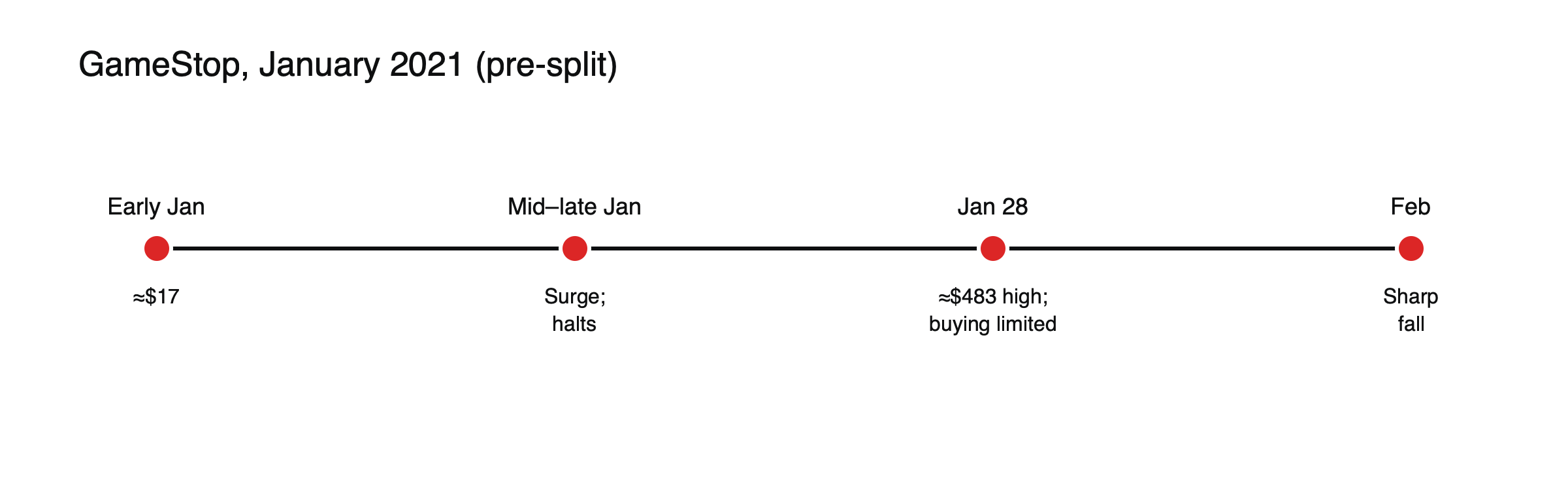
Figure: GameStop in January 2021 (pre-split prices).
The players
GameStop, a video game retailer struggling as games moved online, had become one of the most heavily shorted shares in the US market. Some hedge funds held large short positions, betting on further decline. On the other side, a growing group of individual investors, many active on the Reddit forum WallStreetBets, argued that the shares were undervalued and that the short interest set up a squeeze. One of them, Keith Gill, had posted about the stock for months under the name Roaring Kitty and became a figure of the episode. As the price soared, at least one large short-selling fund needed emergency funding from other investors.
The options effect
Many retail buyers bought short-dated call options, giving them the right to buy shares at set prices. The dealers who sold those options hedged by buying shares, and as the price rose, they needed to buy more, adding to the upward pressure alongside short covering. This combination, sometimes called a gamma squeeze, helps explain how the price moved so far so fast. See what a short squeeze is.
Why it happened
- Extreme short interest: borrowed shares had been lent more than once.
- Coordinated retail buying and call options that forced dealers to buy shares to hedge.
- Limited float relative to demand.
The broker restrictions
On January 28, Robinhood and other brokers limited purchases, saying clearinghouse collateral demands had jumped. Buying restrictions while selling remained open drew lawsuits and congressional hearings.
Why brokers restricted trading
US share trades then settled two days after the trade date. During that period, brokers must post collateral with the clearinghouse to cover the risk that trades fail to settle. As GameStop’s price and volatility exploded, the clearinghouse’s collateral demands on brokers rose sharply, and some, including Robinhood, limited purchases of the affected shares to reduce their exposure. The fact that customers could sell but not buy fueled anger and accusations, though the restrictions were explained by collateral requirements rather than any wish to help short sellers.
Meme stocks
GameStop was not alone. Other heavily shorted or beaten-down shares, such as cinema chain AMC, saw similar surges driven by online communities, becoming known as meme stocks. Their prices often moved with social media attention rather than company news, rising and falling far more than their businesses justified.
Aftermath
Hedge funds took heavy losses; Congress held hearings; the SEC’s review contributed to faster settlement, with the US moving to T+1 in May 2024. See why US stocks moved to T+1 settlement.
After 2021
GameStop’s shares fell sharply after the January peak but remained far above their pre-squeeze levels for a long time, and the company used the higher price to raise money by selling new shares. It split its shares four-for-one in 2022, which is why the January 2021 prices are usually quoted on a pre-split basis. Renewed bursts of online enthusiasm, including the return of Roaring Kitty in 2024, produced further sharp but short-lived spikes.
Regulatory follow-up
Congress held hearings with the heads of the brokers, hedge funds and trading firms involved, and the SEC published a staff report on the episode. Debate focused on payment for order flow, short-selling transparency and settlement times. The move to faster settlement, one business day after the trade from May 2024, was partly a response, because shorter settlement reduces the collateral brokers must hold. See why US stocks moved to T+1 settlement.
Lessons
Crowded shorts can unwind violently; brokers can restrict trading in extreme conditions; prices driven by positioning can fall as fast as they rise. See what a short squeeze is and what moves stock prices.
Timeline at a glance
| Date | Event | GameStop (pre-split) |
|---|---|---|
| Late 2020 | Heavy short interest; retail interest builds | Under $20 |
| Early January 2021 | Buying accelerates | About $17–$20 |
| Mid to late January | Trading halts for volatility | Surging |
| January 28, 2021 | Intraday peak; brokers restrict buying | About $483 |
| February 2021 | Squeeze unwinds | Falls sharply |
Lessons for CFD traders
For short sellers, the episode showed that crowd attention can overwhelm fundamentals and that a heavily shorted share can rise many times over within weeks, far beyond any stop. For buyers, it showed that prices driven by positioning and social media can collapse as quickly as they rise. CFD providers raised margin requirements and limited positions in meme stocks during the frenzy, which added another risk for traders already in them. See short selling myths that mislead new traders.
Trading apps and the retail wave
Commission-free trading apps, which had spread in the years before 2021, made it easy for millions of people to buy shares and options from their phones, often for the first time. Combined with pandemic savings, stimulus payments and time at home, they brought a wave of new retail investors into the market. Online forums gave that wave a way to coordinate attention on a few shares, something individual investors had rarely been able to do at such scale.
The short side in numbers
Suppose a fund was short 1,000 shares at $20. (Illustrative position.) At $40, its loss was $20,000; at $100, $80,000; near the $483 peak, about $463,000, more than twenty times the original value of the position. Every rise forced a decision between paying more to cover and risking even larger losses. Multiplied across the very large short positions in GameStop, losses ran into billions, and the need to buy back shares fed the very rise that caused them.
Why the price fell so fast
Once the largest shorts had covered and the brokers’ restrictions slowed new buying, the forces that had driven the price up disappeared. Holders who had bought near the top began to sell, options that had fueled the rise expired or lost value, and the price fell sharply within days. As in most squeezes, the decline was nearly as fast as the rise, and many late buyers lost most of their investment.
Payment for order flow
Many commission-free brokers earned money by routing customer orders to trading firms, which paid for the right to execute them, a practice known as payment for order flow. During the GameStop episode, critics questioned whether this created conflicts of interest, especially when brokers restricted buying. Brokers argued that the practice let customers trade without commissions and that the restrictions were driven by collateral requirements. The debate led to regulatory reviews of how retail orders are handled, though the practice was not banned in the United States. Similar debates continue in other countries considering their own rules on retail order handling.
Frequently asked questions
Did retail traders win?
Some who bought early and sold near the peak made large gains; many who bought late lost heavily as the price collapsed. Some short sellers took very large losses.
Why are GameStop’s 2021 prices quoted as pre-split?
Because the company split its shares four-for-one in 2022, so prices from before the split are four times higher than equivalent post-split prices.
This article is educational content and does not constitute financial, investment, legal or tax advice. Digital assets are volatile and you may lose the amount you invest.
Sources
- Anatomy of a short squeeze (VW 74% stake; free float 6% vs short interest 12%; ~€200 to over €900; GameStop short interest ~140% of float) — Janus Henderson
- What were the biggest short squeezes in history? (GameStop at $17.25 before the surge; Robinhood halted purchases on January 28, 2021) — IG
- What is a short squeeze (intraday peak of $483 on January 28, 2021) — Freedom Isn’t Free
- What is a short squeeze? (NYSE halted GameStop several times; brokers restricted trades) — BrokerChooser