
How Geopolitical Events Move Oil and Gold
Wars, sanctions and shipping threats can cut oil supply and add risk premiums, while gold draws haven demand. How each reacts, with 1973, 2022 and 2026 cases.
Geopolitical events move oil and gold differently. Oil reacts to threatened supply: wars, sanctions and blocked routes can remove barrels or add a risk premium. Gold draws safe-haven buying. In early 2026, oil jumped after military action in the Middle East closed the Strait of Hormuz in practice, and gold set records.
How oil reacts
- Actual supply loss: disrupted production or exports, as in the 1973 embargo, which quadrupled oil prices within months.
- Shipping chokepoints: threats to routes such as the Strait of Hormuz can lift prices even before supply is lost.
- Sanctions: limits on a major exporter, as with Russia in 2022.
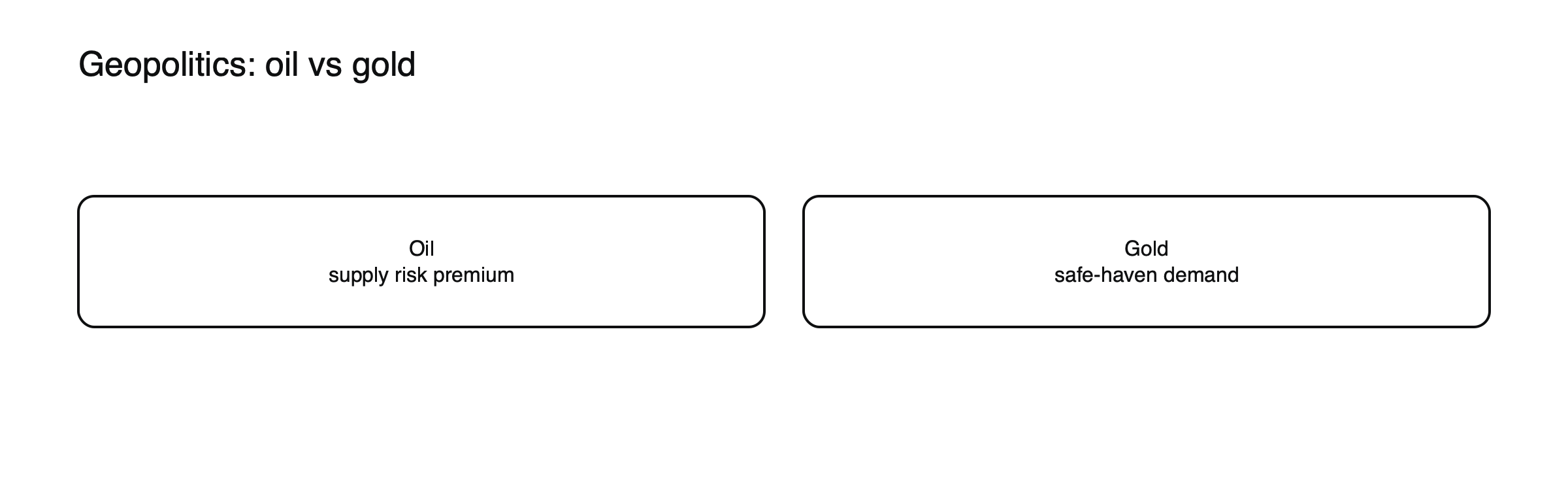
Figure: Different assets, different reactions.
2026: a case study
| Date | Event | Oil market |
|---|---|---|
| Before late February | Tensions rising | Brent around $72–73 |
| February 28 | Military action; Strait of Hormuz effectively closed | Prices jump |
| March–April | Gulf exports curtailed; OPEC+ raises targets on paper | Brent climbs toward $120 |
| April–May | OPEC+ output falls to about 33 million barrels a day from about 43 million | Prices stay high |
| June–early July | Tanker traffic gradually resumes; reserves released | Brent back near $72 |
The episode combined an actual supply loss, a chokepoint and a large risk premium, then reversed as routes reopened. Traders who bought late in the spike faced losses as the premium disappeared.
How gold reacts
Gold tends to rise on uncertainty, especially when it involves major powers, sanctions or currency concerns; central banks’ reserve buying since 2022 partly reflects sanctions risk. See how central bank gold buying affects the price.
Gold in 2026
Gold had already set a record above $5,100 in January 2026 on central bank buying and broad uncertainty, and it traded above $5,200 in late February as the conflict began. It then fell to around $4,060 by late June, showing that safe-haven buying does not guarantee lasting gains: once the immediate fear passes, other drivers, such as interest rates and positioning, reassert themselves. See what moves gold prices.
Which commodities react, and how
| Commodity | Typical reaction to geopolitical shocks |
|---|---|
| Crude oil | Rises on threats to supply or shipping routes |
| Natural gas | Rises sharply where a region depends on threatened supply |
| Gold | Rises on uncertainty, especially involving major powers or sanctions |
| Grains | React to conflicts in major exporting regions |
| Industrial metals | Can fall on growth fears or rise on sanctions against producers |
Why moves often fade
Risk premiums shrink if supply proves unaffected, other producers raise output or strategic reserves are released. Prices can reverse sharply once tensions ease.
Lessons from 1973 and 2022
The 1973 oil embargo quadrupled oil prices within a few months and contributed to years of high inflation, showing how a lasting supply cut can reshape the economy. In 2022, sanctions on Russia and the disruption of its gas exports pushed European gas prices to about ten times normal levels and lifted oil and grain prices. Both episodes involved real, sustained losses of supply, which is why their effects lasted far longer than typical geopolitical spikes.
Policy responses
Governments and producers respond to supply shocks. Strategic petroleum reserves can be released, other producers can raise output if they have spare capacity and shipping can be rerouted. In 2026, record releases of strategic reserves helped bring prices down as Hormuz traffic resumed. These responses are part of why risk premiums often shrink faster than traders expect.
What it means for traders
Expect gaps over weekends and overnight, wider spreads and fast reversals. Size positions smaller around developing events. See why prices gap over weekends.
See what moves crude oil prices, what moves gold prices and how commodity CFDs work.
Measuring geopolitical risk
Researchers publish indices that count references to geopolitical tensions in major newspapers, giving a rough measure of how much risk markets are worried about. Traders also watch implied volatility in oil and gold options, which rises when markets expect large moves. Neither predicts events, but both show when fear is building.
A playbook for developing events
- Ask whether supply has actually been lost, or only threatened.
- Check spare capacity and whether it can reach buyers.
- Reduce position size before weekends while events are developing.
- Expect wider spreads and gaps, and avoid tight stops.
- Watch for policy responses, such as reserve releases, that can reverse moves.
Sanctions and how they work
Sanctions on a major producer rarely remove all of its exports. More often, they change who buys, at what price and through which routes. After 2022, Russian oil was redirected toward buyers in Asia, often at discounts, while Western countries applied price caps on seaborne Russian crude. The net effect on global supply was smaller than the initial fears, but shipping distances, costs and benchmark spreads all changed.
Shipping and insurance
Conflicts near sea routes raise the cost of moving commodities even when supply is intact. War-risk insurance premiums rise, some shipowners avoid dangerous waters and voyages are rerouted, for example around southern Africa instead of through the Red Sea and Suez Canal. Longer voyages tie up more ships and raise freight costs, which feed into delivered prices and can widen gaps between regional benchmarks.
Grains and conflict
Wars in major farming regions affect food commodities. When conflict disrupted shipments from the Black Sea in 2022, wheat and corn prices rose sharply, and export routes became a central issue for global food security. Agricultural markets show that geopolitical risk is not limited to energy and gold.
Oil and gold reactions compared
Oil reacts to the specific risk to supply, so its moves depend on where the conflict is and which routes are threatened. Gold reacts to broader uncertainty, so it can rise even when no commodity supply is at stake. Watching both helps judge what kind of risk markets are pricing: a jump in oil with little move in gold points to a supply concern, while a jump in gold with steady oil points to wider fear.
Common misreadings
- Treating every headline as a lasting supply loss.
- Buying after the spike rather than before the risk.
- Forgetting that policy responses can reverse moves.
Weekend risk, illustrated
Suppose tensions escalate over a weekend while markets are closed. (Illustrative scenario.) A trader holding a short oil CFD from Friday at $80 sees the market reopen on Sunday evening at $86. A stop placed at $82 fills near the opening price, so the loss is about three times what was planned. Gold may gap higher at the same time. Developing geopolitical situations make weekend gaps more likely, which is why many traders reduce exposure on Fridays during such periods. See why prices gap over weekends.
Protecting against geopolitical shocks
Traders use several approaches: smaller positions, wider stops, guaranteed stops where offered, or holding gold as a partial offset to positions that would suffer in a crisis. None removes the risk entirely, and each has a cost in calm periods, but planning in advance avoids having to decide under pressure when news breaks. Writing a short plan for each developing situation, listing what would make you cut or close positions, turns a vague worry into specific actions. Reviewing that plan after the event has passed shows whether it really helped and what to change next time.
Frequently asked questions
Why do oil prices sometimes fall after a conflict begins?
Because markets often price risks in advance; if supply proves less affected than feared, or reserves are released, the premium unwinds.
Is gold always a good hedge against geopolitical risk?
It often rises during uncertainty, but its gains can fade quickly, as in 2026, and other drivers such as interest rates still matter.
This article is educational content and does not constitute financial, investment, legal or tax advice. Digital assets are volatile and you may lose the amount you invest.
Sources
- Crude oil and petroleum product prices increased sharply in 1Q26 (after military action in the Middle East on February 28 and the de facto closure of the Strait of Hormuz) — US EIA, April 2026
- The stagflation beast is stirring (1973 embargo quadrupled oil prices in a few months) — Bank of Finland Bulletin, April 2022
- Gold surges past $5,000 as investors seek safety (geopolitical tensions; central bank buying) — Barchart, January 2026
- OPEC+ lifts quotas for fourth month running despite Gulf production collapse (output 42.77 million b/d in February vs 33.19 million in April 2026; Brent $96.63 on June 8; reversal of 2023 cut of 1.65 million b/d; 21 members) — Kotak Neo, June 2026
- OPEC+ decides on additional output increase as transit through the Strait of Hormuz resumes (Brent about $72 on July 3, down from about $120 after the conflict began; +188,000 b/d from August) — FN News, July 2026
- OPEC+ to boost oil production 206,000 b/d as Iran conflict threatens supply (Hormuz carries about 20% of global crude and product flows; Saudi and UAE spare capacity about 2.5 million b/d per the IEA) — World Oil / Bloomberg, March 2026
- Gold rebounds above $4,060 (gold $4,063.17 on June 26, 2026) — USAGOLD
- Europe’s energy crisis (gas reached about ten times normal levels in 2022) — Foreign Policy, August 2022
- OPEC+ to raise oil output again as Hormuz traffic normalizes (OPEC+ output 42.77 million b/d in February vs 33.13 million in May; record releases of strategic reserves; Brent $72) — Reuters via Standard, July 2026