
Growth Stocks vs Value Stocks
Growth stocks are priced for fast future earnings; value stocks trade cheaply against current profits. How they differ, how rates affect each, what 2022 showed.
Growth vs value stocks differ in what investors pay for. Growth stocks come from companies expected to grow fast, so they trade at high valuations and rarely pay big dividends. Value stocks trade cheaply relative to current earnings or assets, often in mature industries. Which does better depends heavily on rates and the cycle.
Side by side
| Growth | Value | |
|---|---|---|
| What investors pay for | Future growth | Current profits and assets |
| Typical valuation | High P/E | Low P/E |
| Dividends | Low or none | Often higher |
| Rate sensitivity | High | Lower |
| Typical sectors | Technology, consumer internet | Financials, energy, industrials |
| Main risk | Growth disappointments | “Value traps” in declining businesses |
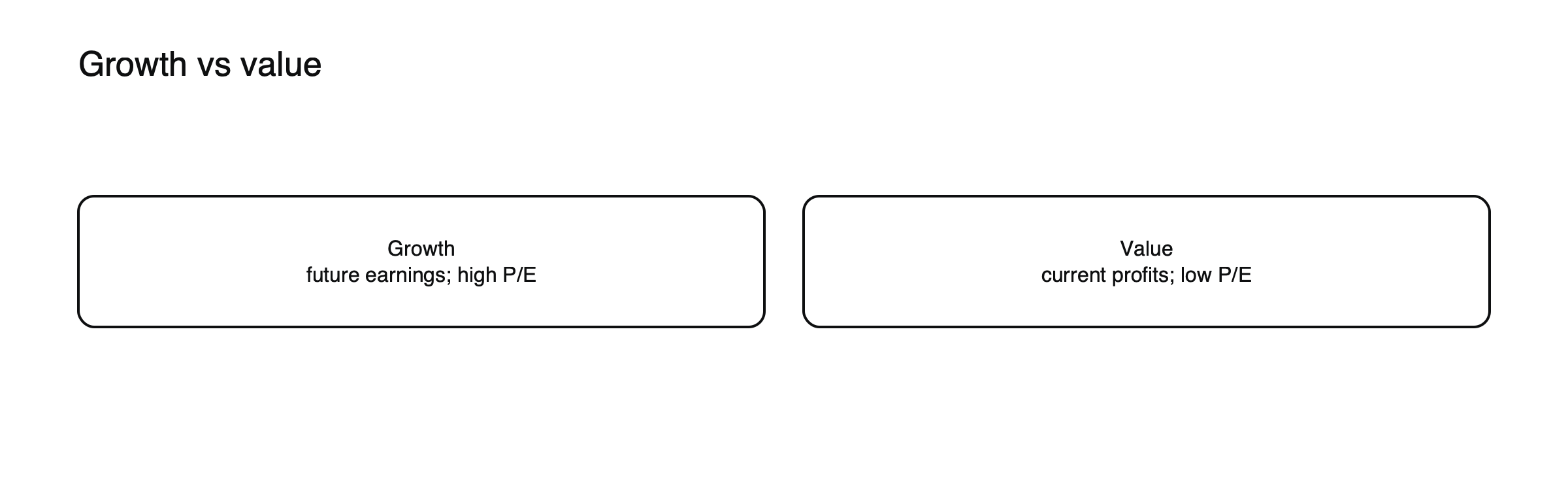
Figure: What each style pays for.
How investors classify them
Index providers sort shares into growth and value using measures such as price-to-earnings, price-to-book, dividend yield and expected earnings growth. Shares with high multiples and fast expected growth fall into growth indices; those with low multiples and higher yields fall into value indices. Many companies sit in between, and a company can move from one style to the other as its growth slows or its valuation changes.
Two companies over five years, illustrated
A growth company trades at 40 times earnings, with earnings expected to grow 25% a year. A value company trades at 10 times earnings, with 2% growth and a 4% dividend yield. If both deliver their expected growth for five years, the growth company’s earnings roughly triple; even if its P/E falls to 25 as growth matures, the share price rises about 1.9 times. The value company’s earnings rise about 10%; if its P/E improves to 12, its shares rise about 1.3 times, plus about 20% in dividends. If the growth company’s expansion slows to 10% a year instead, its shares could fall even as profits rise. (Illustrative figures.) Growth investing pays when growth arrives; value investing pays when pessimism fades.
How rates tip the balance
Growth stocks’ profits lie further in the future, so rising rates cut their value more. In 2022, as rates rose, growth stocks were hit harder; over the prior decade of low rates, growth had outperformed value by a wide margin. See why tech stocks are so sensitive to bond yields.
2022 in style terms
In 2022, rapidly rising interest rates reversed a decade of growth leadership. Growth shares, especially unprofitable technology companies, fell sharply, while value sectors such as energy, financials and consumer staples held up better or rose. Over the previous decade of very low rates, growth had outperformed value by a wide margin.
The long-run record
Academic research found value outperformed growth by about 4.3% a year from 1963 to 1991, but the edge narrowed sharply in later decades.
When cheap is a trap
“Value is safer” fails when a cheap stock is cheap for a reason. See stock valuation mistakes.
See how to calculate and read a P/E ratio and what moves stock prices.
Value traps and growth traps
A value trap is a share that looks cheap but stays cheap or gets cheaper, because its business is in lasting decline. A growth trap is the opposite: a share priced for rapid growth that never arrives, so both earnings expectations and the multiple fall together. Both traps come from taking the headline valuation at face value without examining the business behind it.
Quality as a third style
Many investors add a third lens: quality, favoring companies with high returns on capital, stable profits and strong balance sheets. Quality companies can be growth or value shares. They have often held up better in downturns, because their profits are more resilient, and they help avoid the traps that pure growth or pure value screens can fall into.
Style cycles
Leadership between growth and value tends to shift over years rather than months, driven by interest rates, inflation and the economic cycle. Value has often led when rates and inflation rise and economic growth broadens; growth has often led when rates fall and growth is scarce, making companies that can grow on their own more valuable.
Style indices and funds
Major index providers publish growth and value versions of their indices, and many funds track them. Comparing the growth and value indices shows which style is leading. Because the indices are rebalanced periodically, companies move between them as their valuations and growth rates change, so the style indices are a moving snapshot rather than fixed groups.
Growth, value and the economy
Value shares are often concentrated in sectors tied to the economic cycle and interest rates, such as banks, energy and industrials, so they tend to benefit when growth is broad and rates rise. Growth shares are concentrated in technology and other businesses that can expand regardless of the cycle, so they often lead when overall economic growth is weak and investors pay up for companies that can grow on their own.
Styles in different markets
Stock markets differ in their style mix. The US market is heavily weighted toward large technology and other growth companies, while European and UK markets contain more value sectors such as banks, energy and consumer staples. Part of the long period in which US shares outperformed Europe reflects growth outperforming value.
Checking your own exposure
Investors and traders can end up concentrated in one style without intending it, for example by holding several technology shares. Grouping positions by style, as well as by sector, shows whether a portfolio would suffer most from rising rates, which usually hurt growth, or from a downturn in cyclical sectors, which usually hurt value.
Common misreadings
- Treating a low P/E as automatically value and a bargain.
- Assuming growth will always beat value, or the reverse.
A rate rise and the two styles, illustrated
Suppose bond yields rise one percentage point. (Illustrative figures.) Investors might lower the P/E they pay for a fast-growing company from 40 to 30, a fall of 25%, because more of its value lies in distant profits. For a mature value company, they might lower the P/E from 10 to 9, a 10% fall. Neither company’s earnings changed; the different sensitivity to rates explains why growth indices often fall further than value indices when yields rise, and rise further when yields fall.
Blending the styles
Because leadership shifts unpredictably over years, many investors hold both styles, or favor approaches that combine them, such as buying growing companies at reasonable valuations. Holding both reduces the risk of being on the wrong side of a long style cycle, at the cost of never being fully in the leading style. For traders, the more useful point is to know which style each position represents, so that a rate shock does not hit every position at once.
How each style returns cash
Value companies, often mature and highly profitable, tend to return much of their cash through dividends and buybacks. Growth companies usually reinvest most of their cash to expand, paying small dividends or none. That difference shapes total returns: value investors rely more on income, growth investors on rising share prices. Investors who need regular income often lean toward value; those who can wait for capital gains often accept growth’s lower dividend payouts in exchange.
Frequently asked questions
Is value investing dead?
No. Value lagged growth for much of the 2010s, but it led in 2022 as rates rose. Its long-run edge has narrowed, and its performance varies widely by period.
Can a company be both growth and value?
Yes. A company growing faster than average but trading at a modest multiple, sometimes called growth at a reasonable price, combines features of both.
This article is educational content and does not constitute financial, investment, legal or tax advice. Digital assets are volatile and you may lose the amount you invest.
Sources
- Value stocks outlook 2022 (growth beat value over the prior decade; value ahead early in 2022; Fama-French findings) — Fortune, January 2022
- Sectors for investors to watch in 2023 (defensive sectors outperformed in 2022; growth hurt more by rising rates) — Masterworks, December 2022
- 6 types of stocks you should know (common vs preferred; growth vs value; sectors) — NerdWallet