
Hawkish vs Dovish: What Central Bank Language Signals
Hawkish means leaning toward tighter policy; dovish means leaning toward easier policy. How each tone moves currencies and bonds, with examples and caveats.
Hawkish vs dovish describes which way a central bank is leaning. Hawkish means focused on fighting inflation and open to higher rates or keeping them high; dovish means focused on growth and jobs and open to cutting rates. Currencies usually strengthen when a central bank sounds more hawkish than expected and weaken when it sounds more dovish.
Side by side
| Hawkish | Dovish | |
|---|---|---|
| Priority | Controlling inflation | Supporting growth and jobs |
| Rate bias | Raise or hold high | Cut or hold low |
| Typical words | “Vigilant,” “further tightening,” “persistent inflation” | “Patient,” “downside risks,” “appropriate to ease” |
| Usual currency effect | Stronger | Weaker |
| Usual bond effect | Short-term yields rise | Short-term yields fall |
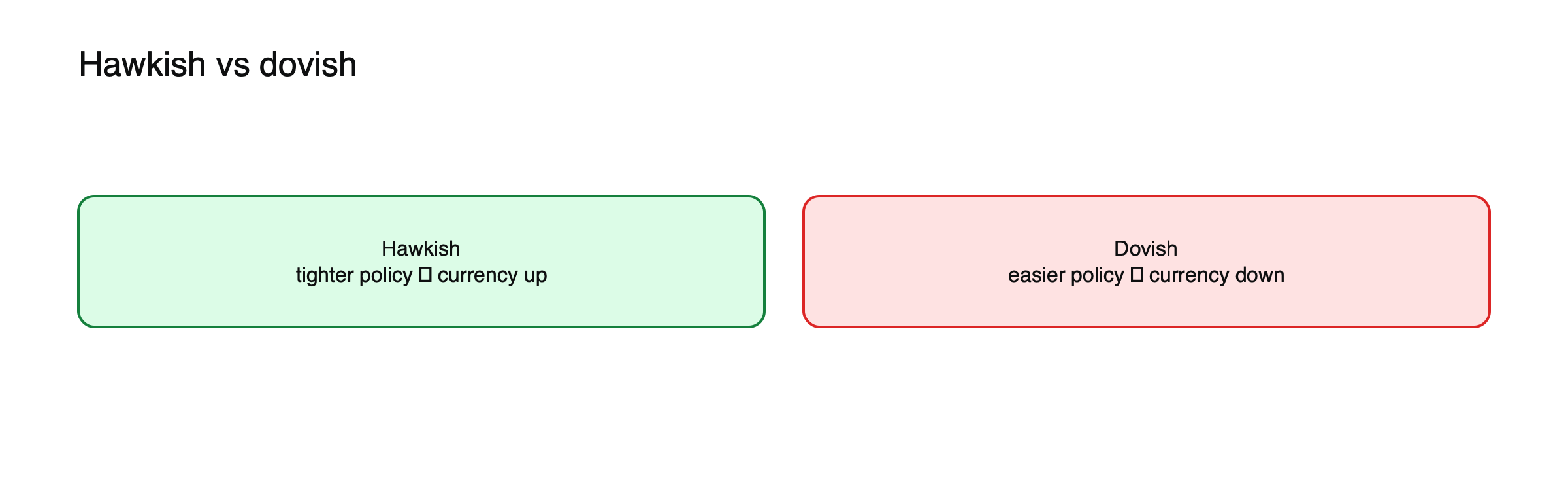
Figure: What each tone usually means for the currency.
Why tone matters as much as action
Markets price expected decisions in advance. The tone tells them about the next decisions. When the Bank of Japan unexpectedly widened its yield band in December 2022, markets read it as a hawkish shift and the yen had its biggest one-day jump since 1998.
The September 2024 Fed cut
When the Federal Reserve cut rates in September 2024 for the first time since 2020, the size of the cut and the message about future moves mattered as much as the decision itself. Markets reacted not only to the move but to how the Fed described the path ahead, with assets such as gold reaching records after the announcement. The episode is a reminder that the guidance about the next steps often carries more weight than the step just taken.
Relative, not absolute
What counts is the tone compared with expectations and with other central banks. A rate hike delivered with soft guidance can be read as dovish, weakening the currency. See how central bank decisions move currencies.
When hawkish does not help the currency
A very hawkish stance can hurt a currency if markets think it will cause a recession, or if inflation is seen as out of control. Context decides.
A decision read three ways
Suppose a central bank holds its rate, as every economist expected. (Illustrative scenario.)
- Hawkish hold: the statement says inflation remains too high and further increases cannot be ruled out. Short-term yields rise and the currency strengthens.
- Neutral hold: the statement barely changes. Markets move little.
- Dovish hold: the statement drops a reference to further tightening and mentions risks to growth. Yields fall and the currency weakens.
The rate was the same in all three cases; the words decided the market’s reaction.
Projections, dots and votes
Central banks give markets more than a statement. The Federal Reserve publishes officials’ projections for future rates, often called the dot plot. The Bank of England publishes how each member voted. The ECB and others publish staff forecasts for growth and inflation. A shift in these, such as more officials projecting cuts or a vote moving from 7–2 to 5–4, can move currencies even when the decision itself is unchanged.
Hawks and doves inside the committee
Rate-setting committees include members who lean hawkish and others who lean dovish. Speeches by individual members between meetings are watched for clues about how the balance is shifting. A known hawk sounding cautious about further increases, or a dove expressing concern about inflation, can be more informative than a speech that simply repeats the official line.
Hawkish cuts and dovish hikes
A central bank can cut rates and still sound hawkish, for example by signalling that it does not plan to cut again soon. Markets may then push the currency higher, because the expected path of rates is less dovish than they had feared. Likewise, a hike accompanied by hints that it is the last can weaken the currency. What matters is the whole expected path, not the single decision.
How to read the tone
Compare statements with the previous one, watch changes in projections and listen to the press conference. See how to read a central bank statement and what moves currency prices.
Tone across central banks
Because currencies are priced in pairs, traders compare the tone of two central banks at once. A hawkish Federal Reserve and a dovish ECB together tend to push EUR/USD lower; if both turn hawkish at the same time, the effects can largely cancel. Tracking a simple scorecard of each major central bank’s stance, updated after every meeting, helps make sense of moves across many pairs. See how interest rate differentials drive currency pairs.
Common misreadings
- Reacting to the decision headline before reading the guidance.
- Treating a single official’s speech as the committee’s view.
- Assuming a hawkish central bank always means a stronger currency, regardless of recession risk.
A short glossary of central bank phrases
| Phrase | Usual reading |
|---|---|
| “Remain vigilant” on inflation | Hawkish; rates may stay high or rise |
| “Further policy firming may be appropriate” | Clearly hawkish |
| “Data dependent” | Neutral; next move undecided |
| “Risks are more balanced” | A step away from hawkish |
| “Patient” | Dovish; no rush to raise rates |
| “Appropriate to reduce the degree of restriction” | Dovish; cuts likely |
(Typical interpretations; exact wording varies by central bank, and the change from the previous statement matters most.)
Forward guidance
Forward guidance is a central bank’s description of how it expects policy to evolve, such as saying rates are likely to stay high for some time or that further cuts may follow. It is one of the most powerful tools for steering markets, because it shapes expectations of many future decisions at once. Changes in guidance, even a single word, are therefore treated as policy moves in their own right. Suppose a central bank replaces “further increases may be needed” with “policy is well positioned.” (Illustrative wording.) Markets will usually read that as the end of the hiking cycle, pushing short-term yields down and weakening the currency, even though nothing about the current rate has changed. Guidance can also be dropped altogether when uncertainty is high, which markets often read as a signal that the bank wants maximum flexibility for its next decision. Reading guidance carefully is often far more useful than reading the decision itself.
How markets measure tone
Traders do not rely on impressions alone. They watch how interest rate futures and swaps reprice in the minutes after a statement: if the expected number of future cuts falls, the market has read the message as hawkish; if it rises, dovish. Two-year government bond yields usually move first, and currencies follow. Some analysts also compare the wording of successive statements line by line to spot changes.
Decision day, step by step
The statement is released first, and markets react within seconds. The press conference follows, often bringing a second, sometimes larger, move as the chair answers questions. Weeks later, the minutes or account of the meeting add detail about the debate. Positions opened on the first headline can be caught out by the press conference, which is why many traders wait for it before acting.
A tone checklist
- What changed in the statement compared with last time?
- Did projections or the vote split shift?
- How did futures and two-year yields react?
- Was the tone more or less hawkish than the other central bank in the pair?
Frequently asked questions
Where do the terms hawk and dove come from?
They were borrowed from politics, where hawks favor a hard line and doves a softer approach. In central banking, hawks prioritize fighting inflation and doves supporting growth and employment.
Can the same central bank be hawkish and dovish in one meeting?
Yes. A statement can contain hawkish and dovish elements, and markets judge the overall balance against what they expected.
This article is educational content and does not constitute financial, investment, legal or tax advice. Digital assets are volatile and you may lose the amount you invest.