
How Central Bank Decisions Move Currencies
Central bank decisions move currencies through surprises in rates, guidance and tools. Examples from the Bank of Japan, the Swiss National Bank and the Fed.
Central bank decisions move currencies when they change the expected path of rates or policy. A surprise rate move, new guidance or a new tool can move a currency more in minutes than weeks of data. When the Bank of Japan unexpectedly loosened its bond-yield cap in December 2022, the yen had its biggest one-day surge since 1998.
How often central banks decide
The major central banks set policy at scheduled meetings, usually around eight times a year for the Federal Reserve, the European Central Bank, the Bank of England and the Bank of Japan, with dates published well in advance. Each meeting is a known event on the calendar, so traders can prepare. Unscheduled moves are rare but powerful: in March 2020, as the pandemic hit markets, the Federal Reserve cut rates between meetings, a sign of how serious the situation had become.
What markets react to
- The decision vs expectations: only surprises move prices much.
- Guidance and projections: signals about future moves.
- Tone: whether policymakers sound hawkish (leaning toward tighter policy) or dovish (leaning toward easier policy).
- Balance sheet and other tools: bond buying, yield caps, currency floors.
The tools beyond interest rates
Policy rates are the main tool, but not the only one. Central banks can buy government bonds to push down longer-term yields, cap yields at a target, as the Bank of Japan did for years, or sell bonds to reduce their balance sheets. Some have set floors or ceilings for their currencies, as Switzerland did from 2011 to 2015. Changes to any of these can move currencies as much as a rate decision, because they change the expected return on holding that currency. See currency intervention.
Three examples
Bank of Japan, December 2022. Widening the 10-year yield band was read as a step toward tighter policy; the yen surged.
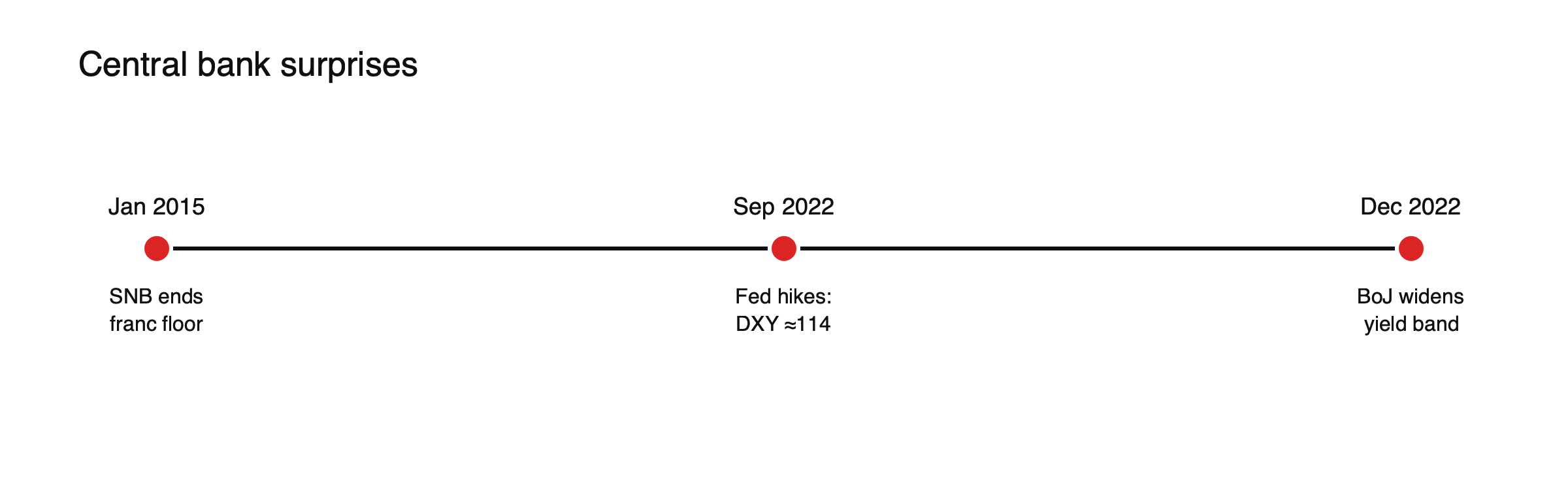
Figure: Three policy moves that shook currencies.
Swiss National Bank, January 2015. Abandoning the 1.20 floor against the euro without warning sent the franc up about 30% within minutes.
Federal Reserve, 2022. The fastest rate rises in decades pushed the dollar index to a 20-year high near 114 in September 2022.
Anatomy of a decision day
| Time | What happens | Typical market behavior |
|---|---|---|
| Hours before | Positioning and caution | Spreads widen slightly; volumes fall |
| Announcement | Decision and statement released | First, fast move as algorithms read the text |
| Minutes after | Traders digest details, projections, votes | Move extends or reverses |
| Press conference | Chair answers questions | Often a second, larger move |
| Days and weeks after | Minutes, speeches, data | Market refines its view of the path |
Why the effect differs
A rate hike that markets already expected may leave a currency flat or even weaker if the guidance sounds softer than hoped. The relative stance against other central banks matters too. See what happens to currencies when a central bank pivots.
A decision, illustrated
Suppose the Bank of England is expected to hold at 4.5%, but surprises with a cut to 4.25%. (Illustrative scenario.) In the first seconds, sterling drops as short-term gilt yields fall. In the statement, the bank says further cuts will be gradual and depend on wage data; sterling recovers part of its fall. At the press conference, the governor stresses that inflation risks remain, and sterling ends the day only modestly lower. The decision was a surprise, but the guidance limited its effect, which is why traders wait for the full picture before judging a move.
Divergence between central banks
Currencies respond most strongly when central banks move in different directions. A bank cutting while its counterpart holds or raises rates widens the expected rate gap and can start a trend lasting months. When major central banks all move together, as in the coordinated hiking of 2022 or easing cycles in downturns, the effects on exchange rates partly cancel. See how interest rate differentials drive currency pairs.
Risk around decisions
Spreads widen and prices can gap around announcements and press conferences. See what markets listen for in a central bank meeting and what moves currency prices.
Policy pivots
The largest currency moves often come at turning points: the first rate cut after a hiking cycle, the first hike after years of low rates, or the end of an unusual policy such as negative rates. Markets try to anticipate these pivots, so the run-up can matter as much as the decision itself, and a pivot that comes sooner or later than expected can produce sharp repricing. See hawkish vs dovish.
A decision-day plan
- Check the expected decision and how certain markets are about it.
- Note the time of the statement and the press conference.
- Decide whether to hold, reduce or close positions in the currency.
- Avoid placing tight stops just before the announcement.
- Wait for the press conference before acting on the first move.
Common misreadings
- Treating a rate change as a surprise when markets had fully priced it.
- Ignoring changes to projections or votes.
- Assuming a hike always strengthens a currency, whatever the guidance says.
How markets price decisions in advance
Before most meetings, futures and swap markets already show the probability of each outcome, such as a 90% chance of a hold and a 10% chance of a cut. Analysts and the financial press repeat these odds, and central banks often guide expectations through speeches in the weeks before. As a result, the decision itself is usually well known; what remains uncertain is the guidance about future meetings. Checking these probabilities before a decision shows how big a surprise would be needed to move the currency.
Independence and credibility
A central bank’s credibility affects how its currency reacts. When markets trust that it will act to keep inflation under control, its signals carry weight and the currency tends to respond in the expected direction. When its independence is questioned, for example because of political pressure to cut rates, the same signals may be discounted, and the currency can weaken even after a rate rise. Political comments about a central bank can therefore move a currency on their own.
Balance sheet decisions
Decisions to slow, stop or reverse bond buying can matter as much as rate changes. Reducing bond holdings tends to push longer-term yields up, which can support a currency, while announcing new purchases usually weighs on it. These decisions are often made at the same meetings as rate decisions, so traders read the whole package rather than the rate alone.
Surprises by design
Most central banks try to avoid surprising markets, preferring to signal moves in advance so that financial conditions adjust smoothly. Occasionally, though, a bank surprises on purpose, for example with a larger-than-expected rate rise meant to show that it is serious about inflation, or an unexpected policy change timed to catch speculators off guard, as Switzerland did in 2015. Such moves tend to produce the biggest currency reactions of all, and they are a reminder that the market’s expected path is a forecast, not a promise. Markets also remember surprises. A central bank that has shocked them once may find its later signals treated with more caution, which can make future moves in its currency larger and less predictable. Investors may demand extra compensation for holding a currency whose central bank has a history of sudden changes.
Frequently asked questions
Why did the currency fall after a rate hike?
Usually because the hike was expected and the guidance suggested fewer increases ahead than markets had hoped, so the overall path of rates looked lower than before.
Do central banks ever act between meetings?
Rarely, and usually only in emergencies, such as the Federal Reserve’s cuts in March 2020. Such moves tend to produce very large market reactions.
This article is educational content and does not constitute financial, investment, legal or tax advice. Digital assets are volatile and you may lose the amount you invest.