
How Index Rebalancing Works and Why It Moves Stocks
Index providers add, remove and reweight members, and tracking funds must trade. Why rebalancing moves stocks, with Tesla's 2020 S&P 500 entry as example.
Index rebalancing is when a provider adds, removes or reweights members, usually on a set schedule. Funds tracking the index must then trade to match it, often at the same closing price, and those forced trades can move prices: before Tesla joined the S&P 500 in December 2020, index funds were expected to buy over $80 billion.
What triggers a rebalance
- Scheduled reviews: many indices review quarterly; others semi-annually or annually.
- Corporate events: mergers, spin-offs and delistings.
- Weight caps: rules that limit single-stock influence, such as the Nikkei 225’s 10% cap applied at April and October reviews.
The schedule
Many major indices review their membership on fixed dates. The S&P 500 rebalances quarterly, on the third Friday of March, June, September and December, with changes announced a few days in advance. The FTSE 100 is reviewed quarterly based on company size. Other providers rebalance semi-annually or annually, and some changes happen at any time when companies are acquired or delisted. Announcement dates and effective dates are published, so traders can plan around them.
Why stocks move
Index funds must trade regardless of price, typically at the close on the effective date. Additions see buying pressure; deletions see selling. Other members may be sold to make room, as funds sold other stocks to buy Tesla.
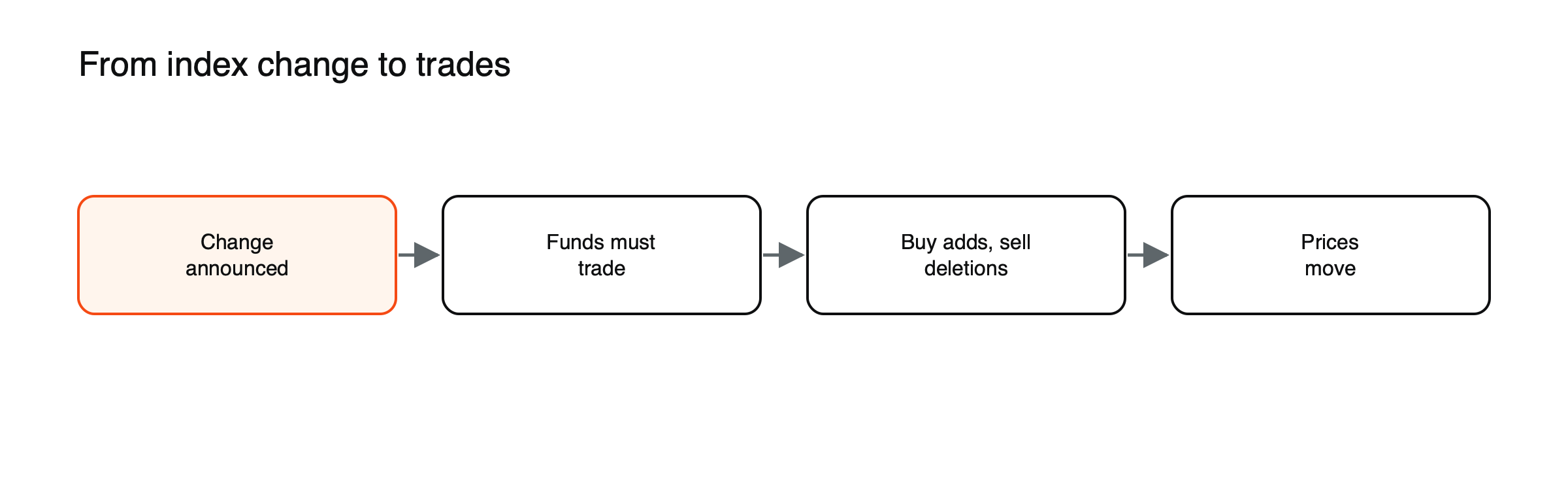
Figure: How rebalancing turns into trades.
An addition, illustrated
Suppose a company worth $40 billion is added to an index tracked by funds holding a combined 20% of each member’s free float. Those funds must buy about $8 billion of the company’s shares by the effective date, many of them at the closing price on that day. If the company normally trades $500 million of shares a day, the index buying equals about 16 days of normal volume. The price often rises between the announcement and the effective date, and can fall back after the buying is done. (Illustrative figures.)
The Tesla example
Tesla was the largest company ever added to the S&P 500. Combined with quarterly rebalancing, expected index trading topped $100 billion around the inclusion. Research suggests highly volatile additions tend to become less volatile in the year after joining.
Deletions and the stocks that replace them
When a company is removed, often because its value has fallen or it has been acquired, index funds must sell it, usually at the close on the effective date. Shares being deleted can fall further, and shares replacing them can rise. Sometimes deleted shares recover after the selling pressure ends, which some investors try to anticipate. Stocks moving between indices, such as from a mid-cap index into a large-cap one, face selling from one group of funds and buying from another.
Weight caps and reweighting
Some indices cap the weight of any single company, either at regular reviews or when a company grows too large. When a cap applies, funds must sell some of that company’s shares and buy the others. The Nikkei 225’s 10% cap and caps on technology-heavy indices are examples. Reweighting can create flows in large companies that have nothing to do with their business performance.
What it means for traders:
- Volume spikes near the close on rebalance days.
- Pre-announcement moves: prices often adjust between the announcement and the effective date.
- Index CFDs: the index level itself is unaffected by rebalancing, but member stocks can move sharply.
See why a handful of stocks can drive an entire index, how stock index CFDs work and what moves stock market indices.
The closing auction
Most index funds trade at the official closing price on the effective date to match the index exactly. Exchanges run closing auctions that match large volumes of orders at a single price, and on major rebalancing days these auctions can be among the busiest of the year. Large imbalances between buying and selling in the auction can move closing prices sharply, which matters for anyone holding positions overnight.
Growth of passive investing
As more money is invested in funds that track indices, the trading required at each rebalance has grown. Some analysts argue this makes index membership itself more important for share prices; others note that changes are announced in advance and arbitrageurs trade ahead of them, spreading the impact. Either way, rebalancing days have become significant events in the market calendar.
Eligibility rules
Each index has rules for membership. The S&P 500, for example, requires companies to meet size, liquidity and free-float thresholds and to have positive combined earnings over the most recent four quarters, among other criteria, with a committee making final decisions. That is why some large companies are not members: a large but unprofitable company may wait years before joining. Knowing the rules helps anticipate which companies might be added.
Small-cap index reconstitutions
Indices of smaller companies are often reconstituted on a fixed annual or semi-annual schedule, with many companies moving in and out at once. These events can involve very large trading volumes in shares that are normally less liquid, producing sharp price moves around the effective date and heavy closing auctions.
Rebalancing and CFD positions
For traders holding CFDs on individual shares that are joining or leaving an index, rebalancing can produce sharp price moves around the announcement and the effective date, often concentrated at the close. Wider spreads and larger closing moves are common. Index CFDs themselves are not affected at the moment of the change, but the shares inside them may be.
Common misreadings
- Assuming an addition always means a lasting rise.
- Forgetting that the index level is unchanged by rebalancing itself.
How changes are announced
Index providers publish changes in press releases, typically several days before they take effect, often after the market closes. Shares being added frequently jump in after-hours trading on the announcement. Quarterly review dates are known well in advance, so traders and analysts publish predictions of likely additions and deletions, which means some of the price impact may occur before the official announcement.
Rebalancing and volatility
Shares newly added to a major index may become less volatile over time as they are held by more long-term funds, while the days around the change itself can be very volatile. Research on S&P 500 additions has found that highly volatile companies tended to become calmer in the year after joining. For the index as a whole, the effect is usually small, because the trading is spread across many members and offset by other flows.
Using the calendar
Adding index review dates, announcement dates and effective dates to a trading calendar takes little time and avoids surprises in member shares. On effective days, traders holding member shares often avoid placing orders that would be filled in the closing auction unless they intend to trade it, since closing prices can move sharply. A little planning ahead prevents unexpected fills at distorted closing prices.
Frequently asked questions
Does rebalancing change the index level?
No. Providers adjust the divisor so that the index level is unchanged at the moment of the change. Only individual members’ prices may move because of the trading involved.
Can traders profit from rebalancing?
Some professional traders try to anticipate additions and deletions, but the opportunities are well known and competitive. For most traders, the main point is to be aware of rebalancing days and their effect on member stocks and closing prices.
This article is educational content and does not constitute financial, investment, legal or tax advice. Digital assets are volatile and you may lose the amount you invest.
Sources
- Wall Street braces for trading surge as Tesla enters S&P 500 (index funds to buy more than $80 billion; over $100 billion with quarterly rebalancing) — AP via Audacy, December 2020
- Tesla’s addition to S&P 500 (first day December 21, 2020; volatile additions tend to become less volatile) — Advisor Perspectives
- Nikkei 225 to cap Fast Retailing share weight (reviews in April and October) — Nikkei Asia