
Investment-Grade vs High-Yield Bonds
Investment-grade bonds have higher ratings and lower yields; high-yield bonds pay more for higher default risk and act more like stocks. How they compare.
Investment-grade vs high-yield bonds are split by credit rating. Investment-grade bonds, rated BBB− or higher (Baa3 at Moody’s), come from issuers judged likely to repay and pay lower yields. High-yield, or “junk,” bonds are rated lower and pay more for greater default risk, moving more with the economy and stocks.
Side by side
| Investment grade | High yield | |
|---|---|---|
| Ratings | BBB−/Baa3 and above | Below BBB−/Baa3 |
| Default risk | Lower | Higher |
| Yield | Lower | Higher |
| Main sensitivity | Interest rates | Credit conditions and economy |
| Behavior in recessions | More defensive | Falls with stocks |
| Typical issuers | Large, stable companies, governments | Smaller or more indebted firms |
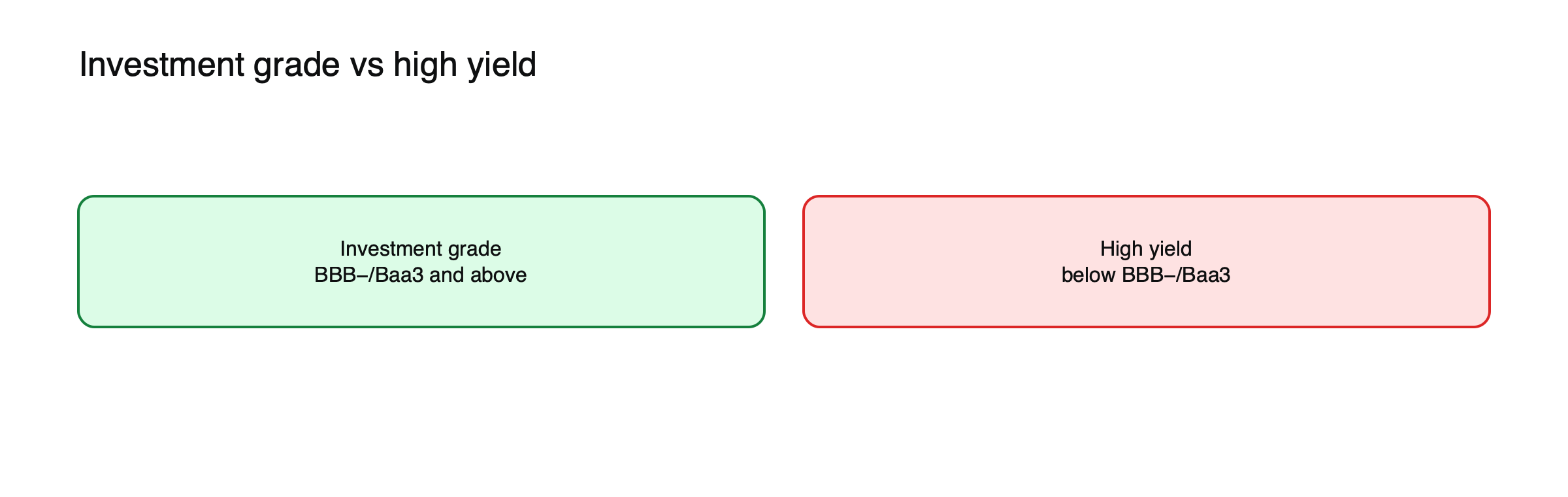
Figure: The rating line.
The rating scale
| S&P and Fitch | Moody’s | Category |
|---|---|---|
| AAA | Aaa | Highest quality |
| AA | Aa | Very high quality |
| A | A | Upper medium |
| BBB | Baa | Lower medium, lowest investment grade |
| BB | Ba | Speculative |
| B | B | Highly speculative |
| CCC and below | Caa and below | Substantial risk, near default |
Plus and minus signs, or numbers at Moody’s, divide each band further. The line between BBB− and BB+ separates investment grade from high yield and matters because many institutions may hold only investment-grade bonds.
Credit spreads
The extra yield over government bonds, the credit spread, widens when investors worry about defaults and narrows when they are confident. Spreads are a widely watched gauge of risk appetite.
Spreads in a crisis
In March 2020, as the pandemic hit, US high-yield spreads jumped to about 1,087 basis points over Treasuries, about 10.9 percentage points, as investors priced widespread defaults. By July 2026, they were around 270 basis points, near multi-year lows. Investment-grade spreads move in the same direction but much less. See what a credit spread is.
How they behaved in 2022
Rising rates hit investment-grade bonds hard, down nearly 16%, because of their longer duration; high-yield bonds, with shorter durations and higher coupons, fell less but carry more credit risk in a recession.
Fallen angels and rising stars
Companies whose ratings drop from investment grade to high yield are called fallen angels. Their bonds often fall sharply as investors restricted to investment grade must sell, sometimes creating bargains for high-yield buyers. Companies moving the other way, rising stars, can see their bonds rise as a wider pool of investors becomes able to buy them.
A recession, illustrated
Suppose a recession begins and central banks cut rates. (Illustrative scenario.) Government bond yields fall, lifting investment-grade bond prices, which are mostly driven by rates, perhaps 5%. High-yield spreads widen sharply as default fears rise, outweighing lower government yields, and high-yield bonds fall perhaps 10%. In 2022, by contrast, rising rates hurt investment grade more. The two classes respond to different threats.
When investment grade loses more
“Investment grade is safe” applies to default risk, not price: long, high-quality bonds can lose more than junk bonds when rates jump.
See how bond duration predicts price moves, how to calculate yield to maturity and how bonds work.
Default rates
Defaults among investment-grade issuers are rare, while high-yield default rates rise sharply in recessions and fall in expansions. When defaults occur, bondholders usually recover part of their money, but recovery rates vary widely by industry and by where the bonds rank among the company’s debts. High yields compensate for these risks, and the key question for investors is whether the extra yield is enough.
Funds and ETFs
Most individual investors reach both markets through funds and ETFs, which spread risk across hundreds of issuers. High-yield funds are more volatile, often behaving like a mix of bonds and shares, while investment-grade funds behave more like government bond funds with a modest credit premium.
Which suits whom
| Goal | Usually better fit |
|---|---|
| Stability and recession protection | Investment grade |
| Higher income, accepting equity-like risk | High yield |
| Diversification from shares | Investment grade |
Coupons and duration, illustrated
Suppose an investment-grade bond fund holds bonds averaging 10 years to maturity with 4% coupons, a duration of about 7, while a high-yield fund holds bonds averaging 6 years with 7% coupons, a duration of about 4. (Illustrative figures.) If government yields rise 2 points and spreads stay unchanged, the investment-grade fund falls about 14% and the high-yield fund about 8%, before income. The high-yield fund’s larger coupons also cushion the fall. That is why investment-grade bonds suffered more in 2022’s rate shock.
Liquidity
Investment-grade bonds from large issuers trade frequently, while many high-yield bonds trade rarely, especially smaller issues. In stressed markets, high-yield bonds can become hard to sell without large price concessions, and high-yield funds may see their prices drop below the value of their holdings. Liquidity risk is part of what the higher yield pays for.
Covenants and protections
High-yield bonds often include covenants, promises by the issuer that limit additional borrowing, asset sales or dividend payments, to protect bondholders. In strong markets, investors sometimes accept weaker covenants to obtain higher yields, which can leave them more exposed if the issuer later struggles.
Sector mix
The two markets contain different industries. Investment-grade indices are heavy in banks, utilities and large industrial and technology companies; high-yield indices contain more energy, telecommunications, leisure and smaller industrial firms. Sector shocks, such as an oil price collapse, can hit high-yield indices much harder.
Common misreadings
- Treating a high yield as a bargain without considering default risk.
- Assuming investment-grade funds cannot fall sharply.
The limits of ratings
Credit ratings are opinions, updated periodically, and they can lag events. Before the 2008 financial crisis, many complex securities carried top ratings that proved badly wrong. Ratings are useful for broad categories, but spreads, which change daily, often signal trouble sooner. Professional investors use both, along with their own analysis of the issuer.
Emerging market bonds
Bonds from emerging market governments and companies span the rating scale, from investment grade to deeply speculative. They add currency, political and liquidity risks, and when issued in dollars, the issuer’s ability to earn dollars matters too. Their yields and spreads tend to move with global risk appetite and the dollar.
Loans and private credit
Alongside high-yield bonds, lower-rated companies borrow through leveraged loans, which usually pay floating rates and rank ahead of bonds, and increasingly through private credit funds that lend directly. These markets grew quickly in the years of low rates and are less transparent than public bond markets, which makes their risks harder to judge.
High yield and shares
High-yield bonds often move with share prices, because both depend on company profits and the economy. In sell-offs, high-yield bonds usually fall less than shares but much more than investment-grade bonds. Investors who hold high yield for diversification from shares may find it offers less than expected in a downturn.
Choosing a mix, illustrated
An investor wanting bond income might hold 70% in an investment-grade fund and 30% in a high-yield fund. (Illustrative mix, not a recommendation.) The investment-grade part provides stability and tends to rise in recessions as government yields fall; the high-yield part adds income in good times but can fall sharply in bad ones. Adjusting the mix shifts the balance between income and resilience. Before choosing, checking each fund’s duration, average rating and spread shows how it is likely to behave if rates rise or the economy weakens.
Rising rates and defaults
Higher interest rates take time to affect high-yield issuers, because many borrowed at fixed rates when rates were low. As those bonds mature and must be refinanced at higher rates, interest costs rise, and weaker companies may struggle to refinance at all. Investors watch the schedule of maturing high-yield debt, sometimes called the maturity wall, for signs of future defaults. Rising default rates usually show up first in the lowest-rated bonds, whose spreads widen ahead of the rest.
Frequently asked questions
Why are high-yield bonds called junk?
The informal term reflects their higher default risk; many issuers are sound businesses with more debt or less history.
Can investment-grade bonds default?
Rarely, but yes. Downgrades usually come first, which is why ratings and spreads are watched closely.
This article is educational content and does not constitute financial, investment, legal or tax advice. Digital assets are volatile and you may lose the amount you invest.
Sources
- Bonds: a H1 2023 report card (2022 Treasury returns from −4.1% for 2-year to −16.3% for 10-year; investment grade nearly −16%) — WisdomTree
- Bloomberg US Aggregate bonds (index of investment-grade bonds; 2022 −13.0%) — Up My Interest
- Bond credit spread (US high-yield OAS 1,087 bp on March 23, 2020; about 270 bp on July 10, 2026) — BIT Knowledge Hub