
How Bond Duration Predicts Price Moves
Duration estimates how much a bond's price moves when yields change: about −duration × yield change. A 10-year 4% bond loses about 8% if yields rise 1 point.
Bond duration measures how sensitive a bond’s price is to interest rates: price change ≈ −modified duration × yield change. A 10-year 4% bond at par has a modified duration of about 8.1, so a 1-point rise in yields cuts its price by about 8%. Longer maturities and lower coupons mean higher duration.
The formula
% price change ≈ −modified duration × yield change (in percentage points)
Worked examples
- 10-year 4% bond, modified duration ≈ 8.1: yields +1 point → price ≈ −8.1% (exact repricing gives −7.7%, since the rule is an approximation)
- Bond portfolio worth $10,000, duration 6: yields +0.5 point → about −3%, or −$300
(Example values.)
Duration by maturity
| 4% bond priced at par | Macaulay duration | Modified duration | Price if yields rise to 5% |
|---|---|---|---|
| 2 years | About 1.96 years | About 1.89 | About −1.9% |
| 5 years | About 4.63 years | About 4.45 | About −4.3% |
| 10 years | About 8.44 years | About 8.11 | About −7.7% |
| 30 years | About 17.98 years | About 17.29 | About −15.4% |
(Example values, annual coupons.) Duration grows with maturity, but more slowly, because coupons paid along the way pull the average timing of cash flows forward.
Macaulay and modified duration
Macaulay duration is the weighted average time until a bond’s cash flows are received, measured in years. Modified duration adjusts it for the bond’s yield and gives the approximate percentage price change for a 1-point change in yield. Traders and fund factsheets usually quote modified or effective duration, the version that answers how much the price moves.
What raises duration
- Longer maturity: cash flows further away.
- Lower coupons: more of the value comes at the end.
- Lower yields: duration rises as yields fall.
Why it mattered in 2022
When yields jumped, long-duration bonds lost far more: 10-year Treasuries fell about 16% while 2-year notes fell about 4%.
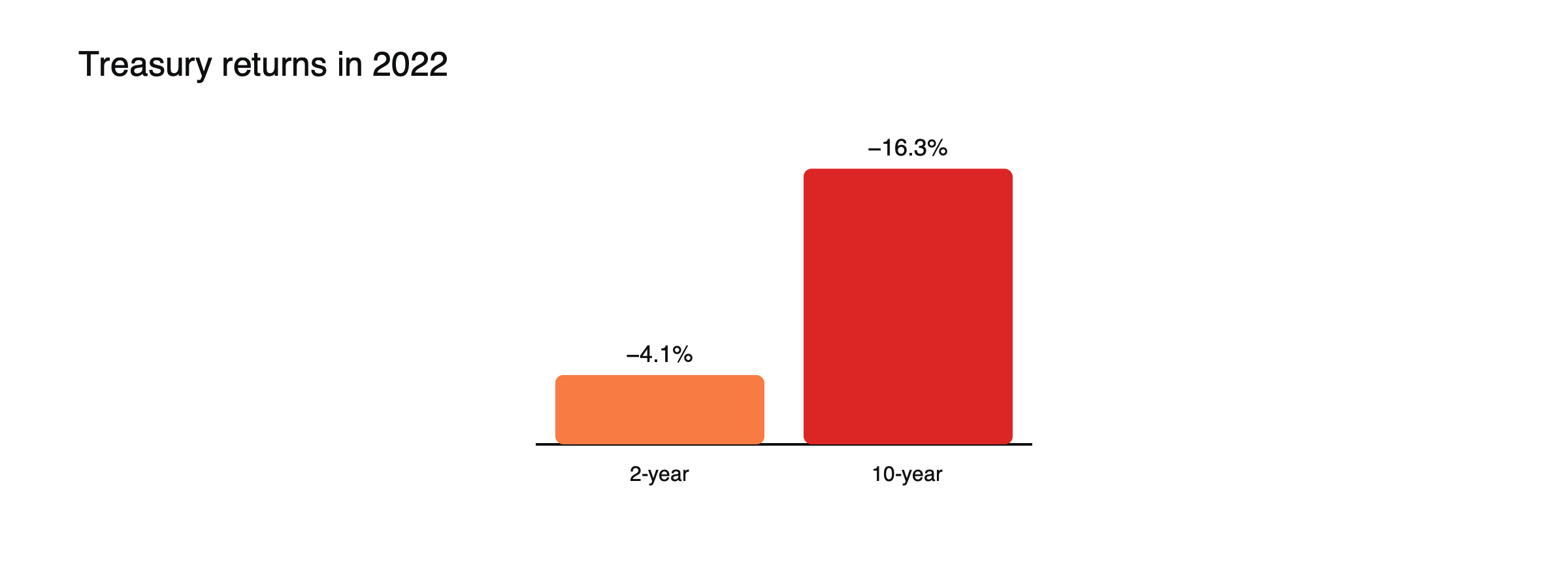
Figure: Longer duration, bigger losses. Source: WisdomTree.
Convexity, worked through
For the 10-year bond with a modified duration of about 8.11, the duration rule predicts a fall of about 8.1% if yields rise 1 point and a rise of about 8.1% if they fall 1 point. The exact changes are about −7.7% and +8.5%. The bond loses less than predicted when yields rise and gains more when they fall, because its duration changes as yields move. This curvature, called convexity, matters for large yield changes and is generally favorable to holders of ordinary bonds.
DV01: duration in money
Traders often measure rate sensitivity as the change in value for a 0.01-point move in yields, called DV01 or the value of a basis point. For $10,000 of the 10-year bond, a modified duration of about 8.11 gives a DV01 of about $8.11: each 0.01-point rise in yields costs about $8.11. A 0.25-point move, common around central bank meetings, would cost about $203. (Example values.)
Using duration
Match duration to how long you need the money, and expect long-duration bonds and bond CFDs to swing more with central bank news. The rule works best for small yield changes; for large moves, convexity matters too.
See why bond prices fall when yields rise, how to calculate yield to maturity and how bonds work.
Duration of a bond fund
Bond funds and ETFs publish an average duration for their portfolios. A fund with a duration of 6 would be expected to lose about 6% if yields across its holdings rose 1 point, and gain about 6% if they fell. Because funds keep replacing maturing bonds, their duration stays roughly constant over time, unlike an individual bond, whose duration shortens as it approaches maturity.
Duration and your time horizon
A useful rule of thumb is that if your holding period roughly matches a bond’s duration, the effects of a change in rates on price and on reinvested income tend to offset each other: higher rates lower the price but raise the return on reinvested coupons. Investors with short horizons are usually better served by short-duration bonds, which swing less.
Duration for CFD traders
Bond futures, and CFDs based on them, have durations similar to the bonds they reference. A 10-year bond future moves several times as much as a 2-year one for the same change in yields, so position sizes should be adjusted accordingly. Comparing DV01 rather than nominal size gives a fairer picture of risk across maturities.
A portfolio’s duration, worked through
A bond portfolio holds 50% in bonds with a duration of 2, 30% with a duration of 6 and 20% with a duration of 15. Its overall duration is the weighted average: 0.5 × 2 plus 0.3 × 6 plus 0.2 × 15, which equals 5.8. If yields across all maturities rose 1 point, the portfolio would be expected to fall about 5.8%. (Example values.) Changing the mix, for example moving the long bonds into short ones, lowers duration and rate risk.
Duration and the level of yields
Duration rises as yields fall, because coupons are worth less relative to the final repayment. When yields were very low before 2022, many bonds had unusually high durations, which is one reason the rise in yields that year caused such large losses.
Callable bonds and effective duration
For bonds that can be repaid early, or mortgage-backed securities whose borrowers can prepay, cash flows change with interest rates. Effective duration estimates price sensitivity allowing for those changes and is the figure usually quoted for such bonds and the funds that hold them.
Hedging with duration
Traders hedge rate risk by matching DV01 rather than amounts. To hedge $10,000 of a 10-year bond with a 2-year bond, a trader would need roughly four times as much of the 2-year bond, because its duration is about a quarter of the 10-year’s. Matching DV01 makes the two positions move by similar amounts for a parallel change in yields.
Common misreadings
- Treating duration as the bond’s maturity.
- Relying on the duration rule for very large yield changes.
Key rate duration
Yields do not always move by the same amount across maturities. Key rate durations measure sensitivity to changes at specific points on the yield curve, such as 2, 5, 10 and 30 years. A portfolio may have little exposure to short-term rates but a lot to long-term ones, which matters when the curve steepens or flattens. See what the yield curve is.
Inflation-linked bonds
The duration of an inflation-linked bond measures sensitivity to real yields, not ordinary yields. Its price falls when real yields rise, even if inflation expectations are unchanged. See what real yield is.
Quick estimates for traders
For quick risk checks, multiply position value by modified duration and by the expected yield change. A $20,000 position in a fund with a duration of 7 would move about $1,400 for a 1-point change in yields, or about $350 for a quarter-point change. Comparing these numbers with the account size shows whether a central bank surprise would be an inconvenience or a serious loss. (Example values.)
Duration and holding period, illustrated
An investor buys a bond with a duration of about 4.5 years and plans to hold for about that long. If yields rise 1 point right after purchase, the price falls about 4.5%. But each coupon received can now be reinvested at a yield 1 point higher, and the bond’s price rises back toward face value as maturity approaches. Over a holding period close to the duration, the higher reinvestment income roughly offsets the initial price loss, leaving the overall return close to the original yield. (Example values, simplified.) An investor who needed the money after one year would not have that time to recover, which is why matching duration to the time horizon matters. Bond funds, which never mature, do not offer the same certainty over any fixed period.
Frequently asked questions
Is duration measured in years or percent?
Macaulay duration is in years; modified duration is the percentage price change for a 1-point change in yield. They are close in value for most bonds.
Why did long bonds lose so much in 2022?
Because their durations were high and yields rose by several percentage points. A duration near 8 combined with a yield rise of more than 2 points meant double-digit losses.
Leverage, margin and cost figures in this article are example values for illustration. Actual terms depend on the provider, the instrument and the rules in your country.
This article is educational content and does not constitute financial, investment, legal or tax advice. Digital assets are volatile and you may lose the amount you invest.
Sources
- Bonds: a H1 2023 report card (2022 Treasury returns from −4.1% for 2-year to −16.3% for 10-year; investment grade nearly −16%) — WisdomTree
- Why ordinary investors got hit so hard in 2022 (Bloomberg US Aggregate −13.1% through December 28, worst since 1976; 10-year yield from about 1.5% to about 4.2%) — Yahoo Finance Morning Brief, December 2022