
Major, Minor and Exotic Currency Pairs
Majors pair the US dollar with leading currencies; minors pair those currencies without the dollar; exotics add emerging-market currencies. How they differ.
Major currency pairs combine the US dollar with another leading currency, such as EUR/USD, and are the most traded and cheapest. Minor pairs, or crosses, combine two majors without the dollar, such as EUR/GBP. Exotic pairs add a smaller or emerging-market currency, such as USD/ZAR, and usually have wider spreads and bigger swings.
Majors
The usual list: EUR/USD, USD/JPY, GBP/USD, USD/CHF, AUD/USD, USD/CAD and NZD/USD. The dollar is on one side of 89% of all FX trades, so these pairs have the deepest liquidity. EUR/USD is the most traded pair.
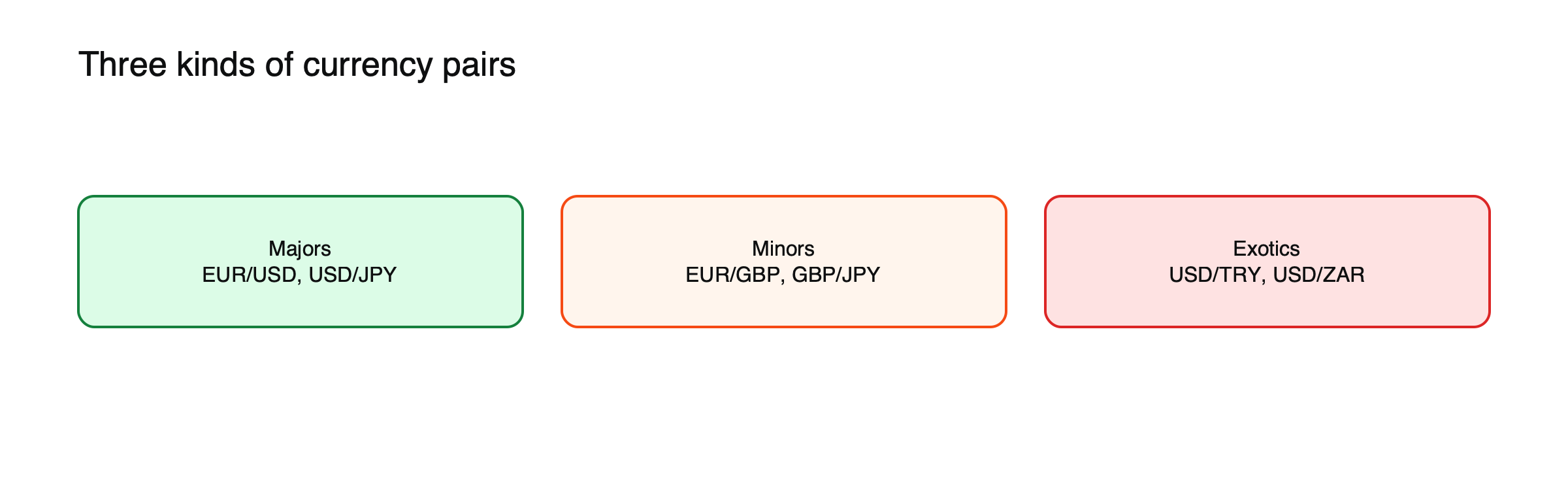
Figure: Liquidity falls and spreads widen from majors to exotics.
The seven majors at a glance
| Pair | Nickname | Often driven by |
|---|---|---|
| EUR/USD | Fiber | Fed and ECB policy, US and eurozone data |
| USD/JPY | Gopher | US Treasury yields, Bank of Japan policy, risk sentiment |
| GBP/USD | Cable | Bank of England policy, UK data and politics |
| USD/CHF | Swissie | Safe-haven demand, Swiss National Bank |
| AUD/USD | Aussie | Commodity prices, China, Reserve Bank of Australia |
| USD/CAD | Loonie | Oil prices, Bank of Canada |
| NZD/USD | Kiwi | Dairy and commodity prices, Reserve Bank of New Zealand |
Minors
Pairs of major currencies without the dollar: EUR/GBP, EUR/JPY, GBP/JPY, AUD/JPY and others. Their prices are derived from the two dollar pairs. See how cross rates are calculated.
Popular crosses
EUR/GBP reflects the relative outlook for the eurozone and the UK and often moves less than either currency does against the dollar. EUR/JPY and GBP/JPY combine European or British news with the yen’s sensitivity to risk sentiment and can move sharply. AUD/JPY is often watched as a gauge of global risk appetite, since it pairs a commodity currency with a safe haven.
Exotics
A major currency against a smaller one: USD/TRY, USD/ZAR, USD/MXN and others. These pairs have lower liquidity and wider spreads, and can move far more in a day: one estimate puts USD/ZAR’s typical daily range at 1,000 to 1,500 pips, against about 80 for EUR/USD.
What makes exotics different
Exotic currencies often belong to economies with higher inflation, higher interest rates and more political risk. Their markets are smaller, so large orders move prices more, and liquidity can vanish in a crisis. Some countries restrict capital movements, which can make prices jump or make positions hard to close. High interest rates mean large rollover in one direction: holding the exotic currency long against the dollar may earn a credit, while shorting it can be expensive. See emerging market currencies in risk-off markets.
Costs in practice
Suppose a broker quotes USD/ZAR with a spread of 100 pips and the pair trades near 18.00. (Illustrative figures.) A pip on one standard lot is 10 rand, about $0.56, so the spread costs about $56 a lot, compared with around $10 for a 1-pip spread on EUR/USD. Moves are larger too, so the cost relative to a typical day’s move may not be very different, but the risk per lot certainly is.
How regulators define a major pair
Market convention calls the seven dollar pairs above the majors. EU retail rules use a slightly different definition: any pair made up of two of the US dollar, euro, Japanese yen, British pound, Canadian dollar and Swiss franc counts as major, with leverage capped at 30:1. That makes crosses such as EUR/GBP and EUR/JPY «major» for leverage purposes, while AUD/USD and NZD/USD, majors by market convention, fall under the 20:1 limit for other pairs. Brokers’ contract specifications show which limit applies to each pair.
Why the category matters
| Majors | Minors | Exotics | |
|---|---|---|---|
| Liquidity | Highest | Moderate | Lowest |
| Typical spread | Tightest | Wider | Widest |
| Volatility | Lower | Varies | Highest |
| Leverage caps (EU retail) | 30:1, except AUD and NZD pairs at 20:1 | 30:1 between the six main currencies, otherwise 20:1 | 20:1 |
Costs, leverage limits and risk all scale with the category. See which currency pairs are the most volatile and what a currency pair is. For the bigger picture, read how the forex market works.
Choosing between them
Majors suit most traders, especially those starting out: costs are lowest, information is plentiful and prices move more predictably around scheduled events. Crosses let traders express a view on two non-dollar economies directly. Exotics can offer large moves and high rollover income, but their costs, gaps and political risks call for smaller positions and more experience.
Which pairs trade most
EUR/USD is the most traded currency pair in the world, followed by pairs such as USD/JPY and GBP/USD, which together account for a large share of all turnover. Heavy trading is what keeps their spreads tight and their prices reliable. Rankings shift slowly over the years as economies and financial centers change, but the dollar’s place on one side of most trades has stayed remarkably stable.
How majors move together
Because they share the dollar, majors often move together: when the dollar strengthens broadly, EUR/USD, GBP/USD and AUD/USD tend to fall while USD/JPY and USD/CAD rise. Holding several dollar pairs in the same direction can therefore be one large dollar trade in disguise. See currency correlation.
Matching pairs to approaches
Short-term traders usually stick to majors and the busiest crosses, where costs are lowest. Traders following economic themes may prefer crosses that isolate two economies, such as EUR/GBP. Those looking for interest income sometimes favor higher-yielding currencies, accepting their larger risks. The choice of pair is part of the strategy, not an afterthought. See how to choose currency pairs.
Mixing categories in one account
Holding a mix of majors, crosses and exotics changes the account’s overall risk more than the number of positions suggests. One lot of an exotic pair can carry more risk than several lots of majors, because of wider spreads, bigger moves and the chance of gaps. Sizing each position by its own stop and pip value, rather than by habit, keeps the categories comparable. Giving exotic pairs their own, smaller overall risk limit keeps them neatly in proportion.
Frequently asked questions
Is EUR/GBP a major or a minor pair?
By market convention it is a minor, or cross, because it excludes the dollar. Under EU retail leverage rules, it counts as a major pair because both currencies are among the six main currencies.
Why do exotic pairs have such wide spreads?
Because fewer banks make prices in them, volumes are lower and the risk of sudden moves is higher, so dealers charge more to take the other side.
This article is educational content and does not constitute financial, investment, legal or tax advice. Digital assets are volatile and you may lose the amount you invest.
Sources
- The 10 most volatile forex pairs (USD/ZAR 1,000–1,500 pips; EUR/USD about 80 pips) — Dukascopy
- Top 10 most volatile forex pairs (exotics have lower liquidity and wider spreads; minors are crosses without USD) — Forex.com
- ESMA adopts CFD measures (30:1 major pairs; 20:1 non-major pairs) — Finadium
- Global FX trading hits $9.6 trillion per day (dollar on one side of 89% of trades) — BIS
- Overview of ESMA CFD rules implementation (major currency pairs are any combination of USD, CAD, EUR, GBP, CHF and JPY; 3.33% margin) — Interactive Brokers