
Why Did Oil Prices Go Negative in April 2020?
On April 20, 2020, expiring May WTI fell from $17.73 to −$37.63 as Cushing storage ran out and holders paid others to take delivery. What happened and why.
Oil prices went negative on April 20, 2020, when the expiring May WTI contract fell from $17.73 to settle at −$37.63 a barrel. Lockdowns had crushed demand, storage at the Cushing delivery point was filling, and holders who could not take oil paid others to take their contracts, a first in 37 years.
Timeline
- March–April 2020: lockdowns cut fuel demand sharply; a price war adds supply.
- Early April: Cushing stocks climb quickly; the futures curve moves into steep contango.
- April 20: with one day before expiry, the May contract collapses to −$37.63, touching −$40.32; the June contract settles at $20.43.
- April 21: the May contract expires and turns positive.
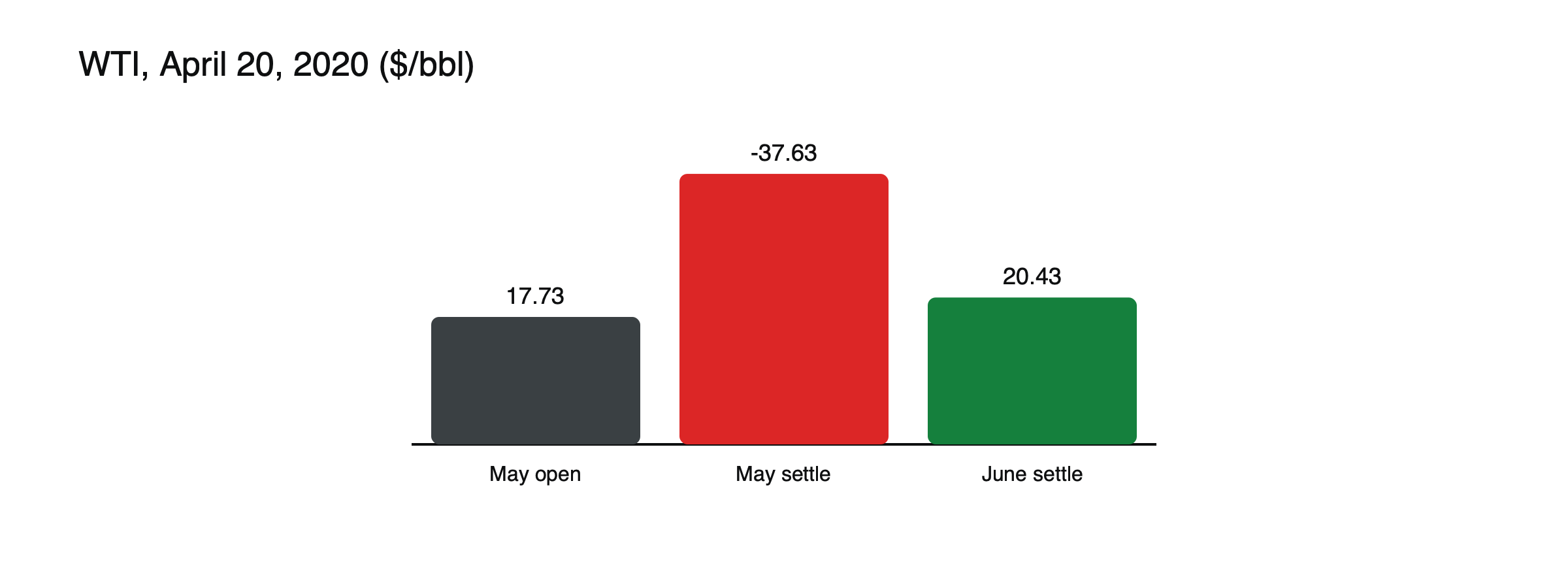
Figure: The May contract’s collapse. Sources: CFTC; Hart Energy.
The price war and the pandemic
Demand was collapsing as lockdowns spread in March 2020, but supply was rising. Talks between OPEC and Russia on output cuts broke down early that month, and Saudi Arabia responded by raising production and cutting its prices, starting a price war just as the world stopped traveling. Global oil demand fell by an unprecedented amount, and the excess oil had to go into storage, filling tanks on land and then tankers at sea.
What a negative price meant
A negative price meant that holders of the expiring contract were paying others to take oil off their hands. Anyone holding the May contract at expiry had to accept delivery of physical oil at Cushing, Oklahoma, and with nearly all storage there booked, many holders had nowhere to put it. Selling at minus $37.63 meant paying $37.63 a barrel to avoid that obligation. For buyers with spare storage, the price was effectively an offer to be paid for taking oil.
Why it happened
- Physical delivery: WTI futures require taking oil at Cushing if held to expiry.
- No storage: most space was booked or full.
- Late sellers: positions had to be closed with few buyers left, and liquidity had been falling for days.
Brent, which is cash-settled and seaborne, never went negative.
The OPEC+ deal
On April 12, 2020, OPEC+ agreed to the largest coordinated output cut in its history, to take effect from May. The deal came too late to prevent the collapse in the May contract, because demand had already fallen far more than any cut could offset in the short term, and storage was nearly full. It did, however, help set up the recovery that followed in the second half of the year. See what OPEC+ is.
Who was hurt
Holders of long positions in the expiring contract, including some retail products that had not rolled in time. Some brokers’ CFDs referencing the May contract also showed negative prices.
How exchanges and providers responded
Before the collapse, the exchange that runs WTI futures had changed its systems to allow negative prices, recognizing that they were possible. Some trading platforms and brokers were not ready: their systems could not handle negative prices, and some clients suffered large losses or found positions closed at unexpected levels. Afterward, many providers reviewed how their products tracked expiring contracts and moved CFDs away from the front month earlier, and some funds that held near-dated futures restructured to hold later months. See commodity trading mistakes around contract rolls.
The recovery
Once the May contract expired, prices for the next contract stayed low but positive, and the market gradually recovered as lockdowns eased, output cuts took effect and storage was drawn down. By the summer of 2020, WTI was back around $40, though it took well over a year for prices to return to pre-pandemic levels.
Lessons
Know which contract a product tracks and when it expires; a low price can always go lower; storage and delivery matter in physical markets. See what contango and backwardation are, commodity trading mistakes around contract rolls and how commodity CFDs work.
Timeline at a glance
| Date | Event | WTI front month |
|---|---|---|
| Early March 2020 | OPEC–Russia talks fail; price war begins | Falling fast |
| March–April | Lockdowns cut demand; storage fills | Steep contango |
| April 12 | OPEC+ agrees record cuts from May | Little immediate effect |
| April 20 | May contract collapses before expiry | Settles at −$37.63 |
| April 21 | May contract expires | Turns positive |
| Summer 2020 | Demand recovers; storage drawn | Around $40 |
Lessons for traders
The episode is the clearest modern example of why it matters which contract a product tracks and when that contract expires. It also shows that prices can move beyond levels that seem logically impossible, that liquidity can vanish in specific contracts even when the wider market functions and that physical constraints, such as storage, can overwhelm financial positions. Traders who held the June contract, or Brent, faced painful moves but not the collapse of the expiring May contract. See how a futures roll adjusts a commodity CFD price.
The storage trade
In a market with steep contango, anyone with storage can buy oil for prompt delivery, store it and sell a later futures contract at a higher price, locking in a profit if the gap exceeds storage costs. In early 2020 the gap became so large that traders chartered tankers simply to hold oil at sea. That trade kept prices from falling even further for a while, but once storage on land and at sea was nearly full, it could no longer absorb the excess, and the expiring contract had no natural buyers left. See what contango and backwardation are.
What regulators found
The US Commodity Futures Trading Commission’s staff later reported that liquidity in the expiring contract had been falling well before April 20, as most participants had already rolled or closed positions. With few buyers left on the final full trading day, the remaining sellers drove the price far below zero. The report described the move as the first negative price for the contract in its 37-year history.
Products caught out
Some investment products and trading accounts were still linked to the May contract in its final days, either because their rules rolled late or because individual traders had not closed. Holders of those positions faced losses far larger than they had thought possible, since few had considered that a price could fall below zero. The episode prompted many providers to roll earlier and to review how they explain expiry risk to clients.
What it means for CFD traders today
For anyone trading oil CFDs, the practical lessons are simple: know whether the CFD follows a futures contract or a cash price, know its roll and expiry dates and avoid being tied to the front month in its last days, especially when the curve is in steep contango and storage is tight. A stop-loss offers little protection when a contract stops trading normally.
Why WTI and not Brent
WTI futures are settled by physical delivery at Cushing, a landlocked storage hub, so holders at expiry must take oil there. Brent futures are cash-settled against a seaborne crude basket, so holders are never forced to find storage at a single point. When Cushing filled, WTI’s expiring contract had a problem Brent did not share. Brent fell steeply in 2020 too, settling around $25 on April 20, but it never went below zero. The difference in how the two contracts settle explains most of the gap. See WTI vs Brent. Contracts that settle in cash simply cannot force anyone to take physical delivery, which removes the specific trap that caught holders of the expiring May WTI contract in 2020.
Frequently asked questions
Did all oil prices go negative?
No. Only the expiring May WTI futures contract settled below zero. The June contract stayed positive, and Brent, which is cash-settled, never went negative.
Could it happen again?
It is possible in principle whenever storage at a delivery point runs out near expiry, but exchanges, providers and traders are now much more aware of the risk.
This article is educational content and does not constitute financial, investment, legal or tax advice. Digital assets are volatile and you may lose the amount you invest.
Sources
- CFTC staff interim report on WTI trading around April 20, 2020 ($17.73 to −$37.63; first negative price in 37 years; liquidity decreased well before April 20) — CFTC, November 2020
- US crude futures plunge below zero (low of −$40.32; June contract $20.43; storage at Cushing) — Hart Energy, April 2020
- May WTI crude prices recover ahead of the contract expiry (turned positive on expiry day) — ICIS, April 2020
- Lack of storage space drives Nymex WTI to record low (Brent settled at $25.57, not constrained by physical delivery) — Journal of Petroleum Technology