
How Volkswagen Briefly Became the World’s Most Valuable Company in 2008
In October 2008 Porsche revealed control of about 74% of VW, leaving little stock for short sellers. VW jumped from about €200 to €1,005 in two days.
The Volkswagen short squeeze came in late October 2008, when Porsche disclosed control of about 74% of VW’s ordinary shares. With Lower Saxony holding 20%, only about 6% was freely available against short interest near 12%. Shorts scrambled to buy, pushing VW from about €200 to €1,005 and briefly making it the world’s most valuable company.
Timeline
- 2008: Porsche gradually raises its stake in VW; hedge funds short the stock, expecting it to fall.
- Friday, October 24: VW closes around €210.
- Sunday, October 26: Porsche discloses 42.6% in shares plus 31.5% in cash-settled options, a total of about 74.1%.
- Monday, October 27: VW opens around €348 and closes near €517.
- Tuesday, October 28: shares briefly trade above €1,000; VW’s market value tops ExxonMobil’s.
- Following days: Porsche releases some shares to ease the squeeze, and the price falls back.
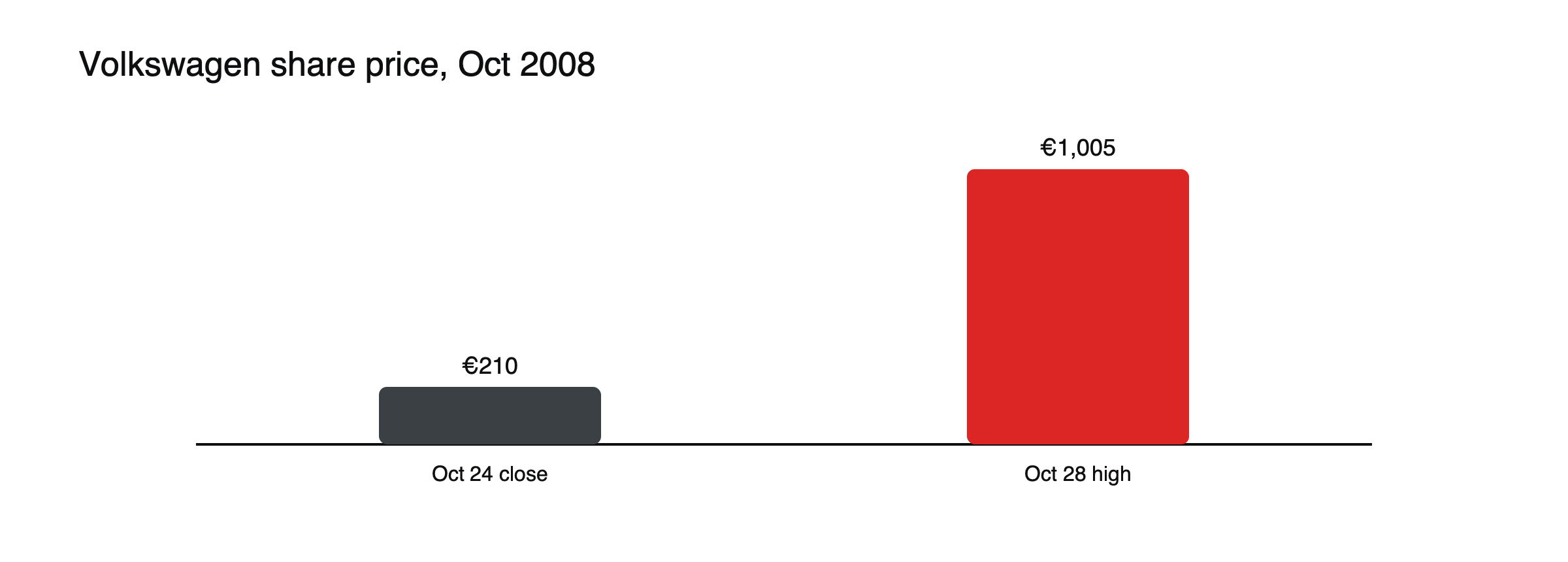
Figure: Volkswagen’s squeeze in two trading days. Sources: Capital.com; International Banker.
How Porsche built its stake
Through 2007 and 2008, Porsche, then a much smaller company than Volkswagen, steadily increased its holding in VW shares. Alongside the shares it owned outright, it built a large position through cash-settled options, which gave it the economic benefit of further shares without having to disclose them as holdings under the rules at the time. Many investors assumed Porsche owned about 35% and would stop well short of full control. The Sunday announcement that it effectively controlled about 74% came as a shock.
Why hedge funds were short
Many hedge funds held a popular trade: long VW’s non-voting preference shares and short its ordinary shares, betting that the large gap between their prices would narrow. Others simply shorted the ordinary shares, believing that VW’s valuation, inflated by Porsche’s buying, could not last as the economy entered recession. Both groups needed to buy ordinary shares to close their shorts, and the announcement revealed that almost none were available.
Who held the shares
Porsche controlled about 74% through shares and options, Lower Saxony held about 20%, leaving only around 6% freely tradable, about half the shares sold short.
Monday and Tuesday
On Monday, October 27, VW’s ordinary shares opened around €348 and closed near €517, as shorts rushed to cover in a market where few sellers existed. On Tuesday, the price briefly topped €1,000, and for a short time VW’s market value exceeded that of ExxonMobil, making it the world’s most valuable listed company, even though VW’s car business had not changed in two days. Porsche later agreed to release some shares to ease the shortage, and the price fell back within days.
The index effect
VW’s surge made it a much larger part of Germany’s DAX index, which forced funds tracking the index to buy more VW shares, adding to the pressure, and distorted the index itself. Deutsche Börse, which runs the DAX, responded by changing its rules to cap the weight of any single company in the index. The episode showed how a squeeze in one share can spill into the indices that contain it.
Why it happened
Short interest exceeded the shares available to buy. Short sellers had to buy from the few holders willing to sell, at almost any price.
Aftermath
Hedge funds lost billions. Porsche itself later ran into financial trouble, and VW eventually took over Porsche’s car business.
Porsche’s own fall
Building the VW stake had loaded Porsche with debt, and as the financial crisis deepened and credit dried up, it struggled to refinance. Its chief executive left in 2009, and the plan for Porsche to take over VW was reversed: VW eventually acquired Porsche’s car business. Investors who had lost money in the squeeze brought legal claims against Porsche, accusing it of misleading the market about its intentions, cases that dragged on for years.
Changes to disclosure rules
German regulators later tightened the rules on disclosing positions held through derivatives such as cash-settled options, so that large economic stakes could no longer be built out of sight. Similar changes followed elsewhere in Europe. The aim was to prevent another situation in which the true ownership of a company was unknown to the market until it was too late.
Lessons
Check free float, not just shares outstanding; disclosure of large stakes can change supply overnight; squeezes can hit even large, mature companies. See what a short squeeze is, what short interest is and what moves stock prices.
Timeline at a glance
| Date | Event | VW ordinary shares |
|---|---|---|
| 2007–2008 | Porsche builds its stake; funds short VW | Rising |
| Friday, October 24, 2008 | Close before the announcement | About €210 |
| Sunday, October 26 | Porsche discloses about 74.1% control | Market closed |
| Monday, October 27 | Shorts scramble to cover | Opens about €348, closes about €517 |
| Tuesday, October 28 | VW briefly the world’s most valuable company | Peak about €1,005 |
| Following days | Porsche releases some shares | Falls back |
Lessons for CFD traders
For anyone shorting shares through CFDs, the VW squeeze is a reminder to check the free float and who owns the rest, not just the number of shares outstanding. A stop placed above the price would have been filled far above its level on Monday morning, and providers can raise margins or close positions in extreme conditions. Shorts in companies with a dominant shareholder carry a hidden risk that the supply of shares can disappear overnight. See short selling myths that mislead new traders.
The pair trade, illustrated
Suppose a fund held a long position in VW’s preference shares and a short of equal value in its ordinary shares, betting that the ordinary shares’ large premium would shrink. (Illustrative positions.) On the Friday before the announcement, the ordinary shares traded around €210. By Monday’s close they were near €517, while the preference shares, which carried no votes and were not part of the shortage, fell. Both legs lost money at once: the short rose against the fund by nearly 150%, and the long fell. A trade designed to be market-neutral turned into one of the worst losses of the year, because the two share classes stopped behaving like each other.
Why the free float matters
Shares outstanding counts every share a company has issued; the free float counts only those available to trade. With Porsche controlling about 74% and Lower Saxony about 20%, VW’s free float was around 6%, roughly half the shares sold short. Short sellers who had looked at total shares outstanding saw a large, liquid company; those who looked at the free float would have seen a trap. See what short interest is.
Two famous squeezes compared
| Volkswagen 2008 | GameStop 2021 | |
|---|---|---|
| Trigger | Disclosure of a hidden stake | Coordinated retail and options buying |
| Short interest | About 12% vs 6% float | About 140% of float |
| Peak move | About €210 to €1,005 | About $17 to $483 |
| Duration | Days | Weeks |
Why shorts could not wait
In late 2008, banks were cutting lending and asking hedge funds for more collateral. Funds short VW faced rising margin calls on a position that kept moving against them, with no sign of new shares becoming available. Waiting for the price to fall back was not an option for many of them; they had to buy at whatever price sellers demanded, which is exactly the dynamic that turns a squeeze into a spike. The market simply ran out of sellers.
Frequently asked questions
Did VW’s business change during the squeeze?
No. The surge was driven entirely by the shortage of shares available to buy, not by any change in Volkswagen’s operations or profits.
Could a squeeze like this happen today?
Disclosure rules are now stricter, making a hidden stake of this kind much harder to build, but squeezes still happen whenever short interest is high relative to the shares freely available.
This article is educational content and does not constitute financial, investment, legal or tax advice. Digital assets are volatile and you may lose the amount you invest.
Sources
- Anatomy of a short squeeze (VW 74% stake; free float 6% vs short interest 12%; ~€200 to over €900; GameStop short interest ~140% of float) — Janus Henderson
- The Volkswagen short squeeze (Porsche 42.6% plus 31.5% options = 74.1%; up to €1,005; most valuable company on October 28) — International Banker
- Biggest short squeezes (opened €348, closed €517 on October 27, 2008) — IG
- What is a short squeeze? (Lower Saxony 20%; under 6% available) — BrokerChooser