
Bitcoin, Gold and the Dollar Under Market Stress
How bitcoin, gold and the US dollar behaved in recent sell-offs, from 2020 to 2026. Which acted as a haven and which traded like a risk asset, and why.
In recent market stress, bitcoin, gold and the dollar have played different roles. The US dollar has usually strengthened as investors rushed for cash. Gold has held value over weeks and months, though it can dip at first. Bitcoin has mostly traded like a risk asset, falling with stocks when fear peaks, despite its “digital gold” label.
Side by side
| Bitcoin | Gold | US dollar | |
|---|---|---|---|
| March 2020 dash for cash | Fell about 50% in one day | Fell about 15% in five sessions, then rose | Rose as investors sought cash |
| 2022 rate hikes | Fell about 66% from January to November | About flat for the year | Index hit a 20-year high near 114 |
| August 5, 2024 carry unwind | Fell with global stocks | — | Fell about 14% against the yen in under a month |
| Early 2026 | Weak | Record above $5,400 an ounce | — |
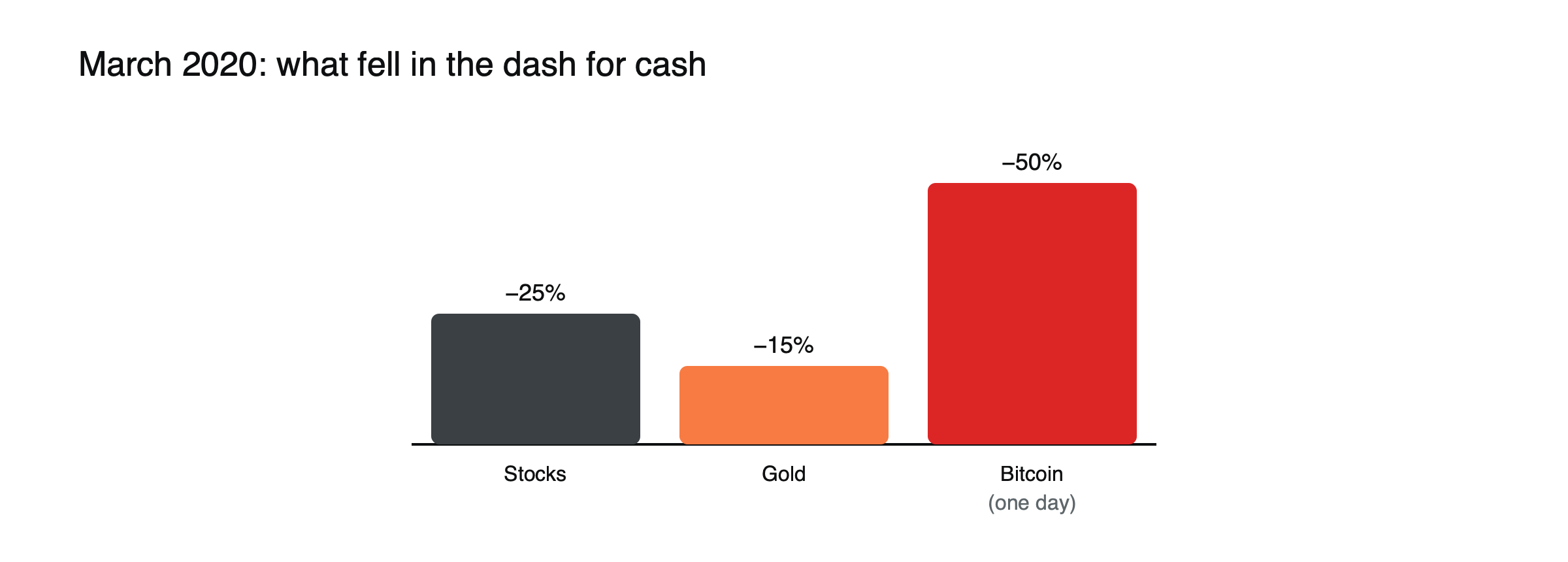
Figure: In a liquidity panic, even havens fell. Sources: Myth of Money; Nasdaq.
October 10, 2025
In a sharp crypto sell-off on October 10, 2025, more than $19 billion of leveraged positions were liquidated in a single day, one of the largest such events on record. The crash came from leverage within crypto markets rather than a broad financial panic, showing that bitcoin can suffer severe stress of its own, regardless of what gold and the dollar are doing. See what causes liquidation cascades.
The dollar’s role
The dollar is the world’s funding currency. In a panic, borrowers and investors need dollars to meet obligations, so demand jumps. See how a strong dollar hits commodities, emerging markets and crypto.
Gold’s role
Gold has no credit risk and a long history as a store of value. Central banks bought gold at the fastest pace in decades from 2022, adding a source of demand that does not depend on market mood.
Gold in 2026
In January 2026, gold rose above $5,400 an ounce, a record, while crypto prices fell. The divergence showed investors treating gold as a store of value in uncertain times while selling bitcoin as a risk asset. Central bank buying, geopolitical tension and concerns about currencies supported gold even as real yields stayed relatively high. See why gold falls when real yields rise.
Bitcoin’s role
Bitcoin is still held largely by investors who also own other risk assets. When they need cash or cut risk, bitcoin is sold alongside stocks.
What spot ETFs changed
Since US spot bitcoin ETFs began trading on January 11, 2024, more institutions and long-term investors have gained easy access to bitcoin. That broadened its ownership beyond crypto traders, and at times reduced its correlation with technology shares. But ETF holders can also sell quickly in risk-off moves, so the ETFs did not turn bitcoin into a haven. See who owns bitcoin ETFs.
Where the usual answer flips
In a slow-burning crisis of trust in money or governments, bitcoin’s fixed supply and independence from banks can attract buyers. The “risk asset” reading fits liquidity panics best; it may not fit every kind of stress.
What it means
Bitcoin has not reliably behaved as a hedge in sharp sell-offs. Gold has been steadier over longer periods, and the dollar has led in acute panics. See why correlations go to one in a crisis and what bitcoin is.
Three stress types, compared
| Type of stress | Dollar | Gold | Bitcoin |
|---|---|---|---|
| Acute liquidity panic | Usually rises | May dip first, then recover | Usually falls sharply |
| Rate-driven tightening | Usually rises | Mixed | Usually falls |
| Loss of trust in money or governments | May fall | Usually rises | Could attract buyers |
(General tendencies based on recent episodes; future crises may differ.)
A portfolio view, illustrated
Suppose an investor holds 5% of a portfolio in bitcoin and 5% in gold. (Illustrative mix.) In a liquidity panic, bitcoin might fall 40% and gold 10% at first, a combined hit of about 2.5% of the portfolio. Over the following months, gold has often recovered faster. The two holdings do not offset each other in the first days of a panic, but they respond differently over longer periods.
Why the dollar dominates acute panics
Most global debt, trade and funding are in dollars. When markets freeze, companies, banks and governments scramble for dollars to meet obligations, and that demand outweighs almost everything else in the short term. Central bank dollar swap lines, used in 2008 and 2020, exist to ease exactly this pressure.
Time horizon changes the answer
Over a single day of panic, the dollar has usually been the strongest of the three, and both gold and bitcoin can fall. Over weeks and months, gold has often recovered and outperformed, as falling real yields and safe-haven demand return. Over years, bitcoin has delivered large gains with very large drawdowns. Which asset looks like a haven depends on the time frame examined.
Volatility compared
Bitcoin’s price has typically been several times as volatile as gold’s, and gold’s more volatile than major currency pairs. That difference alone limits bitcoin’s role as a stabilizer: an asset that can fall 50% in a day, as in March 2020, cannot reliably cushion a portfolio in the short term.
Relationships change
Correlations among the three have shifted over time. Bitcoin’s link with technology shares strengthened in 2022 and weakened at times after spot ETFs launched. Gold’s link with real yields loosened after 2022 as central banks bought heavily. The dollar’s safe-haven role has been more consistent, but even it can weaken when the shock comes from the United States itself.
Other havens
Beyond the dollar and gold, the yen and Swiss franc have often risen in sell-offs, and US Treasuries have usually gained in growth scares. See why the yen rallies when global markets sell off.
Common misreadings
- Treating bitcoin as a proven crisis hedge.
- Assuming gold always rises in a panic.
A stress hedge, illustrated
Suppose an investor wants protection against a sudden market panic. (Illustrative plan, not a recommendation.) Holding some cash in dollars covers the immediate dash for cash; a gold allocation adds protection over the following months and against currency debasement; bitcoin, if held, is sized as a speculative position rather than a hedge, small enough that a 50% fall would not force other sales. The plan assigns each asset the role it has actually played in recent stress.
What each asset needs to work
The dollar works as a haven when the world needs dollar liquidity. Gold works when investors fear inflation, currency debasement or geopolitical risk, and when real yields are not rising sharply. Bitcoin’s case as a haven would depend on investors trusting it more than traditional money, which has not been the dominant behavior in recent panics.
Crypto’s own crises
Bitcoin has also faced crises that started inside crypto. In 2022, the collapse of the Terra stablecoin and later the failure of the FTX exchange caused sharp falls that had little to do with the dollar or gold. In such episodes, crypto falls while traditional havens may barely move, a reminder that bitcoin carries risks of its own on top of its sensitivity to global markets.
If the dollar weakens
A crisis that undermines confidence in the dollar itself, such as fears about US government finances or central bank independence, would test the usual pattern. In that case, the dollar could fall while gold rises, and bitcoin might attract buyers looking for alternatives. Such episodes have been rare, but they are the scenario in which bitcoin’s supporters expect it to shine. Watching the dollar’s behavior during US-centered shocks helps judge whether that scenario is developing.
How to compare them fairly
Comparing the three assets fairly means looking at several episodes, not one, and at both the first days and the following months. It also means considering costs and access: holding dollars is simple, gold involves storage or fund fees, and bitcoin involves custody and security choices. For traders using CFDs, all three are available, but the very different volatility of each means position sizes should differ widely to carry similar risk. A bitcoin position with the same risk as a gold position may be only a fraction of its size, and both much smaller than an equivalent currency position.
Frequently asked questions
Is bitcoin digital gold?
Its fixed supply invites the comparison, but in recent market stress, it has behaved more like a risk asset than like gold.
Which held up best in 2022?
The dollar, which rose to a 20-year high, while gold was roughly flat and bitcoin fell about 66%.
This article is educational content and does not constitute financial, investment, legal or tax advice. Digital assets are volatile and you may lose the amount you invest.
Sources
- Key financial events of 2020 (stocks down 25%, gold down 15%, bitcoin down 50% in a single day in March) — Myth of Money
- March 2020 review (gold gave back nearly 15% over five sessions after its March 9 high) — Nasdaq
- The Dollar Index (DXY near 114–115 in September 2022; bitcoin fell about 66% in 2022) — BIT Knowledge Hub
- What’s behind the divergence between gold and real yields (central bank buying since 2022) — Janus Henderson
- Tokenized Gold in 2026 (gold above $5,400 in January 2026 while crypto fell) — Tangem
- The Yen Carry Trade that Crashed the Markets in August 2024 (bitcoin fell on August 5) — Money by CJ
- Carry Trade Unwind: Is It Really Over? (yen rose 14% against the dollar from July 10 to August 5, 2024) — Schwab via Advisor Perspectives
- DeFi TVL drops 39% in 2026 (October 10, 2025 crash erased more than $19 billion of leveraged positions) — Cointelegraph, June 2026
- IBIT: the ETF that made bitcoin a blue chip (US spot bitcoin ETFs began trading January 11, 2024) — BIT Knowledge Hub