
Why Does Gold Fall When Real Yields Rise?
Gold pays no interest, so higher inflation-adjusted yields raise the cost of holding it. How the link works, why it held for decades and why it weakened.
Gold tends to fall when real yields rise because it pays no interest. Real yields, rates minus expected inflation, show what safe assets earn after inflation; when they rise, holding gold costs more income, so some sell. The link was close from the late 1990s to 2020, but gold set records in 2025 despite elevated real yields.
How the link works
- Opportunity cost: higher real yields on inflation-protected bonds make a non-yielding asset less attractive.
- Dollar effect: rising US real yields often lift the dollar, which also weighs on gold.
- Expectations: gold reacts to expected changes in real yields, so central bank signals matter.
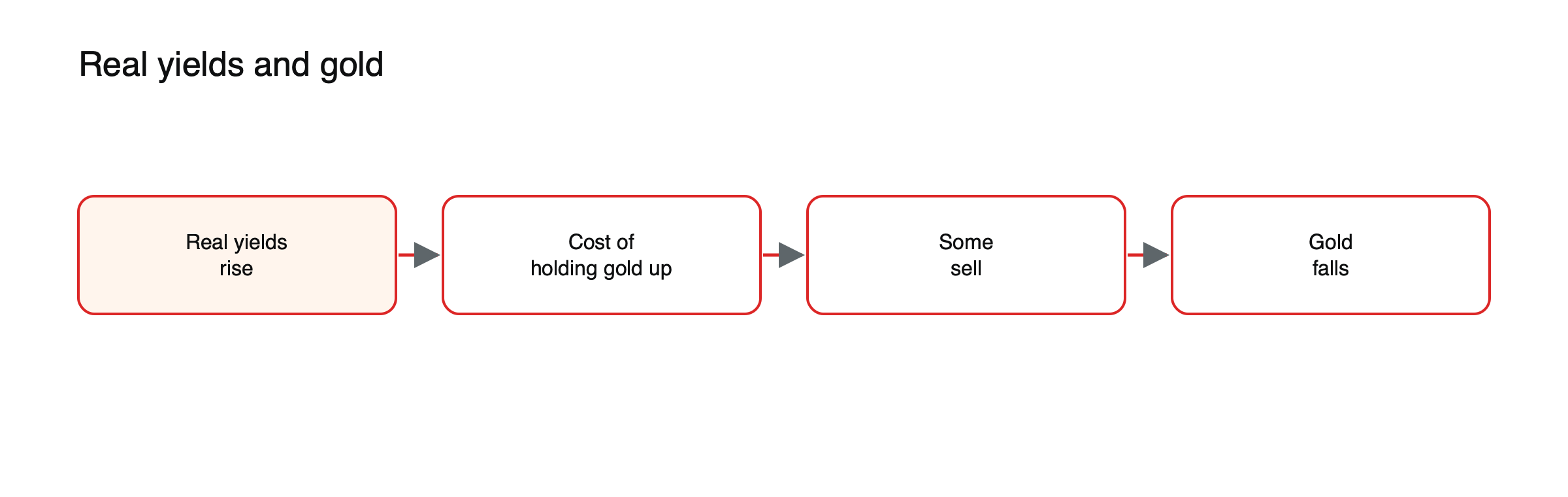
Figure: The opportunity-cost link.
A real yield, in numbers
Suppose the US 10-year Treasury yields 4.3% and the market expects inflation to average 2.3% over the next decade. (Illustrative figures.) The real yield is about 2.0%. Inflation-protected Treasury bonds, whose principal rises with inflation, give a direct market measure of this figure. When that real yield rises from, say, 1% to 2%, an investor holding $100,000 in protected bonds earns about $1,000 a year more after inflation, while gold still earns nothing. That widening gap is the opportunity cost that pressures gold.
How to track real yields
The most widely watched measure is the yield on 10-year inflation-protected US Treasuries, published daily. The difference between ordinary and inflation-protected yields, called the breakeven rate, shows the market’s inflation expectation. Watching both helps separate moves driven by inflation expectations from moves driven by real rates.
When it held
From the late 1990s to 2020, falling real yields coincided with gold’s long rise, and spikes in real yields with gold weakness. In 2022, as real yields surged, gold struggled to gain despite high inflation.
2022 in more detail
In 2022, as the Federal Reserve raised rates rapidly, US real yields rose from negative to clearly positive levels within months. Gold fell during much of that year despite inflation running at multi-decade highs, which surprised investors who expected it to act as an inflation hedge. The episode showed that rising real yields can matter more for gold than high inflation itself.
Why it weakened
From 2022, central banks bought around 1,000 tonnes a year, a price-insensitive buyer that does not care about yields. Gold rose strongly in 2025 even with elevated real yields.
Still a driver, no longer the driver
Real yields still influence direction, but they are one driver among several. Fear, reserve diversification and the dollar can outweigh them.
See why real yields matter for gold, stocks and crypto, what moves gold prices and how commodity CFDs work.
The divergence since 2023
From 2023, gold climbed even while real yields stayed at their highest levels in more than a decade, and in 2025 it rose about 60%. Analysts point to several reasons: central banks buying around 1,000 tonnes a year, concerns about government debt and the dollar’s role, and strong demand from investors in Asia. The old relationship did not disappear, but it was overwhelmed by buyers who do not care about yields. When real yields fell, gold usually still benefited.
Real yields outside the United States
Because gold is priced in dollars and US Treasuries are the main benchmark for safe returns, US real yields matter most. But for investors in other countries, local real yields and the exchange rate also shape the appeal of gold. Very low or negative real yields in some economies have made gold relatively more attractive to local investors even when US real yields were rising.
Using the relationship as a trader
Traders often watch real yields around major US data and Federal Reserve decisions, when both gold and yields can move sharply. A sudden rise in real yields after a hawkish surprise is usually negative for gold in the short term. Over longer periods, the relationship works best as one input among several, alongside central bank demand, the dollar and investor flows. See what moves gold prices.
A real yield shock, illustrated
Suppose US inflation data come in lower than expected while the Federal Reserve signals that it will keep rates high. (Illustrative scenario.) Inflation expectations fall, but nominal yields barely move, so the 10-year real yield rises from 1.8% to 2.1% in a day. Gold drops about 1.5% as the return on inflation-protected bonds becomes more attractive and the dollar firms. A week later, weaker jobs data push real yields back down, and gold recovers most of the loss. Short-term moves like these show the relationship working day to day, even in years when other forces dominate the longer trend.
Breaking down a yield move
A rise in nominal yields can come from higher inflation expectations, higher real yields or both. If the 10-year yield rises 0.5 percentage points because inflation expectations rose by the same amount, the real yield is unchanged, and the effect on gold is usually small or even positive. If instead the real yield rises by 0.5 points, gold usually suffers. Checking which part moved explains many cases where gold reacts differently to similar-looking moves in yields.
The Federal Reserve’s role
Federal Reserve decisions and guidance shape real yields more than any other single factor, because they set the path of short-term rates and influence expectations for inflation. Hawkish surprises tend to lift real yields and weigh on gold; dovish surprises tend to do the reverse. See how central bank decisions move currencies.
Common misreadings
- Watching nominal yields and ignoring inflation expectations.
- Assuming the relationship holds every month.
- Forgetting that the dollar often moves with real yields, adding to the effect on gold.
Real yields and other assets
Gold is not the only asset sensitive to real yields. Growth stocks, whose value depends heavily on profits far in the future, and assets without income, such as many cryptocurrencies, also tend to suffer when real yields rise. Watching how these assets move together on days of large real yield changes helps judge whether gold is reacting to rates or to something specific to gold. See why real yields matter for gold, stocks and crypto.
A routine for gold traders
Before major US data or Federal Reserve decisions, note the current 10-year real yield and the breakeven rate. After the event, check which moved and by how much, and compare gold’s reaction. Over several months, the record shows how sensitive gold has been to real yields in the current environment, which helps decide how much weight to give the relationship in your own analysis. Writing down the real yield and gold’s price before each event, and the change after it, takes only a minute. The habit turns a general idea into a measured relationship you can rely on, or discard, based on evidence from the markets you actually trade every day.
Frequently asked questions
Does gold always fall when real yields rise?
No. It tends to, other things equal, but central bank buying, fear and dollar moves can outweigh it, as they did in 2023 to 2025.
Why use real yields rather than nominal yields?
Because what matters for gold is the return on safe assets after inflation. A high nominal yield with high inflation may leave a real return close to zero.
This article is educational content and does not constitute financial, investment, legal or tax advice. Digital assets are volatile and you may lose the amount you invest.
Sources
- What’s behind the divergence between gold and real Treasury yields? (tracked closely late 1990s–2020; central banks about 1,000 tonnes a year 2022–2024) — Janus Henderson
- Precious metals outlook 2026 (gold above $4,000 and silver above $60 in 2025; gold/silver ratio above 100 then at or below 60; record moves despite elevated real yields) — CME Group, 2026